Introduction
Customer reviews have become an important source of business intelligence for restaurants, food delivery platforms, market research companies, and brands operating in the online food ecosystem. Platforms such as Just Eat contain large volumes of customer feedback related to food quality, delivery experience, pricing, packaging, service standards, and overall satisfaction.
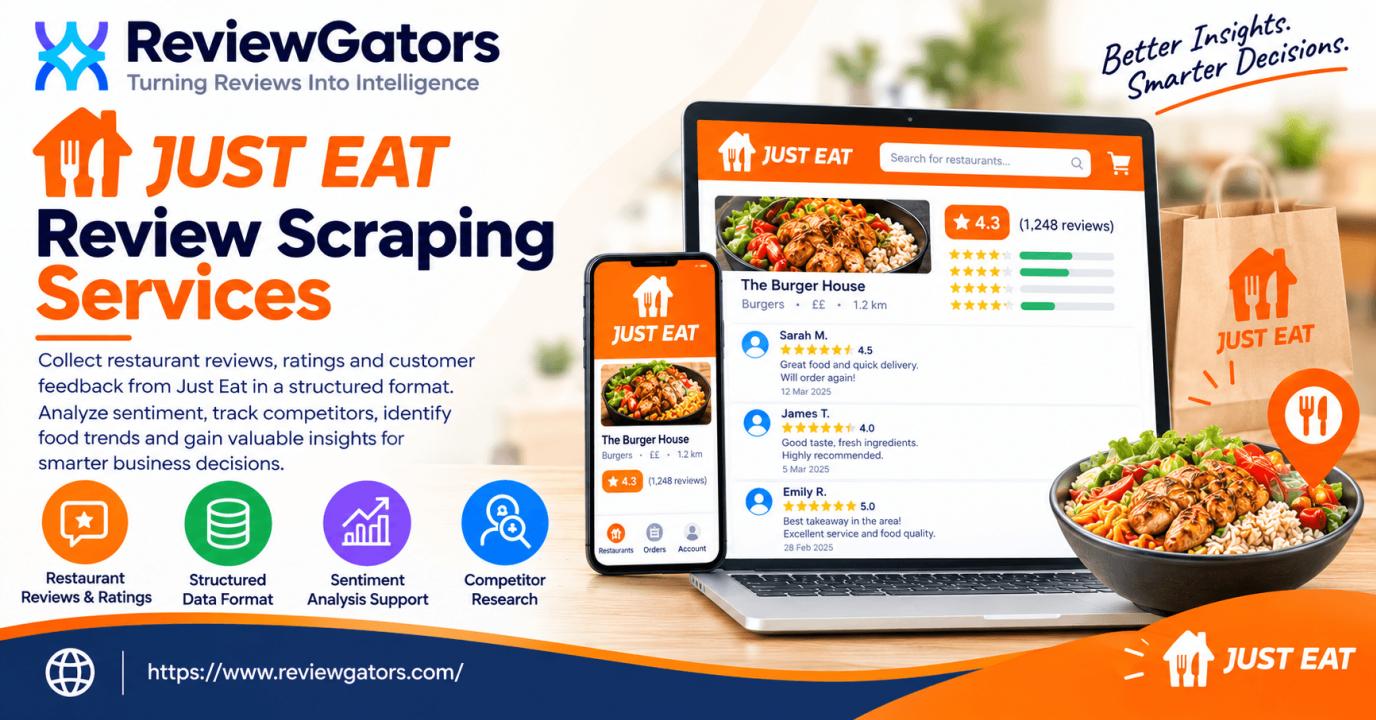
For businesses, manually reviewing thousands of customer comments is neither efficient nor scalable. Just Eat Review Scraping Services help organizations collect publicly available review and rating data in a structured format so it can be analyzed at scale. This makes it easier to identify recurring customer concerns, monitor restaurant performance, compare competitors, and understand changing consumer expectations.
The value of review data is not limited to reputation monitoring. When collected consistently and analyzed correctly, it can support customer sentiment analysis, competitive benchmarking, location-level performance tracking, market research, and operational decision-making.
Understanding Just Eat Review Scraping
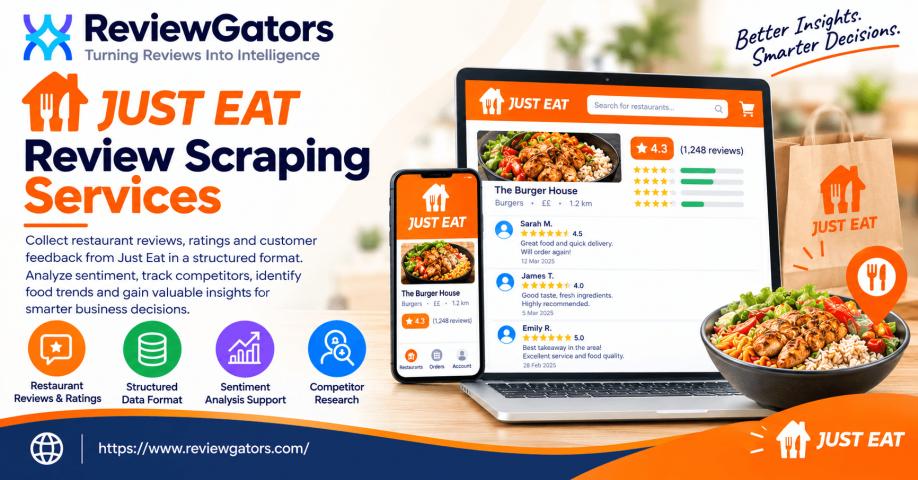
Just Eat review scraping refers to the automated collection of publicly available customer review information from restaurant listings on the Just Eat platform.
The process can include gathering data such as restaurant names, overall ratings, individual review scores, review text, review dates, customer comments, service-related feedback, food quality opinions, delivery experiences, and other relevant publicly available details.
Once collected, this information can be organized into structured datasets and delivered in formats such as CSV, Excel, JSON, XML, or through APIs.
Structured review data is significantly easier to analyze than unorganized online comments. Businesses can sort information by restaurant, location, rating, date, cuisine category, or keyword and use it for further analysis.
For organizations working with a large number of restaurants or locations, automated data extraction provides a scalable way to monitor review activity without relying on manual collection.
Why Businesses Need Just Eat Review Data
Customer feedback provides direct insight into how people experience a restaurant or food delivery service.
A single review may highlight a delivery delay, a packaging problem, poor portion size, excellent food quality, or strong customer service. When thousands of reviews are analyzed together, broader patterns begin to appear.
Businesses can use this information to understand which factors consistently influence customer satisfaction.
For example, a restaurant may receive high ratings for food quality but repeated complaints about delivery times. Another business may receive positive feedback for pricing but negative comments about packaging or order accuracy.
These patterns can help decision-makers focus on specific operational areas that require attention.
Review data can also provide a more detailed picture than an average star rating alone. Two restaurants may have similar overall ratings, but the reasons behind those ratings may be completely different.
By studying review text alongside ratings, businesses gain deeper context about customer experiences.
Key Applications of Just Eat Review Data
One of the most important applications of Just Eat review data is customer sentiment analysis.
Businesses can analyze customer feedback to understand whether comments are generally positive, negative, or neutral. They can also examine sentiment around specific topics such as food quality, delivery speed, pricing, customer service, packaging, and portion size.
Another important application is restaurant performance monitoring.
Restaurant groups with multiple branches can compare customer feedback across locations. This makes it possible to identify high-performing branches as well as locations that may require operational improvements.
Just Eat review data can also support competitive benchmarking. Businesses can compare their own ratings and customer feedback with those of competing restaurants.
This helps reveal competitor strengths, recurring weaknesses, market gaps, and customer expectations that may not be immediately visible through traditional market research.
Market research teams can also use review datasets to study broader trends. By analyzing customer comments across cuisines, cities, restaurant categories, or time periods, businesses can better understand changing consumer preferences.
Challenges and Considerations
Collecting review data at scale involves several technical and operational challenges.
One of the most important considerations is data accuracy. Review datasets need to be collected consistently so that ratings, dates, restaurant names, and review text remain correctly associated.
Another challenge is scale. A small research project may involve a few hundred reviews, while enterprise-level projects may require data from thousands of restaurant listings and large numbers of customer comments.
Data freshness is also important. Review activity changes continuously, so outdated datasets may not accurately represent current customer sentiment or restaurant performance.
Businesses may therefore require scheduled data extraction to keep datasets current.
Data structure is another consideration. Raw review content is more useful when it is normalized and organized into consistent fields. This allows analysts to filter, compare, and integrate the information into dashboards or business intelligence tools.
Monitoring changes to website structure is also important because online platforms can update their layouts and data presentation over time. Reliable extraction systems must be maintained to ensure consistent data collection.
Organizations should also ensure that their data collection and use practices comply with applicable laws, platform terms, privacy obligations, and internal governance requirements.
How Data Extraction Helps Businesses
Automated review data extraction reduces the time and effort required to collect customer feedback manually.
Instead of employees visiting individual restaurant pages and copying review information one by one, automated systems can gather large volumes of publicly available information in a structured format.
This allows teams to spend more time analyzing the data rather than collecting it.
For example, restaurant operators can use extracted review datasets to identify frequently mentioned service problems. Marketing teams can study positive comments to understand which aspects of the customer experience are most appreciated.
Product or menu teams can identify recurring feedback about portion sizes, menu items, packaging, or pricing.
Data extraction also makes historical analysis possible. By collecting reviews over time, businesses can compare changes in customer sentiment before and after operational improvements, menu changes, pricing adjustments, or marketing campaigns.
Structured datasets can also be connected to dashboards and analytical tools, allowing teams to track important metrics more efficiently.
Business Insights and Opportunities
Just Eat review data can reveal opportunities that may not be visible through traditional business reports.
Customer Sentiment
Analyzing review text helps businesses understand what customers actually think about their experiences.
Common positive and negative themes can be identified across thousands of reviews, giving businesses a clearer view of overall customer satisfaction.
Competitor Analysis
Competitor review data can help businesses understand where other restaurants perform well and where customers experience problems.
For example, repeated complaints about slow deliveries, limited menu options, or inconsistent quality may indicate areas where competitors are underperforming.
These insights can support better positioning and service improvements.
Market Trend Identification
Review data can also help identify changing consumer preferences.
Businesses may notice increased mentions of healthier options, vegetarian meals, premium packaging, faster delivery, or value-for-money concerns.
Tracking these trends over time can support product development and market planning.
Location-Level Performance
Multi-location businesses can compare customer experiences across different branches or regions.
If one location consistently receives better feedback than others, businesses can investigate the operational practices behind that performance.
Similarly, repeated negative feedback in a particular location can help management identify areas that need attention.
Better Decision-Making
When customer feedback is available in a structured format, businesses can make decisions based on patterns rather than isolated comments.
Review intelligence can support decisions related to menu optimization, operational improvements, service quality, competitive strategy, customer retention, and market expansion.
Conclusion
Just Eat reviews contain valuable information about customer experiences, restaurant performance, service quality, and changing market expectations.
By using Just Eat Review Scraping Services, businesses can transform large volumes of publicly available customer feedback into organized datasets that are easier to analyze and use.
Structured review data can support sentiment analysis, competitor research, restaurant benchmarking, location-level monitoring, and broader market intelligence.
Instead of treating online reviews as individual comments, businesses can use them as a continuous source of insight. When collected and analyzed effectively, Just Eat review data can help organizations better understand their customers, identify opportunities for improvement, and make more informed business decisions.