Market Overview
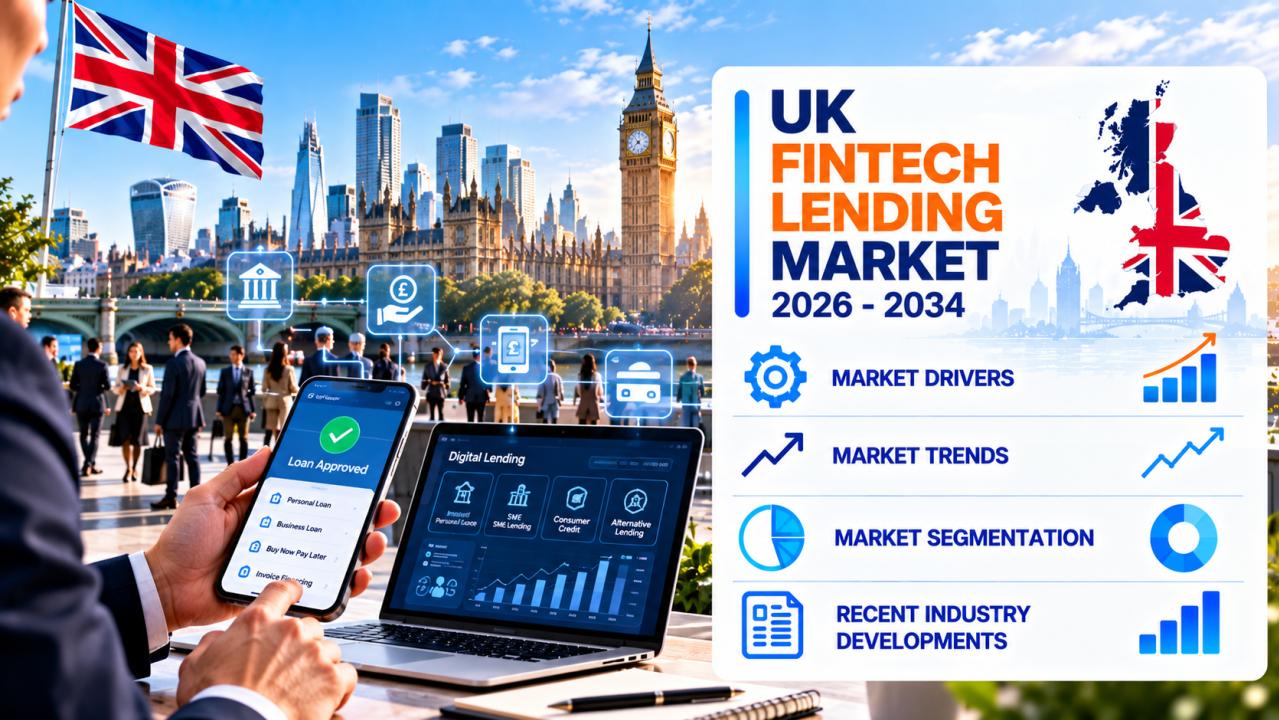
The UK fintech lending market size reached USD 16.2 Billion in 2025 and is projected to reach USD 46.6 Billion by 2034, growing at a compound annual growth rate (CAGR) of 12.12% from 2026 to 2034. The market is driven by increasing adoption of digital solutions, streamlined application procedures, supportive regulation, growing demand for small business loans, data-driven risk assessment, and a customer preference for alternative lending over traditional banking.
UK Fintech Lending Market Summary
- The UK fintech lending market encompasses technology-enabled lending services, including consumer lending, small business lending, and real estate lending, delivered through peer-to-peer, marketplace, direct lending, crowdfunding, and hybrid models.
- These services are valued for faster decisions, lower paperwork, broader access to credit, and more flexible products than traditional bank lending.
- The ecosystem includes fintech lenders and platforms, banks and institutional funders, technology and data providers, credit reference agencies, regulators such as the Financial Conduct Authority (FCA), and individual and business borrowers.
- Major segments identified in the market include service type (consumer lending, small business lending, real estate lending), business model (peer-to-peer lending, marketplace lending, direct lending, crowdfunding, hybrid models), technology type (artificial intelligence and machine learning, blockchain, mobile technology, big data analytics), end user (individuals, businesses), and region (London, South East, North West, East of England, South West, Scotland, West Midlands, Yorkshire and The Humber, East Midlands, others).
- The market is benefiting from open banking, AI-based credit assessment, regulatory sandboxes, and demand from small and medium-sized enterprises and digital-first consumers.
- On 15 July 2026, the FCA began regulating buy now, pay later credit, bringing a fast-growing segment of consumer lending under formal supervision.
Request a Sample Report for In-Depth Market Insights: https://www.imarcgroup.com/uk-fintech-lending-market/requestsample
PORTER'S FIVE FORCES ANALYSIS
- Competitive Rivalry: High. Fintech lenders, challenger banks, established banks, and buy now, pay later providers compete on speed, pricing, user experience, and credit access. Business implication: Companies must differentiate through underwriting accuracy, customer experience, and trusted brands.
- Supplier Power (Funding and Data): Moderate to High. Fintech lenders depend on institutional funders, bank facilities, and data providers, so funding costs and data access directly affect margins. Business implication: Lenders should diversify funding sources and build proprietary data capabilities.
- Buyer Power (Borrowers): Moderate to High. Borrowers can compare offers easily through digital channels and open banking, and switching costs are low. Business implication: Lenders must compete on transparency, fairness, and customer outcomes.
- Threat of Substitutes: Moderate. Traditional bank loans, credit cards, overdrafts, and government-backed lending schemes provide alternatives. Business implication: Fintech lenders should target underserved segments and offer clear advantages in speed and flexibility.
- Threat of New Entrants: Moderate. Authorization, capital, and compliance requirements are significant barriers, but open banking and cloud technology lower technology costs. Business implication: Established players should build scale, regulatory credibility, and strong credit performance.
MARKET GROWTH DRIVERS
Digital Adoption and Streamlined Lending
Consumers and businesses increasingly expect fast, digital-first financial services. Digital platforms offer quicker loan processing with minimal paperwork, and preferences are shifting toward digital solutions, particularly among millennials and Gen Z. Small and medium-sized enterprises are also turning to fintech alternatives when traditional banks are slow or restrictive.
Supportive Regulation and Open Banking
UK policy has encouraged fintech innovation. Open Banking, introduced in 2019, allows lenders to access customer data with consent, improving credit assessment, while FCA regulatory sandboxes encourage innovation with consumer protection. The regulatory perimeter is also maturing: from 15 July 2026, buy now, pay later providers need FCA authorization and must carry out affordability checks, giving consumers access to the Financial Ombudsman Service and strengthening trust in digital credit.
AI and Data-Driven Risk Assessment
AI and machine learning allow lenders to assess creditworthiness using richer data and to price risk more accurately, while big data analytics and mobile technology improve reach and efficiency. In May 2025, UK fintech Abound reported raising £800 million for its AI-based lending platform Render, citing 75% fewer defaults than industry standards, an example of investment flowing into data-driven lending.
UK FINTECH LENDING MARKET SEGMENTATION
Service Type Insights:
- Consumer Lending
- Small Business Lending
- Real Estate Lending
Business Model Insights:
- Peer-to-Peer (P2P) Lending
- Marketplace Lending
- Direct Lending
- Crowdfunding
- Hybrid Models
Technology Type Insights:
- Artificial Intelligence and Machine Learning
- Blockchain
- Mobile Technology
- Big Data Analytics
End User Insights:
- Individuals
- Businesses
Regional Insights:
- London
- South East
- North West
- East of England
- South West
- Scotland
- West Midlands
- Yorkshire and The Humber
- East Midlands
- Others
COMPETITIVE LANDSCAPE
The UK fintech lending market features independent fintech lenders, challenger banks, marketplace platforms, buy now, pay later providers, and established banks launching digital lending offers. Competition is shaped by underwriting quality, funding access, customer experience, and regulatory standing. Market dynamics include increased investment in AI-based credit assessment, formal regulation of buy now, pay later, and growing use of open banking data.
Key players mentioned in the report context include:
- Abound is a UK fintech that raised £800 million in May 2025 for its AI-based lending platform Render, reporting 75% fewer defaults compared with industry standards.
- Buy now, pay later providers, covering around 11 million UK users, became subject to FCA authorization and conduct rules from 15 July 2026.
- Other participants include established peer-to-peer and marketplace lenders, challenger banks, and bank-backed digital lending platforms.
REGIONAL ANALYSIS
- London: The leading hub for fintech lending, with the largest concentration of fintech lenders, investors, regulators, and technology talent.
- South East: A significant market supported by a high-income population, strong consumer credit demand, and proximity to London's financial ecosystem.
- North West: A growing center for fintech and financial services, with Manchester a major hub for lenders and technology firms.
- Scotland: An established financial services market, particularly Edinburgh, with growing fintech activity and SME lending demand.
- Other Regions: The West Midlands, Yorkshire and The Humber, East Midlands, East of England, and South West contribute through regional SME lending, consumer credit demand, and increasing digital adoption.
RECENT INDUSTRY DEVELOPMENTS
September 2026: The Bank of England's Financial Policy Committee reported that UK banks remain appropriately capitalised and that lending growth exceeded 2015–19 averages across all categories, while warning that elevated government bond yields could tighten financing conditions for households and businesses.
July 2026: The FCA's regulation of buy now, pay later credit took effect on 15 July 2026. Providers must be FCA authorized, assess affordability proportionately, give clear repayment information, support customers in financial difficulty, and provide access to the Financial Ombudsman Service.
February 2026: The government and FCA confirmed the start date for buy now, pay later regulation, noting that about 11 million people in the UK use these services.
Key Aspects Required for the UK Fintech Lending Market
- Market Performance: USD 16.2 Billion in 2025, with a projected trajectory to USD 46.6 Billion by 2034.
- Market Outlook: A 12.12% CAGR through 2034 indicates very strong growth across consumer, small business, and real estate lending, driven by digital adoption, open banking, and AI.
- Growth Drivers: Digital adoption and streamlined lending; supportive regulation and open banking; and AI and data-driven risk assessment.
- Competitive Landscape: A market of fintech lenders, challenger banks, marketplace platforms, and established banks competing on speed, pricing, and underwriting quality.
- Value Chain Analysis: From funders and data providers, through fintech lending platforms and technology providers, to individual and business borrowers, overseen by the FCA and other regulators.
- Industry Trends: AI and machine learning credit assessment; blockchain for secure and transparent processes; open banking data use; regulation of buy now, pay later; and digital-first lending for millennials, Gen Z, and SMEs.
- Strategic Recommendations: Invest in AI-based underwriting with strong governance; diversify funding sources; prepare for regulatory requirements including affordability and Consumer Duty; target underserved SME and consumer segments; and use open banking data for faster, fairer decisions.
Note: If you need any specific information that is not currently covered within the scope of the report, we will provide the same as a part of customization.
Speak to an analyst: https://www.imarcgroup.com/request?type=report&id=25435&flag=C
Report Format, Delivery, and Customization Details
- Report Format Mode: PDF and Excel (Editable version in PPT/Word format available on special request)
- Report Delivery Mode: Online Delivery, Physical Delivery
- Report Delivery Time: report delivered over email within 24 to 48 hours. If requested by the client, a physical copy will be delivered within three to ten days.
- Report Confirmation Mode: Yes, via email
- Report Customization Mode: Yes, via Email / Call
- Report Table of Content: Yes
- Report List of Figures: Yes
- Report Methodology Mode: Yes
- Request For Sample Report: Yes