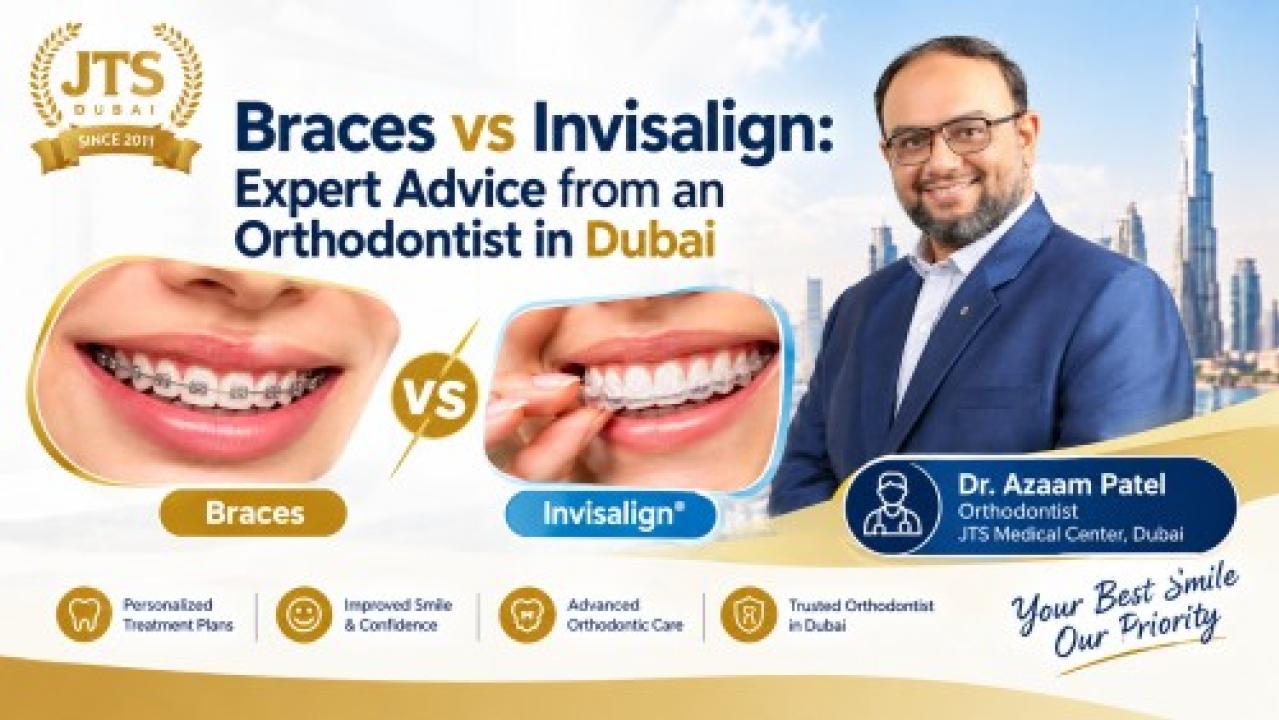
If you’ve ever sat in an orthodontist’s waiting room, you’ve probably heard this question more than once: “So, braces or Invisalign?” It’s easily the most common one patients ask, and it deserves a straight answer.
Both options can leave you with a straighter, healthier smile. They just get there in different ways, and they fit into your daily life very differently. Let’s go through it in plain language.
The Basic Difference
Braces are small brackets glued to your teeth and linked by a wire. The wire puts gentle, steady pressure on your teeth and slowly guides them into place. They stay on for the whole treatment, and only your orthodontist can take them off.
Invisalign works with clear plastic trays called aligners. You get a series of them, each one a tiny bit different from the last, and you switch to a new set every week or two. You can pop them out whenever you need to.
Same goal, different route.
“Braces” Isn’t Just One Thing
When people say braces, they usually picture the classic metal kind. But in Dubai, you can usually choose from a few types:
Traditional metal braces are strong and dependable, and they suit almost every case.
Ceramic braces have tooth-coloured brackets, so they blend in and don’t stand out in photos.
Damon braces use a small sliding clip instead of tiny elastic bands. Many patients find them more comfortable, and they often need fewer adjustments.
Lingual braces sit on the back of your teeth, so no one sees them from the front.
Braces vs Invisalign at a Glance
Braces | Invisalign | |
Look | Visible (metal or tooth-coloured) | Almost invisible |
Removable? | No | Yes |
Comfort | Wires can rub your cheeks and lips at first | Smooth plastic, but tight when you start a new tray |
Eating | Avoid sticky and hard foods | Take them out and eat normally |
Cleaning | Takes extra effort around brackets | Brush and floss as usual |
Effort from you | Low, since they work around the clock | High, since you need 20–22 hours of wear daily |
Complex cases | Can handle almost all of them | Best for mild to moderate cases, though some complex ones are possible |
Risk of losing them | None | Yes, they’re removable |
When Braces Make More Sense
Braces tend to be the better pick when your teeth need serious work. That includes heavy crowding, large gaps, rotated teeth, a deep bite, or an upper and lower jaw that don’t line up well. Fixed braces give your orthodontist more control in those situations.
They’re also the usual route for impacted teeth, which are stuck under the gum and need to be gently pulled into position. And for kids and teens, who might forget to put aligners back in after lunch, braces work 24 hours a day without anyone having to remember anything.
One more point in their favour is the track record. Braces have been used for decades across a huge range of cases, so the results are very predictable.
When Invisalign Is the Better Fit
Invisalign shines if you care about how your treatment looks. Many working adults and people in client-facing jobs prefer it for exactly that reason. It’s also a good match for mild to moderate problems like minor crowding or small gaps.
Daily life is easier, too. Because you take the trays out to eat, there are fewer food rules, and cleaning your teeth is as simple as brushing and flossing.
The catch is discipline. Aligners only work while they’re in your mouth, which means roughly 20 to 22 hours a day. If you know you’d leave them in a case “just for tonight” a bit too often, be honest with yourself about that.
Which One Is Faster?
It depends on your teeth far more than on the product. Braces often take around 12 to 24 months. Invisalign can take roughly 6 to 18 months in suitable mild-to-moderate cases. Your orthodontist can give you a realistic timeline once they’ve examined you. If someone promises a very fast result before even looking at your teeth, be cautious.
Does It Hurt?
Moving teeth always causes some soreness, especially in the first few days and after adjustments or new trays. It usually passes quickly.
With braces, the most common complaint is the rubbing on your cheeks and lips while you get used to them, and orthodontic wax helps a lot. Damon braces are often described as gentler. With Invisalign, there’s nothing sharp, but you’ll feel a tight, pressing sensation when you switch to a new set. Some people also have a slight lisp for the first few days.
What Will It Cost?
That depends on the type of treatment, how complicated your case is and how long it takes. Clear aligners aren’t automatically cheaper or more expensive than braces. The only way to get a real number is a consultation. When you get a quote, ask what it includes, such as retainers, review visits and any extra aligners if your plan needs refining, so you aren’t surprised later.
Why a Specialist Matters
People often focus on the brand, but the person planning your treatment matters just as much. Moving teeth safely means protecting your gums, understanding how your jaws fit together and building a bite that lasts.
A specialist orthodontist has training beyond a regular dental degree. That helps them read your X-rays properly, choose the right system, catch issues early (like jaw discrepancies, habits that push teeth out of place or TMJ problems) and change the plan if your teeth don’t respond as expected.
An Orthodontist Who Offers Both
If you’re in Dubai, Dr. Azeem Patel is a Specialist Orthodontist at JTS Medical Centre in Jumeirah. He holds a BDS and MDS from Mumbai and is a board-certified orthodontist in India. He’s licensed by both the Dubai Health Authority (DHA) and the Ministry of Health (MOH).
What makes him a useful person to talk to when you’re torn is that he’s certified in both Invisalign and the Damon system. His advice isn’t tied to a single product. His services cover metal and ceramic braces, Damon braces, Invisalign, lingual braces, jaw alignment treatment, TMJ management, habit correction, early treatment for children and impacted teeth. He speaks English, Hindi and Urdu.
He also has a 4.9 rating from 27 Google reviews, and a lot of patients mention how clearly he explains each step.
Having both options on the table matters. An orthodontist who can offer either is more likely to suggest what suits your teeth, not whatever is the only thing they do.
Book a consultation with Dr. Azeem Patel
A Quick Way to Decide
Run through these questions:
How complex are my teeth? Only an exam and X-rays can tell you.
Will I really wear aligners 20+ hours a day? If the honest answer is “maybe not,” fixed braces may be the safer choice.
How much do I want it hidden? If a lot, look at Invisalign, ceramic or lingual braces.
Do I snack a lot or love sticky foods? Aligners are easier to live with in that case.
Is this for a child? Younger patients often do better with fixed appliances, and early treatment can help guide jaw growth.
Making Either Treatment Work
A few habits make a big difference. Brush after every meal so you avoid stains and cavities. Don’t skip appointments, because the small check-ups keep everything on track. Follow the instructions you’re given about elastics, wear time and food. And call your orthodontist early if a bracket breaks or an aligner cracks, rather than waiting for your next visit.
Above all, wear your retainer when treatment ends. Teeth naturally try to drift back, and the retainer is what protects the result you paid for.
Frequently Asked Questions
1. Is Invisalign better than braces?
Not always. Invisalign is great for looks and convenience in mild to moderate cases, while braces are often better for complex ones. It comes down to your teeth, so a specialist’s assessment is the best guide.
2. Can Invisalign fix every type of teeth problem?
It can treat many problems, including crowding, gaps and some bite issues. Braces or a combination may be needed for severe cases like major jaw discrepancies or certain impacted teeth.
3. Is Invisalign painful?
It usually causes mild pressure or soreness for a couple of days after each new tray. Most people find it manageable.
4. Do braces hurt?
You may feel sore for the first few days and after adjustments, and your cheeks can get irritated at the start. Both settle as you adjust.
5. How many hours a day do I wear Invisalign?
About 20 to 22. You only take them out to eat, to drink anything other than water, and to clean your teeth.
6. Can I eat normally with braces?
Mostly yes, but avoid very hard, sticky or chewy foods that can break braces, like hard candy, nuts and caramel.
7. What are Damon braces?
They’re a self-ligating system that uses a built-in sliding clip instead of elastic ties. Many patients find them comfortable and may need fewer adjustments.
8. What are lingual braces?
Braces fixed to the back of your teeth, so they can’t be seen from the front. They suit people who want a hidden fixed option.
9. Are ceramic braces as strong as metal ones?
They work well and are far less noticeable. They may need a bit more care with certain foods and can stain if oral hygiene slips, so your orthodontist will advise you.
10. What’s the best age for braces?
Many children are assessed around age 7 or 8 so problems can be spotted early. Most full treatment happens in the teen years, but adults can start at any age as long as their teeth and gums are healthy.
11. Can adults get braces or Invisalign?
Yes. More and more adults in Dubai choose treatment, and both options work well for them.
12. Do I need a retainer afterwards?
Yes. Retainers hold your teeth in their new position. Without one, teeth can slowly shift back.
13. Can orthodontic treatment help with jaw or TMJ problems?
Sometimes. Correcting your bite and jaw alignment can reduce strain. A specialist can tell you whether your symptoms are linked to your bite.
14. How do I know which option is right for me?
Book a consultation. After an exam and X-rays, your orthodontist can walk you through the options, the likely timeline and the expected results.
15. Can I book an appointment at the weekend?
Yes. JTS Medical Centre is open every day from 8:30 am to 9:00 pm. Call +971 4 379 9954 or book online.
The Bottom Line
Neither option is “the best” for everyone. Braces are a proven choice for complex cases, and Invisalign gives you comfort and a discreet look when your case suits it. What decides it is a proper examination by a qualified specialist.
So if you’ve been thinking about straightening your teeth, skip the guessing and get a clear plan.
JTS Medical Centre, Jumeirah Terrace Building, Dental Office 113, Dubai
Phone: +971 4 379 9954
Hours: Open daily, 8:30 am to 9:00 pm
Meet Dr. Azeem Patel and book your orthodontic consultation