
For businesses exploring Flash USDT
software development, the first step is defining exactly what the software will
do. This guide uses the term to describe a clearly labelled USDT transaction
simulator for development, demonstrations, and quality assurance.
The system should operate with mock data,
test tokens, or isolated blockchain environments. It should never present
simulated balances as spendable USDT.
What
Is Flash USDT Software Development?
In this testing context, Flash USDT software development
means creating tools that reproduce the transaction scenarios a USDT
application needs to handle.
Those scenarios may include deposits,
withdrawals, rejected wallet requests, delayed confirmations, API outages, and
payment notifications.
A simulator gives developers control over
these conditions. Instead of waiting for a particular error to happen, they can
trigger it, examine the application’s response, and repeat the test after
making a fix.
The phrase “Flash USDT” can also appear in
promotions for temporary balances or supposed token generators. A balance
displayed by software does not establish that genuine USDT has been received.
Token identity must be checked against the appropriate network and official
asset information, including the contract or asset identifier. Tether’s
supported protocols provide a reference for supported deployments.
How
Does a Flash USDT Transaction Simulator Work?
A useful simulator connects a defined test
scenario to an observable result. The exact setup depends on whether the team
is testing blockchain behaviour, application logic, or both.
1.
Select the testing environment
Ethereum’s network documentation recommends
Sepolia for application development and describes Hoodi as a network for
validator, staking, and protocol testing. Check current guidance before
committing to a testnet. Ethereum network documentation
TRON provides public endpoints for Shasta
and Nile. Teams should verify current network characteristics and compatibility
with their intended workflow. TRON connection documentation
A public testnet does not automatically
provide an official USDT deployment. Any mock token used in testing needs an
explicit identity and clear labelling.
2. Connect
dedicated test accounts
Use wallets and credentials created for
development. Keep them separate from accounts that hold customer funds or
production assets.
Ethereum’s documentation also advises
against reusing mainnet accounts on testnets, or the reverse, for security
reasons. Ethereum account and network guidance
3.
Define the scenario and expected outcome
Specify the sender, recipient, test amount,
token identifier, network, and expected application response.
For example, a checkout test might require
the order to remain pending until the configured confirmation requirement is
met. A second test could check what happens when the payment arrives after the
checkout session expires.
The expected outcome matters as much as the
transaction itself. Without it, the team has activity records but no clear
basis for deciding whether the test passed.
4.
Execute and inspect the result
Run the test through the selected
environment. Show a persistent label such as “Sandbox” or “Testnet” wherever
balances and payment results appear.
Record the relevant events, timestamps,
errors, and state changes. An actual testnet transaction can have a blockchain
transaction hash; a backend-only simulation should use a clearly identified
simulation reference.
5.
Reset the environment
Provide a reliable way to clear temporary
balances and restore test conditions. Retain useful diagnostic records
according to the project’s retention policy, while excluding private keys and
other secrets.
Why
Businesses Build USDT Testing Tools:
The main benefit is repeatability. A team
can recreate a difficult payment condition without exposing customer funds to
the experiment.
A well-designed testing platform can help
businesses:
Find payment errors earlier: Check
deposits, withdrawals, notifications, and account updates before release.
Improve customer-facing messages: Explain
pending, rejected, or expired payments clearly.
Make demonstrations safer: Show product
workflows using labelled test accounts.
Reduce repetitive work: Save scenarios and
rerun them after changes.
Prepare support teams: Reproduce payment
issues in a controlled environment.
Check recovery behaviour: Verify what
happens after an outage, retry, or delayed response.
Simulation also has limits. A passing mock
test does not establish that a production integration will behave correctly
under every network condition. Use it alongside appropriate integration testing
and release checks.
Which
Network Standards Matter for Flash USDT Development?
USDT exists as a token standard on several
blockchains, and the standard in use changes how a simulator needs to be built
and labelled.
ERC-20
(Ethereum) - is the original USDT deployment
standard. For testing, this maps to Ethereum's public testnets — Sepolia for
general application development, Hoodi for validator and protocol-level
testing. A simulator built for ERC-20 workflows should account for Ethereum's
gas fee model and variable confirmation times, since these directly affect how
a checkout or payment-status flow behaves.
TRC-20
(TRON) - is the most widely used USDT standard for
everyday transfers, largely because of its low fees and fast confirmation
times. TRON's Shasta and Nile testnets serve as the corresponding sandbox
environments. A simulator covering TRC-20 should reflect TRON's near-instant
finality, since applications built around it often assume much shorter wait
times than ERC-20 equivalents.
BEP-20
(BNB Smart Chain) - is a third common deployment
standard for USDT, chosen for its low transaction costs and EVM compatibility.
BNB Smart Chain has its own dedicated testnet with faucet support for test
tokens. Because BEP-20 is EVM-compatible, much of the tooling and contract
logic used for ERC-20 testing can be adapted with minimal changes.
Regardless of standard, the same rule
applies: a testnet token is not an official USDT deployment. Each simulated
balance needs an explicit token identifier, the correct network label (ERC-20,
TRC-20, or BEP-20), and a persistent "Sandbox" or "Testnet"
indicator wherever it appears in the interface.
The
Flash USDT Software Development Process:
Define
the scope:
Start with the workflows the business needs
to validate. Document supported networks, wallet integrations, user roles,
reporting requirements, and acceptance criteria.
Decide which tests require blockchain
execution and which can use mock responses.
Design
the interface:
Make the environment visible throughout the
application. Include test labels in transaction details, exported reports,
screenshots, and demonstrations.
Users should be able to understand what
happened, why it happened, and what action is available next.
Build
the backend and integrations:
Develop the services that manage scenarios,
permissions, transaction states, notifications, and logs.
Keep network configuration maintainable.
Chain identifiers, token addresses, RPC endpoints, explorer links, and
confirmation policies should be easy to review and update.
Protect
access and credentials:
Use appropriate authentication, restricted
permissions, secret storage, monitoring, and API controls. Avoid placing
signing keys in source code or logs.
TRON’s integration guidance recommends
wallet authorization for browser applications and a secrets manager or isolated
signer for backend signing. TRON key-handling guidance
Validate,
deploy, and maintain:
Test normal operation, failure handling,
recovery, and the separation between test and production systems.
Deployment should preserve that separation
across databases, credentials, wallets, and endpoints. After release, assign
responsibility for dependency updates, network changes, monitoring, and
regression testing.
What
Should Businesses Check in 2026?
Network support is a maintenance
responsibility, not a one-time architecture decision.
Tether’s legacy-network transition covered
Omni Layer, Bitcoin Cash SLP, Kusama, EOS, and Algorand. Its August 29, 2025
update clarified that it would discontinue direct issuance and redemption on
those networks but would not freeze the contracts; transfers between wallets
could continue. This distinction matters when interpreting older announcements.
Tether’s updated transition notice
Before building or updating an integration,
review Tether’s current supported protocols and the relevant network
documentation.
For production payment acceptance, design
verification around the expected network, official token identifier, recipient,
amount, successful transfer record, and applicable confirmation or finality
policy. A screenshot, token symbol, or transaction hash by itself is
insufficient evidence that the intended payment has settled.
Planning
a USDT Testing Project with Hivelance?
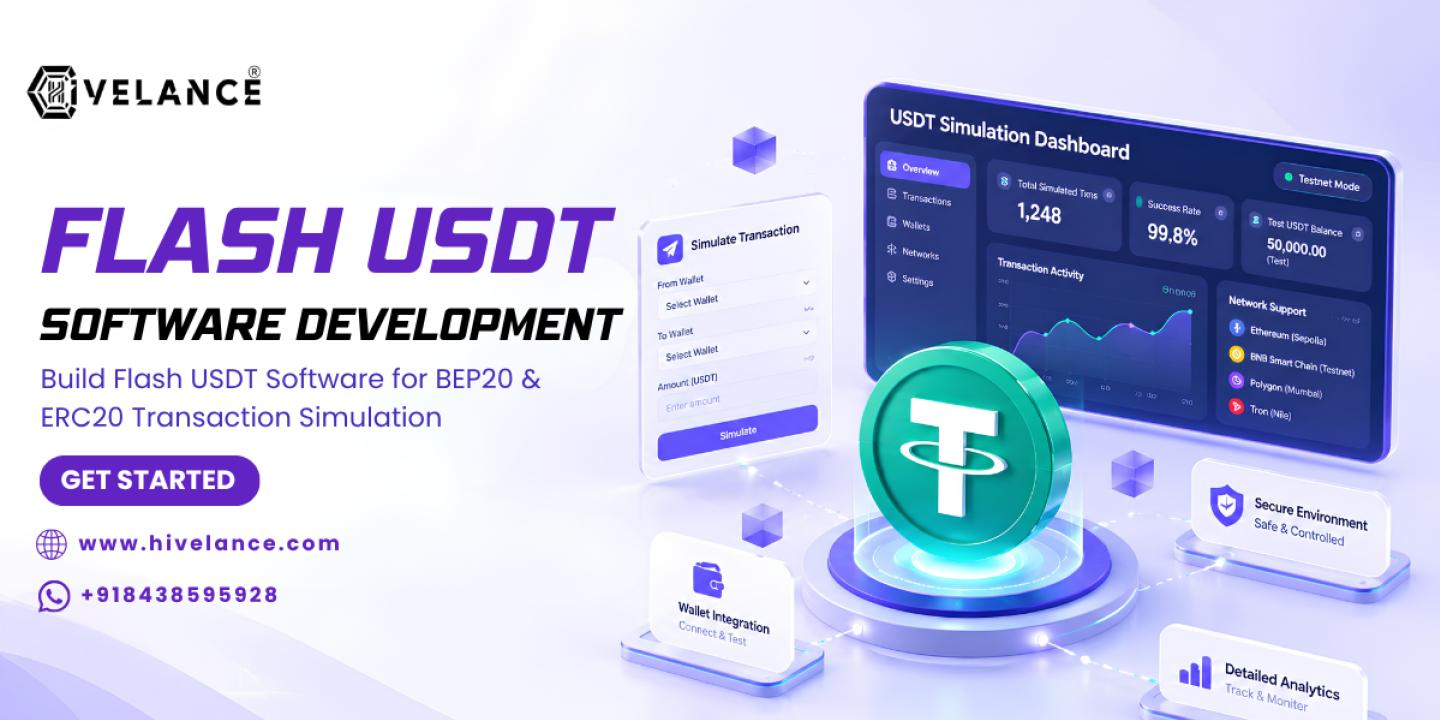
Hivelance offers Flash USDT software development services
for legitimate transaction simulation, wallet integration, and payment
application testing.
A project discussion should begin with
specific questions: Which workflows need testing? Which networks are involved?
What should happen when a transaction fails? How will the team prevent test
activity from being mistaken for real payments?
Depending on the agreed scope, the project
can include dashboards, APIs, wallet connections, scenario management, access
controls, reporting, and deployment support.
Before choosing a development partner,
request a relevant demonstration, documented deliverables, testing criteria,
and a maintenance plan. These give the business a practical basis for
evaluating the proposed solution.
To discuss a project with Hivelance,
prepare a list of target networks, wallet integrations, and payment scenarios.
That information helps turn a broad software request into a defined development
brief.
Know
More:
Visit – https://www.hivelance.com/flash-usdt-software-development
WhatsApp - +918438595928
Telegram - Hivelance
Mail - sales@hivelance.com