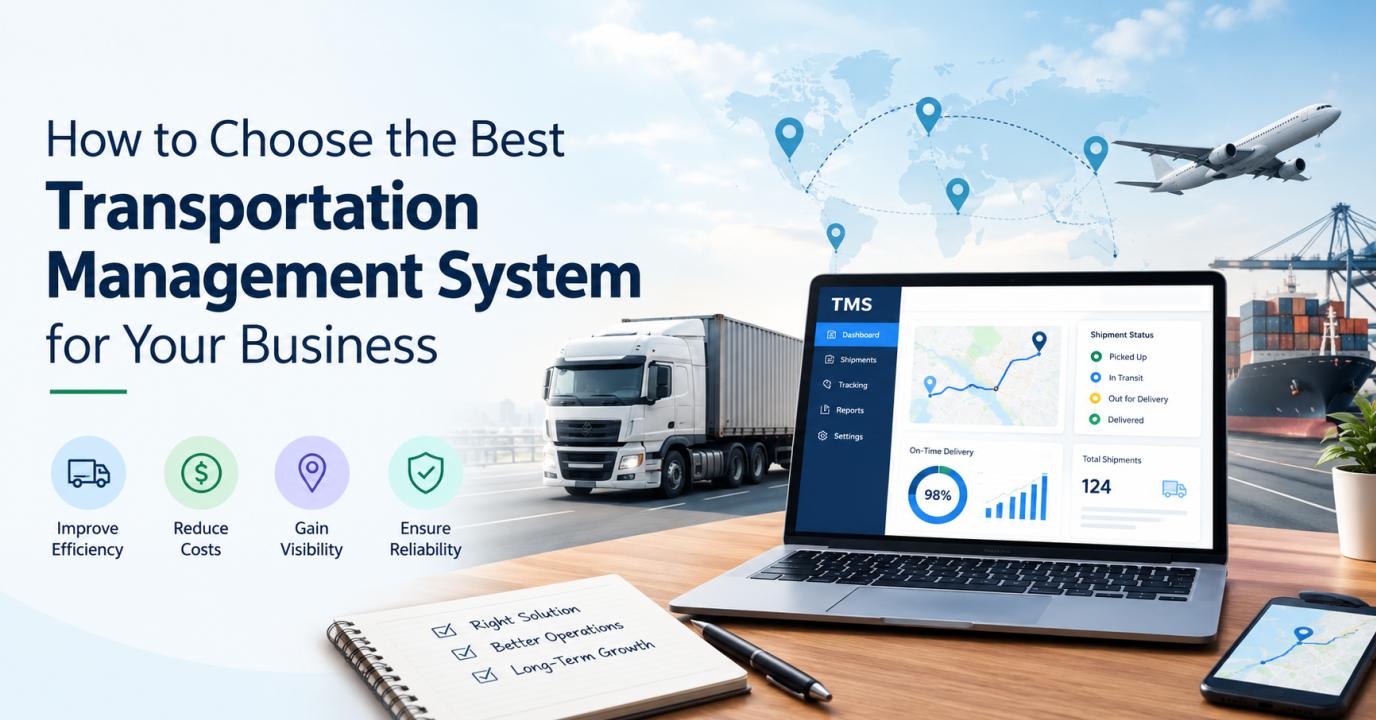
Choosing the best transportation management system requires more than comparing software features. Your TMS should address transportation challenges, integrate with existing systems, improve operational visibility, and support business growth.
A well-selected best transportation management system can simplify route planning, shipment tracking, dispatch management, and transportation analytics. However, finding the right solution requires evaluating your operational needs before comparing providers.
Why Choosing the Right TMS Matters
Transportation operations directly influence delivery performance, operating costs, and customer satisfaction. Businesses relying on spreadsheets, disconnected applications, and manual coordination often experience scheduling errors, shipment delays, and limited visibility.
The right TMS software centralizes transportation planning, execution, monitoring, and reporting. It helps logistics teams coordinate activities, reduce manual work, and make informed operational decisions.
However, your ideal solution depends on shipment volumes, fleet structure, carrier networks, and existing technology.
1. Identify Your Transportation Requirements
Before evaluating transportation management system providers, understand your current transportation challenges.
Review your workflows and identify activities that consume excessive time or create unnecessary costs.
Consider these questions:
- How many shipments, vehicles, and drivers do you manage?
- Do you operate an internal fleet or use third-party carriers?
- Which transportation processes require automation?
- What challenges affect route planning and delivery performance?
- Which existing systems require integration?
Documenting these requirements helps you prioritize essential capabilities and avoid investing in unnecessary features.
2. Evaluate Essential TMS Features
The best transportation management system should provide capabilities that directly support your transportation workflows.
Route Planning and Optimization
Look for automated route planning based on delivery locations, vehicle capacity, distance, and delivery schedules. Your system should accommodate unexpected changes.
Shipment and Dispatch Management
Choose software that centralizes shipment information, vehicle assignments, driver schedules, and dispatch activities. Dispatchers should easily update transportation plans when operational conditions change.
Real-Time Transportation Visibility
GPS, telematics, and tracking integrations help teams monitor shipment movements, identify delays, and provide accurate delivery updates.
Carrier Management and Analytics
Businesses using external carriers need centralized carrier information and performance monitoring.
Reporting dashboards should track transportation costs, on-time deliveries, vehicle utilization, route efficiency, and shipment performance.
3. Check Integration Capabilities
Your TMS must communicate effectively with existing business applications.
Common integrations include:
- Enterprise Resource Planning (ERP)
- Warehouse Management Systems (WMS)
- Order management platforms
- GPS and telematics systems
- Accounting and reporting applications
Evaluate API availability, data synchronization, and third-party integration support.
Poor integrations create duplicate entries, disconnected workflows, and additional administrative work. A connected technology environment supports smoother transportation execution.
4. Consider Fleet Management Needs
Your transportation model should influence software selection.
Businesses managing owned vehicles need capabilities for driver assignments, vehicle availability, trip scheduling, and utilization tracking.
Integrating transportation operations with dedicated Fleet Management Software can improve coordination between transportation planning and fleet activities.
Organizations relying primarily on third-party carriers should prioritize carrier management, shipment visibility, and transportation procurement capabilities.
5. Prioritize Scalability and Flexibility
Your transportation requirements will evolve as your business expands.
Evaluate whether the platform can accommodate:
- Increasing shipment volumes
- Additional vehicles and drivers
- New warehouses and delivery locations
- Multiple carrier networks
- Future integrations and workflow changes
Choose a flexible solution that supports growth without requiring frequent software replacements or expensive restructuring.
6. Compare Transportation Management System Providers
Selecting reliable transportation management system providers is equally important as evaluating software capabilities.
Assess each provider based on:
Industry experience: Understanding of transportation operations and logistics challenges.
Customization: Ability to adapt workflows to your business requirements.
Integration expertise: Experience connecting transportation platforms with enterprise applications.
Implementation support: Assistance with configuration, migration, testing, training, and deployment.
Ongoing maintenance: Reliable technical support and future product enhancements.
Businesses managing complex transportation networks can also explore Transportation & Logistics Solutions to understand broader technology capabilities.
7. Evaluate Usability and Data Security
Even feature-rich transportation software can underperform when employees struggle to use it.
Evaluate the experience of dispatchers, transportation planners, drivers, fleet managers, and operations teams.
Look for intuitive dashboards, straightforward navigation, mobile accessibility, and efficient workflows.
Security is equally important. Review authentication, role-based permissions, encryption, audit logs, backup procedures, and API security.
Request practical demonstrations to assess usability and security controls before committing.
8. Calculate Costs and Expected ROI
The cheapest transportation management solution is not necessarily the most cost-effective.
Consider implementation expenses, licensing fees, integrations, training, maintenance, and future upgrades.
Evaluate potential improvements in:
- Transportation and fuel costs
- Route efficiency
- Vehicle utilization
- Employee productivity
- Delivery performance
- Administrative workload
Establish baseline metrics and calculate expected savings to determine whether the investment supports your business objectives.
9. Test the TMS Before Making a Decision
Software demonstrations should reflect actual transportation scenarios rather than generic product presentations.
Ask shortlisted providers to demonstrate the complete workflow, from order creation and route planning to vehicle assignment, shipment tracking, delay management, and delivery confirmation.
Involve dispatchers, fleet managers, and operations teams during testing. Their feedback can reveal practical limitations before implementation.
Common Mistakes to Avoid
Avoid choosing software solely based on pricing, purchasing unnecessary features, overlooking integrations, or ignoring employee adoption.
Also, consider future transportation requirements. A platform that cannot support increasing operational complexity may create additional costs later.
Final Thoughts
Choosing the best transportation management system requires evaluating operational requirements, essential features, integrations, scalability, security, provider expertise, and expected ROI.
Focus on solutions that address your transportation challenges rather than offering the longest feature list.
Test shortlisted platforms using real business scenarios and involve your operational teams in the selection process.
The right TMS can improve transportation visibility, simplify daily operations, reduce inefficiencies, and establish a scalable foundation for logistics growth.