Market Overview
The Philippines cement market is expanding steadily, driven by sustained government infrastructure investments, accelerating urbanization, and growing residential construction demand. The market size reached USD 1.7 Billion in 2025 and is projected to reach USD 2.7 Billion by 2034, registering a compound annual growth rate (CAGR) of 4.80% during 2026-2034. Modernization of transportation networks, rising public-private partnerships, expansion of industrial zones, and the increasing adoption of sustainable and blended cement solutions are shaping the Philippines cement market share and outlook, with blended cement holding 56.8% and Luzon accounting for 65.5% in 2025.
Request a Sample Report for In-Depth Market Insights: https://www.imarcgroup.com/philippines-cement-market/requestsample
Market Summary
- Government infrastructure spending under the Build Better More program, covering roads, railways, bridges, ports, and flood control systems, is the main demand engine, with infrastructure leading end-use at 42.5% of the market in 2025.
- Blended cement dominates the market at 56.8% in 2025 due to its cost-effectiveness, lower carbon footprint, and improved durability, aligning with evolving environmental regulations and green building standards across the Philippines.
- Luzon represents the largest region at 65.5% in 2025, reflecting the concentration of major infrastructure projects, population density, commercial real estate development, and industrial activity in Metro Manila and surrounding provinces.
- Rapid urbanization, a growing middle class, and efforts to address the housing backlog are driving residential and commercial construction, with socialized and affordable housing projects expanding in growth areas outside Metro Manila.
- Producers are expanding capacity, deploying AI-driven energy management and digital technologies, adopting energy-efficient kiln technology, and scaling waste co-processing and alternative fuels to lower energy costs and emissions in line with environmental mandates.
- The market is segmented by type (blended, Portland, others), end-use (residential, commercial, infrastructure), and region (Luzon, Visayas, Mindanao), with safeguard tariffs on imported cement expected to rationalize domestic production and support local producers.
Market Growth Drivers
Government-Led Infrastructure Investments Under the Build Better More Program
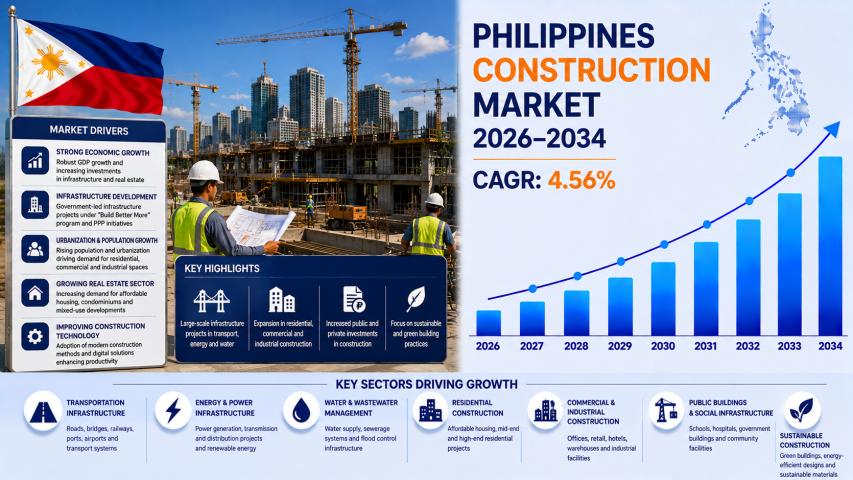
The main driving force behind cement demand in the Philippines is the government’s continued focus on large-scale infrastructure development. The Build Better More program, which replaced Build, Build, Build, covers flagship projects across transportation, water, digital, and energy infrastructure, ensuring steady demand across the construction industry. Its emphasis on regional connectivity, including railways, highways, and port improvements, is creating a steady stream of bulk cement orders from government and private contractors. Annual infrastructure spending remains a major component of gross domestic product, with the Department of Public Works and Highways allocated a major share of the budget.
Rapid Urbanization and Rising Residential Construction Demand
The Philippines is urbanizing rapidly, creating substantial demand for building materials used in residential and commercial construction. A growing middle class, continued urban migration, and the national housing backlog are sustaining demand for cement across high-rise developments in urban areas and horizontal housing in new suburban areas. Housing programs under the Department of Human Settlements and Urban Development have created cement demand in growth areas outside Metro Manila, including Davao, Iloilo, and Baguio, while rising disposable incomes and housing financing from the Pag-IBIG Fund are widening the scope of residential construction and supporting socialized and affordable housing investment.
Expansion of Industrial Zones and Foreign Direct Investment Inflows
The Philippines’ growing appeal as an investment destination is fueling new industrial estates, economic zones, and manufacturing plants that require large volumes of cement. Ease of doing business and other government initiatives are encouraging foreign investment in manufacturing, logistics, and technology industries, all of which drive demand in the construction sector. The construction of new manufacturing plants, warehouses, and commercial buildings in economic zones is creating new consumption patterns, supported by rising private investment in megaprojects, logistics facilities, and tourism-related projects that require a consistent supply of cement across the archipelago.
Porter’s Five Forces Analysis
Competitive Rivalry: Moderate to High
- Local and foreign-invested producers are competing on clinker capacity, distribution terminals, and blended, low-carbon products.
- Intense import competition, mainly from Vietnam and Indonesia, is pressuring domestic market share and capacity utilization.
- Safeguard duties on imported cement are giving local players a fairer competitive platform.
Supplier Power: Moderate to High
- Coal and imported fuel dependence is exposing producers to volatile energy markets and rising electricity tariffs.
- Quarry and raw material access, shaped by complex permitting, is giving raw material sources strong influence.
- Alternative fuels and supplementary cementitious materials such as fly ash and slag are reducing dependence on traditional inputs.
Buyer Power: Moderate
- Government infrastructure contractors are placing bulk orders, strengthening their negotiating position on large projects.
- Private developers and distributors are choosing among blended and Portland products based on cost, durability, and sustainability.
- Green building standards are shaping buyer preferences toward lower-carbon cement.
Threat of Substitutes: Low
- Cement and concrete remain the core construction materials for infrastructure, housing, and industrial projects.
- Alternative materials such as steel and timber are used in selected applications but cannot replace cement at scale.
- Blended cement offers a lower-carbon alternative within the category itself.
Threat of New Entrants: Low to Moderate
- High capital requirements for kilns, clinker capacity, and distribution terminals are raising entry barriers.
- Complex quarry permitting across local government units is delaying new kiln investments.
- Established distribution networks and contractor relationships are favoring incumbents.
Market Segmentation
Type Insights
- Blended
- Portland
- Others
End-Use Insights
- Residential
- Commercial
- Infrastructure
Regional Insights
- Luzon
- Visayas
- Mindanao
Regional Analysis
Luzon: Luzon accounts for the largest share at 65.5% in 2025, driven by the economic primacy of Metro Manila, Central Luzon, and Calabarzon, major transportation megaprojects such as commuter railways, subways, and expressway expansions, and strong residential, commercial, and industrial activity that keeps cement demand consistent throughout the year.
Visayas: Visayas is supported by regional development initiatives, housing programs in growth areas such as Iloilo, and capacity investments such as Taiheiyo Cement Philippines’ PHP 12.8 Billion production line in San Fernando, Cebu.
Mindanao: Mindanao is supported by regional development initiatives and housing programs in growth areas such as Davao, although permitting complexity in parts of the region can delay raw material extraction and new kiln investments.
Competitive Landscape
The Philippines cement market features a competitive environment of local players and foreign-invested producers expanding their presence. Companies are boosting clinker capacity, setting up new distribution terminals, and developing blended and low-carbon cement lines, while investing in digitalization, predictive maintenance, and alternative fuels to improve cost effectiveness. Partnerships with infrastructure contractors and government procurement initiatives are helping players win large-scale contracts, and safeguard duties on imported cement are encouraging investment in modernization and capacity optimization. Detailed profiles of major companies are included in the full report.
Key players include:
- Holcim Philippines, Inc.
- Republic Cement & Building Materials, Inc.
- Eagle Cement Corporation
- Taiheiyo Cement Philippines, Inc.
- Northern Cement Corporation
Recent Industry Developments
October 2026: The Philippines assumed leadership of the ASEAN Federation of Cement Manufacturers for the 2026–2028 term following the federation's meeting in Bali, Indonesia, held from 14 to 16 October. John Reinier Dizon, president of the Cement Manufacturers Association of the Philippines and Republic Cement, was elected federation president. The agenda includes decarbonisation, alternative fuels, low-carbon cement, energy efficiency and regional production capacity, creating opportunities for Philippine industry representatives to influence sustainability initiatives and strengthen regional cooperation.
September 2026: Philippine President Ferdinand Marcos Jr. convened the Private Sector Advisory Council to discuss infrastructure resilience, structural safety and the quality of imported cement. Discussions also covered flood management and water security. The meeting highlighted the government's focus on improving construction standards and ensuring that infrastructure projects use reliable, high-quality materials, reinforcing the importance of cement quality and regulatory oversight in public construction.
August 2026: Holcim announced an agreement to sell its majority stake in its Philippine business to China's Huaxin Building Materials in a transaction valued at at least USD 807 million. The initial sale covers a 68% stake for USD 527 million, with the remaining shares planned for transfer over the following three to five years. The transaction, expected to close in the first half of 2027, represents a significant ownership change in the domestic cement industry and could influence future investment, production strategy and competition.
Key Aspects Required for the Philippines Cement Market
- Market Performance: The market reached USD 1.7 Billion in 2025 and is projected to reach USD 2.7 Billion by 2034, driven by infrastructure investment, urbanization, and residential construction demand.
- Market Outlook: A 4.80% CAGR during 2026-2034 reflects steady expansion supported by the Build Better More program, blended and green cement adoption, and industrial zone development.
- Growth Drivers: Government-led infrastructure investments; rapid urbanization and residential construction demand; and expansion of industrial zones and foreign direct investment, together shaping long-term cement demand.
- Competitive Landscape: Producers including Holcim Philippines, Republic Cement, Eagle Cement, Taiheiyo Cement Philippines, and Northern Cement are competing on clinker capacity, blended low-carbon products, and digital and energy-efficient operations.
- Value Chain Analysis: The value chain runs from quarrying and raw material access and clinker production through blended and Portland cement manufacturing and distribution terminals to residential, commercial, and infrastructure users across Luzon, Visayas, and Mindanao.
- Industry Trends: Accelerating adoption of blended and green cement; digital integration and plant modernization; and expansion of waste co-processing and alternative fuel utilization.
- Strategic Recommendations: Expand blended and low-carbon product lines; invest in energy-efficient kilns and alternative fuels; strengthen distribution terminals serving major construction corridors; and align with government infrastructure procurement.
Note: If you need any specific information that is not covered currently within the scope of the report, we will provide the same as a part of customization.
Speak to an analyst: https://www.imarcgroup.com/request?type=report&id=37574&flag=C
Frequently Asked Questions
1. What is the size of the Philippines cement market?
The market reached USD 1.7 Billion in 2025 and is projected to reach USD 2.7 Billion by 2034.
2. What is the expected growth rate of the Philippines cement market?
The market is projected to grow at a CAGR of 4.80% during 2026-2034.
3. What is driving the growth of the Philippines cement market?
Growth is driven by government infrastructure programs, rapid urbanization, expanding residential and commercial construction, industrial zone development, and rising adoption of sustainable blended cement.