Short answer: no. Two acoustic panels can absorb the same amount of sound and still differ enormously in what a designer can do with them. One bends into curves, another cuts into logos, and a third must stay flat, square, and plain.
Choosing the right acoustic panel material is therefore a design decision as much as a technical one. This guide compares the main options, shows how acoustic wall panels differ in shape, colour, and finish, and explains how to match material to concept without losing performance.
Why Material decides Design Freedom
Every material has its own stiffness, density, and manufacturing method. These traits control how it can be cut, bent, printed, or joined. An acoustic panel material that is soft and fibrous behaves very differently from one that is rigid and brittle.
Designers who understand this early avoid redesigns later, because the drawing must respect what acoustic panels can physically do.
Fabric-wrapped Panels
Fabric-wrapped systems, with a glass wool, mineral wool, or foam core, are the classic choice. They offer huge colour choice, digital printing, and a soft look. Acoustic wall panels in this category can be square, rectangular, or shaped with tapered edges, and large formats give a seamless appearance. Limits include fabric stretch, visible seams on very large runs, and weaker durability in rough public spaces. Curves are possible, but they need skilled fabrication.
PET Felt and Polyester Fibre
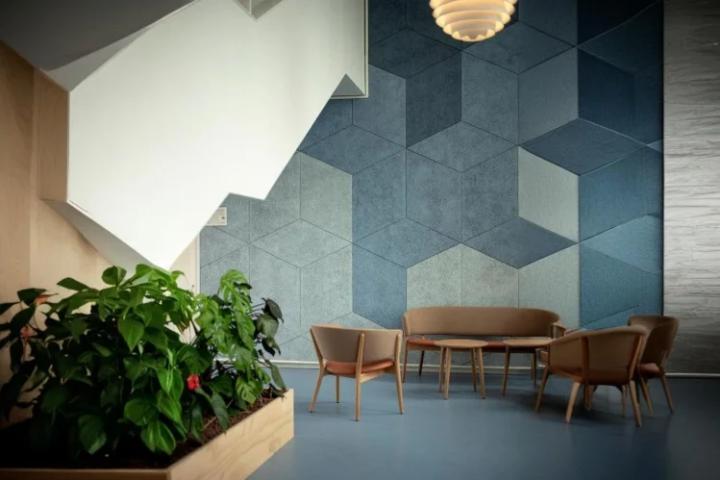
PET felt is among the most flexible materials. It can be laser cut, routed, folded, layered, and thermoformed into 3D shapes. This acoustic panel material comes in many colours, and acoustic panels made from it can mimic slats, hexagons, or custom logos.
It is lightweight, itch-free, and often recycled. The trade-offs are that very thin boards offer limited bass control, and cheap, weakly bonded versions can sag over time.
Wooden and Slatted Panels
Timber and veneer offer warmth that fabric cannot match. Slatted and fluted acoustic wall panels, backed with felt or mineral wool, are popular in offices, hotels, and homes. Design freedom is moderate: patterns can be linear, grooved, or perforated, and curves are possible with flexible substrates.
However, each acoustic panel material choice in wood affects absorption, because open area and backing decide performance. Wood also needs fire treatment and stable substrates in humid climates.
Wood Wool Panels
Wood wool boards bring a raw, textured, biophilic look. Fibre width, colour, and edge profile can be varied, and boards can be painted or left natural. They suit ceilings and walls in gyms, schools, and cafés.
Flexibility in shape is limited, since the material is rigid and cement-bound, and heavy paint reduces absorption. Still, acoustic wall panels of this type give strong visual character with little extra decoration.
Perforated Metal and Gypsum
Perforated metal and gypsum panels with acoustic backing provide a clean, monolithic look. Perforation patterns can be uniform, graduated, or even image-based, and metal can be curved, coloured, or anodised.
Gypsum supports seamless ceilings and walls that read as plain plaster. These systems excel in precision and durability, but they offer less softness and are heavier to install. Designers should confirm the perforation pattern was tested, because performance changes with open area.
Mineral Wool and Glass Wool Boards
These are the performance leaders, with excellent absorption and fire resistance. As an acoustic panel material, they are usually hidden behind facings, so flexibility comes from the finish rather than the core.
Acoustic panels with glass or mineral wool cores can be cut to size and framed in many ways. They are less suited to exposed use, where fibres or crumbling edges may be a concern, so facing quality matters.
Foam Panels
Foam is light, cheap, and easy to cut, which is why it dominates home studios. Wedges, pyramids, and flat tiles are the usual shapes.
However, design flexibility is limited, with fewer colours, a dated look, weaker fire performance, and poor durability. Foam suits temporary or budget treatment, but most architects avoid it for premium interiors.
Read to know more about acoustic wall panels here: Temporary vs. Permanent Acoustic Wall Panels: Which One Fits Your Needs?
Sprayed and Seamless Finishes
Sprayed systems cover curves, domes, and awkward geometry without joints. They give the highest freedom of form, but little freedom of pattern, since the finish is uniform. Heights, access to services, and later repairs need planning. These coatings complement panels rather than replace them in many projects.
Performance Trade-Offs
More freedom can reduce acoustics. Heavy paint clogs pores, narrow slots restrict absorption, and thin boards struggle with bass. Every acoustic panel material has a balance between beauty and performance, so designers should request test reports for the exact pattern and thickness. A striking pattern is pointless if the room remains noisy.
Installation and Mounting
Mounting limits design too. Glued panels sit flat, while z-clips, battens, and track systems allow gaps and shadow lines. Heavy acoustic wall panels need stronger fixings, and large felt sheets may need hidden frames. Plan the support early, and leave an air gap behind acoustic panels where bass control matters.
Fire, Moisture, and Durability
Flexibility means little if a product fails compliance. Check fire ratings, emission certificates, and moisture resistance for each acoustic panel material. PET and metal resist damp well, wood and fabric need care, and foam needs scrutiny. Public buildings demand certified products, so confirm the paperwork before design is frozen.
Cost and Value
Foam is cheapest, fabric-wrapped and PET sit in the middle, and wood, wood wool, and custom metal cost more. Custom shapes raise price in any material. Compare lifetime value, including durability and repair, instead of upfront cost alone. Well-chosen acoustic wall panels avoid replacement and rework.
Matching Material to Project Type
- Offices: PET felt and fabric acoustic panels balance cost, colour, and speech control.
- Hotels and restaurants: Wood slats and wood wool deliver warmth.
- Auditoriums: Perforated gypsum and fabric acoustic wall panels suit precise control.
- Schools: Durable, wipeable boards are best.
- Homes and studios: Fabric, PET, and foam acoustic panels cover most budgets.
Final Thoughts
Design flexibility varies widely across materials. PET felt and sprayed systems lead on form, fabric leads on colour, wood and wood wool lead on warmth, and metal and gypsum lead on precision. Choose each acoustic panel material for what it can do, not just how it looks, verify performance with test data, and your acoustic wall panels will deliver both the design and the sound you planned.
Want to see how different acoustic panel materials look and perform in your space? Order samples from Tranquil Global to match the right finish to your concept.