In this blog, we’ll dive deep into what an AI detector is, how it works, and why it's becoming an essential tool in educ
| Founded year: | 2000 |
| Country: | United States of America |
| Funding rounds: | Not set |
| Total funding amount: | Not set |
Description
Artificial Intelligence (AI) is reshaping our world — from personalized recommendations to autonomous vehicles, it's everywhere. But as AI becomes more sophisticated, especially in generating human-like content, there’s a growing need to distinguish between what's written or created by a machine and what's crafted by a human. This is where AI detectors come into play.In this blog, we’ll dive deep into what an AI detector is, how it works, and why it's becoming an essential tool in education, content creation, research, and digital trust.
What Is an AI Detector?
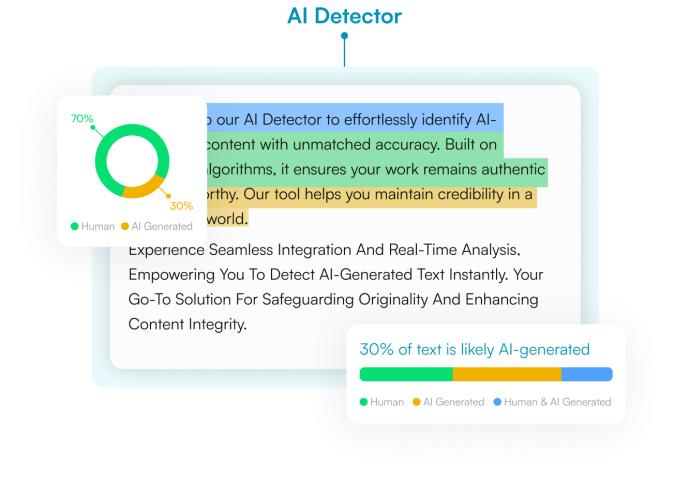
An AI detector is a software tool designed to analyze digital content and determine whether it was written by a human or generated by an artificial intelligence system. These detectors use advanced algorithms to examine the structure, patterns, and word usage in text, flagging content that exhibits signs of being machine-generated.
With tools like ChatGPT, Bard, and other AI content generators becoming widely accessible, distinguishing between human and AI-generated content is becoming more challenging — and more important than ever.
Why Are AI Detectors Important?
As AI technology evolves, the lines between human and machine-generated content continue to blur. Here’s why AI detectors matter:
1. Academic Integrity
In educational institutions, students may be tempted to use AI tools to write essays or solve assignments. AI detectors help educators maintain academic honesty by identifying non-original, machine-written content.
2. Content Authenticity
In journalism, marketing, and SEO, authentic human-written content carries more trust and emotional weight. AI detectors help publishers and agencies ensure their content aligns with originality standards.
3. Combating Misinformation
AI can be used to generate fake news or manipulate public opinion. AI detectors act as a line of defense by identifying content that may have been artificially created for misleading purposes.
4. Legal and Ethical Boundaries
In regulated industries like law, healthcare, or finance, using AI-generated content without disclosure can raise legal and ethical questions. AI detectors support compliance by flagging potentially problematic content.
How Do AI Detectors Work?
AI detectors analyze several linguistic and structural elements to determine whether text is AI-generated. Here are some of the most common techniques used:
– Perplexity & Burstiness
These are measures of how predictable or varied the language is. AI writing tends to be more uniform and predictable, while human writing often includes irregularities or unique phrasing.
– Stylistic Analysis
Detectors compare the tone, sentence structure, and grammar to known patterns of AI writing. Some tools even benchmark against known AI model outputs.
– Machine Learning Models
Advanced detectors use machine learning trained on massive datasets of both human and AI-generated content. Over time, they become better at recognizing subtle cues that separate the two.
– Token Distribution
AI writing often uses certain words or phrasing repeatedly. Detectors analyze how these “tokens” are distributed to find signs of artificiality.
Limitations of AI Detectors
While AI detectors are powerful, they’re not perfect. Here are a few limitations to consider:
False Positives: Sometimes, a detector may flag human-written content as AI-generated.
False Negatives: As AI gets smarter, it may occasionally fool detectors.
Language Variability: Detectors trained on English may be less accurate in other languages.
Over-reliance: Relying solely on AI detectors without human judgment can lead to errors in evaluation.
That’s why AI detection should always be part of a broader content review strategy — not the only line of defense.
Who Uses AI Detectors?
AI detection tools are being adopted across various industries and professions:
Educators and academic institutions
Editors and publishers
SEO experts and digital marketers
HR departments evaluating resumes or cover letters
Journalists fact-checking content sources
Legal professionals ensuring compliance in reports
With AI content becoming more integrated into our daily work, these detectors are emerging as essential tools for maintaining trust and transparency.
The Future of AI Detection
As AI continues to evolve, so will the detectors built to analyze it. We can expect future tools to:
Detect multimedia AI content (images, audio, and video)
Offer real-time detection in writing tools and browsers
Integrate more deeply with content management systems and platforms
Adapt faster through continual learning and feedback loops
What’s clear is that AI detectors will be crucial not just for identifying machine-made content, but also for navigating a future where humans and AI create side by side.
Final Thoughts
AI detectors are no longer niche tools — they are now a vital part of our digital ecosystem. As we embrace the benefits of AI, we must also be mindful of the challenges it brings. Tools that verify authenticity, like AI detectors, help ensure that creativity, communication, and knowledge sharing remain transparent and trustworthy.
Whether you're a teacher, a writer, or a business leader, understanding how AI detection works empowers you to make better decisions in this new digital era. Because in a world increasingly influenced by machines, knowing what’s real matters more than ever.
Have a startup you want to promote?
Feature your startup and reach thousands of entrepreneurs and investors
Feature My Startup