When you’re planning a home improvement or construction project, one of the most common — and frustrating — questions is:
How do I calculate how much concrete I need?
Whether you’re pouring a patio, building footings, or constructing steps, guessing the amount of concrete can lead to two costly mistakes:
-
Ordering too little and delaying your project
-
Ordering too much and wasting money on excess material
Let’s break down how to calculate concrete the right way — even if you're a complete beginner — using a proven step-by-step method.
The Problem: Misjudging Concrete Needs Can Ruin a Project
Imagine this:
You’ve scheduled a mixer delivery, prepped your forms, and have your crew ready. But halfway through the pour, you realize… you’re short by half a yard.
Now you’re scrambling to order more, paying extra for a rush load, and wasting time — all because of a simple miscalculation.
On the flip side, ordering too much means overpaying for concrete you don’t use. It also leaves you with the hassle of disposing excess mix — which isn’t cheap or easy.
In both cases, the root problem is the same: inaccurate concrete yardage estimation.
The Agitation: Why Manual Estimation is a Risk
Let’s be honest — concrete math isn't fun. It involves converting measurements, calculating volumes, and converting cubic feet to cubic yards.
Even if you remember the formula, it’s easy to:
-
Mis-measure length, width, or depth
-
Forget to convert inches to feet
-
Skip adding overage (which is critical!)
Just one small error can cost hundreds of dollars — or ruin the timing of your pour.
Plus, different projects have different shapes. A slab is easy, but what about cylindrical columns, stairs, or odd shapes?
That’s why so many DIYers and even contractors either guess or overestimate "just in case," which results in costly waste.
The Solution: A Fast, Foolproof Way to Calculate Concrete
Fortunately, there’s an easier — and smarter — way to get it right every time.
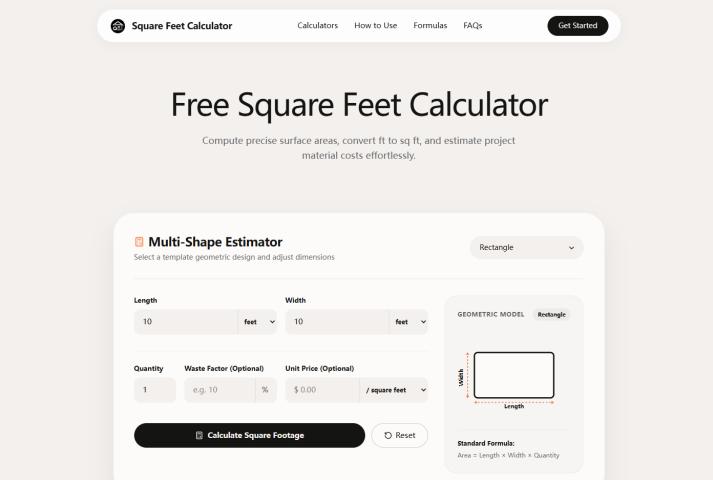
You can use a Concrete Calculator designed specifically to help homeowners, contractors, and builders accurately measure concrete volume for any type of pour.
📌 What Is a Concrete Calculator?
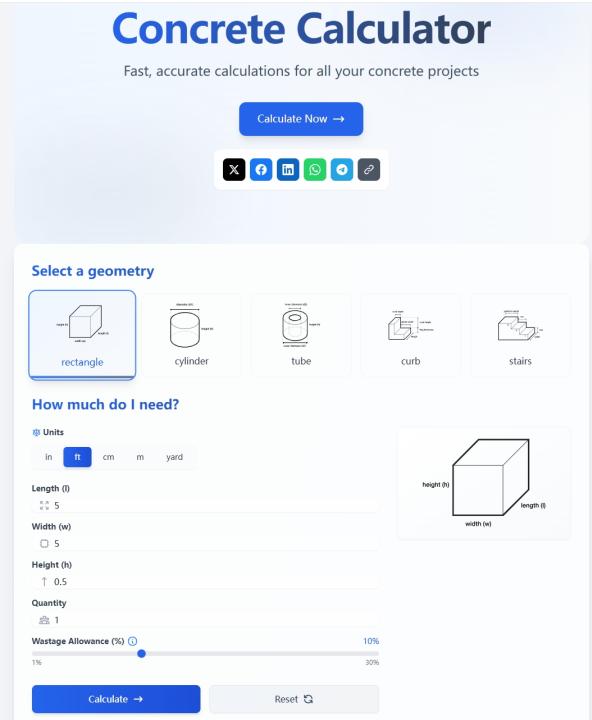
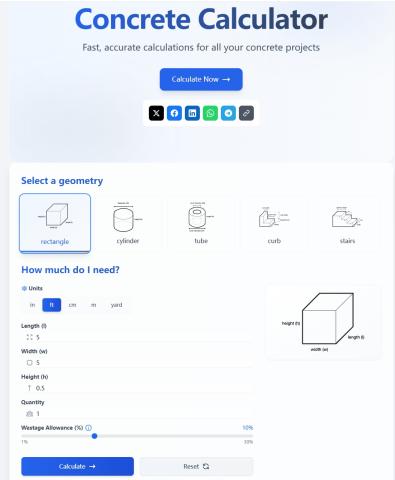
A Concrete Calculator is a digital tool that lets you plug in your project dimensions — whether it’s a rectangular slab, footing, column, or custom shape — and instantly tells you:
-
The cubic yards (or cubic meters) of concrete you need
-
How many 40lb, 60lb, or 80lb bags to buy
-
Suggested overage to reduce waste risks
This saves time, cuts cost, and improves accuracy.
✔️ How to Use a Concrete Calculator (Step-by-Step)
Let’s walk through a basic example of using the tool for a simple slab:
✅ Step 1: Measure Your Project
Let’s say you're pouring a patio.
-
Length: 12 feet
-
Width: 10 feet
-
Depth: 6 inches (convert to 0.5 feet)
✅ Step 2: Input the Numbers
Go to the Concrete Calculator and select "Slab".
Enter:
-
12 (Length)
-
10 (Width)
-
0.5 (Depth)
Click “Calculate”.
✅ Step 3: Get Your Results
The calculator will tell you:
-
You need 1.85 cubic yards of concrete
-
You’ll need approx 93 bags of 40lb mix or fewer larger bags
-
It automatically includes recommended overage
Just like that — no math, no mistakes.
Different Project Types Need Different Calculations
One of the best features of a concrete calculator is its flexibility.
You’re not just limited to slabs. Here's how you can use it for different structures:
🔹 Concrete Footings
Perfect for decks or sheds. Just input:
-
Linear length
-
Width
-
Depth
You'll get volume and bag estimates instantly.
🔹 Columns or Piers
Cylindrical shapes are tricky manually. But with a calculator:
-
Input diameter and height
-
Get cubic yards and recommended bags
🔹 Steps or Stairs
Complex shapes like stairs are supported too. Some calculators let you input number of steps, height, tread depth, and width.
Using a calculator helps remove the guesswork and avoids under-pouring halfway through the job.
Why You Should Add 10% Overage (and Let the Calculator Do It)
Concrete pours rarely go 100% according to plan. Forms shift, ground isn’t level, and a little always gets lost during mixing or transport.
That’s why pros always add at least 10% extra to their calculations.
The Concrete Calculator does this for you by default, helping avoid expensive delays or additional trips to the hardware store.
Common Mistakes to Avoid When Calculating Concrete
Even with tools, it's important to keep these tips in mind:
-
Use consistent units (feet and inches can’t be mixed)
-
Convert inches to feet before calculating (e.g., 4 inches = 0.33 feet)
-
Measure twice to prevent input errors
-
Always round up to the nearest quarter yard
FAQ: Concrete Calculation Tips for DIYers
Q: How many cubic feet are in a cubic yard?
There are 27 cubic feet in a cubic yard (3' x 3' x 3').
Q: Can I calculate concrete without a calculator?
Yes, but it requires manual volume math:
Volume (ft³) = Length × Width × Depth
Then divide by 27 to get cubic yards
But why struggle when an online concrete calculator does it in seconds?
Q: How much does a bag of concrete cover?
Here’s a rough guide for a 4" thick slab:
-
40 lb bag ≈ 0.3 sq ft
-
60 lb bag ≈ 0.45 sq ft
-
80 lb bag ≈ 0.6 sq ft
The calculator converts yardage to bags based on thickness and area for you.
Bonus Tip: Bookmark This Concrete Calculator for Future Projects
You never know when you'll need it again — a new walkway, hot tub pad, or mailbox footing. Keep this link handy:
👉 Concrete Calculator: https://concrete-calculator.app/
Conclusion: Be Smart, Not Sorry — Calculate Before You Pour
Concrete projects are too expensive to wing it. With the right tool and a few key measurements, you can:
-
Avoid costly misorders
-
Prevent project delays
-
Stick to your budget
Whether you're a first-time DIYer or a seasoned builder, using a concrete calculator gives you confidence — and accurate results — every time.
No more guessing. Just perfect pours.