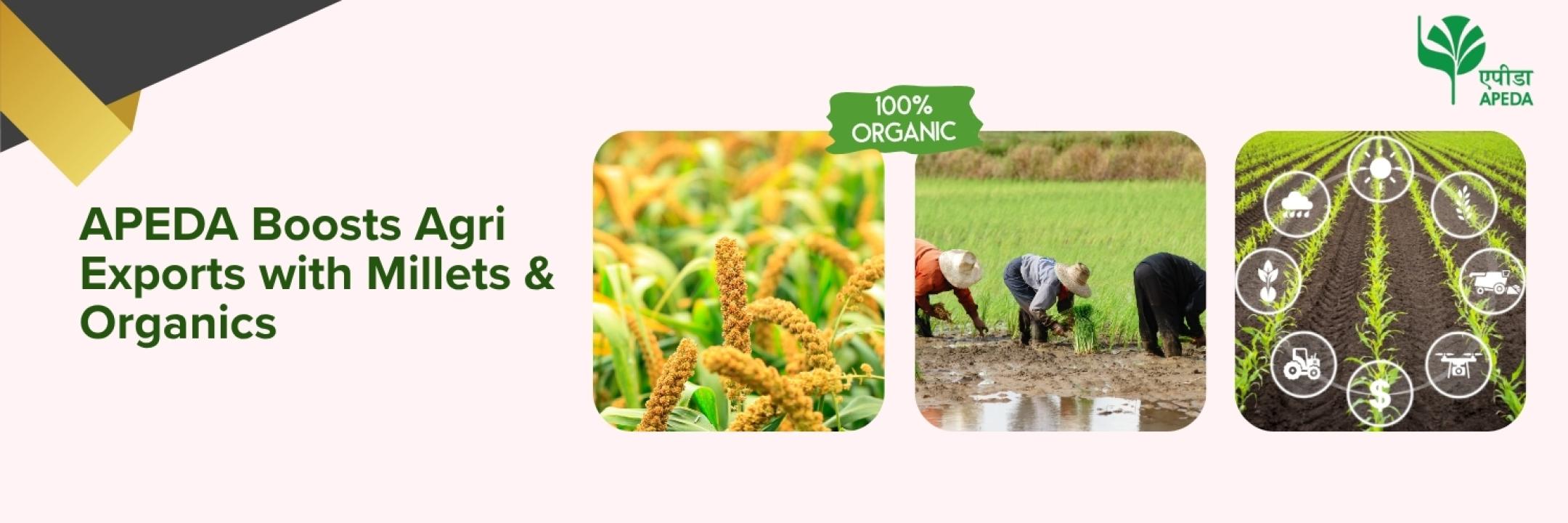
India’s agricultural economy is undergoing a transformative shift — one driven by quality, sustainability, and global competitiveness. At the center of this transformation stands APEDA — the Agricultural and Processed Food Products Export Development Authority — a government body that has played a pivotal role in promoting India’s agricultural exports globally. With its latest initiatives focusing on millets, organic farming, and smart agriculture, APEDA is empowering Indian farmers and exporters to access international markets with confidence.
What is APEDA? (Meaning and Full Form)
APEDA
stands for Agricultural and Processed Food Products Export Development
Authority. It was established by the Government of India in 1985 under the
APEDA Act to promote the export of scheduled agricultural products. These
include fruits, vegetables, meat, dairy, cereals, organic foods, and more. In
recent years, APEDA has intensified efforts to boost the global trade of
millets and smart farming products. By supporting quality standards,
certification, and market access, APEDA plays a vital role in enhancing India’s
agricultural exports and making them globally competitive.
Commodities Covered under APEDA
| Category | Details |
| Legal Framework | Established under the APEDA Act, 1985 by the Government of India. |
| Core Objective | Promote and develop the export of scheduled agricultural and processed food products |
| Geographical Scope | Works across India with international focus on export markets in over 200 countries. |
| Scheduled Products | Covers fruits, vegetables, meat, poultry, dairy, cereals, organic produce, millets, and more. |
| Export Promotion | Facilitates marketing, branding, packaging, quality improvement, and market access. |
| Financial Assistance | Provides subsidies for infrastructure development, packaging, transport, and export activities. |
| Quality Assurance | Sets product standards and certifications for global compliance (e.g., NPOP for organics). |
| Digital Initiatives | Introduced systems like Tracenet, e-RCMC, and online registration for ease of doing business. |
| Sustainability Focus | Actively promotes organic farming, millets, and climate-smart agriculture exports. |
Online APEDA Registration Process for Agri Exporters
1. Obtain an IEC (Import Export Code): Before starting the APEDA registration, the business must first obtain an Import Export Code from the Directorate General of Foreign Trade (DGFT). This is a compulsory requirement for any exporter.
2.
Visit the APEDA Website:
Go to https://apeda.gov.in and
click on the option “Register as Exporter.”
3.
Enter IEC and Company Details:
Enter your IEC number. The system will auto-fetch your business details from
the DGFT database. You’ll then be asked to provide contact information such as
your email ID, mobile number, and business address.
4.
Upload Required Documents:
Upload necessary documents in PDF format. This includes your IEC certificate,
PAN card, bank certificate or cancelled cheque, company registration
certificate or partnership deed, and address proof.
5.
Pay the Registration Fee:
Pay the APEDA registration fee of ₹5,900 (including GST) online using net
banking, credit card, or debit card.
6.
Submit the Application:
After submitting the form and documents, APEDA will verify the details. Once
approved, your RCMC certificate will be issued. This usually takes 7 to 15
working days.
Documents Required for APEDA Registration
- IEC
Certificate (Import Export Code)
- PAN Card
of the business
- Bank
Certificate or Cancelled Cheque
- Company
Incorporation Certificate or Partnership Deed
- Address
Proof (like electricity bill or rent agreement)
- Digital
Signature Certificate (DSC)
- Valid
Mobile Number and Email ID
Fees for APEDA registration (RCMC)
1.
Official Registration Fee:
The government fee for APEDA registration (RCMC) is ₹5,900, which is inclusive
of GST.
2. Payment Mode: The fee is to be
paid online during the registration process on the official APEDA website: https://apeda.gov.in.
3. Validity: This fee is valid for 5
years from the date of registration. After that, renewal is required.
4. Third-Party Charges (Optional): If
you use consultants or registration agents, they may charge an extra fee of
₹3,000–₹4,000 for documentation and processing help.
5. Total Cost with Agent: When using
professional services, the total cost may go up to ₹9,000–₹9,500.
6. Agent Use is Optional: Using a
third-party agent is not mandatory. Exporters can complete the process on their
own through APEDA’s online portal.
7. What the Fee Covers: The ₹5,900 fee covers the government charges for issuing the Registration-Cum-Membership Certificate (RCMC), which is essential for exporting scheduled agri-products.
Benefits of APEDA in the Agriculture Sector
1. Boosts Agri-Exports: APEDA promotes the export of Indian agricultural and
processed food products, helping farmers and agri-businesses access global
markets and earn higher incomes.
2. Financial Assistance: Offers subsidies and financial aid for packaging,
infrastructure, transport, branding, and participation in international trade
fairs.
3. Market Development: Helps in identifying export opportunities, conducting
market research, and promoting Indian products abroad through exhibitions and
buyer-seller meets.
4. Product Certification & Quality Control: Ensures that products meet global
quality standards by supporting certifications like organic (NPOP), HACCP, ISO, and food safety protocols.
5. Support for Organic and Millet Farming: Encourages sustainable farming by
promoting exports of organic
produce and millets, offering incentives and building
export clusters.
6. Training & Capacity Building: Organizes regular training sessions,
workshops, and webinars to educate exporters, FPOs, and farmers on export
processes, documentation, and global standards.
7. Traceability & Transparency: Tools like Tracenet help maintain transparency and
traceability in organic farming, increasing trust among international buyers.
8. Digital Export Systems: Provides a digital platform for registration (e-RCMC),
application tracking, and accessing export data, making processes efficient and
transparent.
9. Encourages Farmer Producer Organizations (FPOs): Supports collective farmer efforts
through FPOs and cooperatives, enabling small and marginal farmers to enter the
export value chain.
10. Drives Value Addition: Promotes the export of processed and value-added products,
increasing profitability and reducing post-harvest waste.
Initiatives by APEDA for Millet Exports
1.
Creation of a Millet Export Promotion Program: APEDA developed a dedicated export
promotion strategy focusing on value-added millet products like millet noodles,
biscuits, health mixes, snacks, and breakfast cereals.
2.
Market Identification and Access:
APEDA identifies high-potential export destinations and connects Indian
exporters with importers, retailers, and food chains worldwide.
3.
Support to Millet Export Clusters:
APEDA collaborates with state governments and FPOs to develop export-oriented
millet clusters in Rajasthan, Karnataka, Maharashtra, Odisha, and Andhra
Pradesh.
4.
Quality Standards and Certification:
To ensure global acceptance, APEDA supports exporters in obtaining necessary
certifications such as organic (NPOP), HACCP, ISO, and FSSAI compliance.
5.
Financial Assistance and Subsidies:
Exporters are eligible for assistance under APEDA’s Agri Export Policy schemes,
including branding, packaging, transportation, and participation in
international fairs.
6.
Capacity Building and Training:
Regular workshops, buyer-seller meets, and webinars are conducted to train
millet exporters on export documentation, hygiene practices, global packaging
trends, and digital marketing.
7.
Global Millet Promotion Campaigns:
APEDA partners with Indian embassies, consulates, and trade offices to organize
millet food festivals and tastings in global cities like Dubai, London, Tokyo,
and Berlin.
8.
Digital Export Tools: Exporters
can register through APEDA’s portal and use systems like Tracenet for
traceability, e-RCMC for online membership, and market intelligence tools for
millet trends.
Promoting Organic Products for Global Markets
India
is emerging as a global leader in organic farming, and APEDA is playing a key
role in promoting organic products in international markets. Through the
National Programme for Organic Production (NPOP), APEDA ensures certification,
quality standards, and traceability for organic goods. It supports farmers and
exporters with training, infrastructure, and financial aid. Organic products
like spices, tea, rice, and millets are in high demand globally. APEDA
organizes buyer-seller meets, trade fairs, and export promotion events to
connect Indian producers with global buyers. With growing awareness of health
and sustainability, APEDA’s initiatives are helping India tap into premium
organic markets in the US, EU, and beyond.
How APEDA Enhances Agri Exports
| Focus Area | APEDA’s Initiatives | Impact on Exports |
| Millets (Shree Anna) | - Branding Indian millets globally as “Shree Anna” - Millet Export Promotion Forums - Participation in international millet expos and food festivals | - Increased millet exports to 125+ countries - Boost in farmer income from drought-prone regions |
| Organic Products | - Operates NPOP (National Programme for Organic Production) - Support for organic clusters & certification | - Organic exports crossed ₹11,000 crore - Indian organic produce accepted in EU, US, & Asian markets |
| Smart Farming Products | - Export support for hydroponic produce, precision agri-tools - Promotes climate-smart agri-technology in expos - Encourages export of agri-tech inputs | - New export opportunities in tech-based agriculture - Positioning India as a leader in smart farming exports |
| Financial Assistance | - 40% subsidy for export infrastructure - Reimbursement for packaging, branding, and transport | - Reduced export costs for FPOs and MSMEs - Better global packaging and brand value |
| Capacity Building | - Exporter training programs - Buyer-seller meets, webinars, and trade fairs - Guidance on documentation and compliance | - Increased participation from small exporters - Faster and more professional export readiness |
| Market Diversification | - Targets new markets in Africa, Latin America, and ASEAN - Custom market reports and demand forecasts | - Reduced dependency on traditional markets - New demand channels for niche products like millets |
Smart Farming and Tech Support by APEDA
APEDA
actively promotes smart farming by integrating modern technologies like AI,
IoT, drones, and blockchain into India’s agriculture. These innovations help
farmers monitor soil health, automate irrigation, predict pest outbreaks, and
ensure higher yields. APEDA supports the use of satellite-based GIS mapping and
precision farming tools to meet global export standards. It also promotes
blockchain traceability systems, ensuring transparency from farm to export,
especially for organic products. Through its digital platforms like TraceNet
and Agri-Exchange, APEDA connects farmers directly with international buyers.
Additionally, APEDA encourages smart packaging with QR-code labels, enhancing
trust and product visibility. Training sessions and field demonstrations are
regularly organized to educate farmers and exporters on using these technologies.
Smart farming, backed by APEDA, is making Indian agriculture efficient,
export-ready, and globally competitive.
Final Thought
APEDA is playing a transformative role in making Indian agriculture globally competitive. By promoting the export of scheduled products—especially millets, organic produce, and smart farming innovations—APEDA is connecting farmers and agri-entrepreneurs to high-value international markets. Through initiatives like NPOP certification, Tracenet for traceability, financial assistance, and export training, APEDA ensures quality, transparency, and readiness. Its support for millet clusters, FPOs, and agri-tech tools is reshaping the future of farming. With a focus on sustainability, value addition, and global branding, APEDA is empowering Indian agriculture to thrive in the global economy.