The global Passive Authentication Market is growing rapidly as organizations seek advanced security solutions that improve user experience while ensuring data protection. Passive authentication uses behavioral patterns such as typing rhythms, mouse movements, and device usage habits to verify user identity without intrusive prompts, enabling seamless and secure interactions. This technology is gaining traction across industries like BFSI, healthcare, telecommunications, and government due to rising cyber threats and demand for frictionless security.
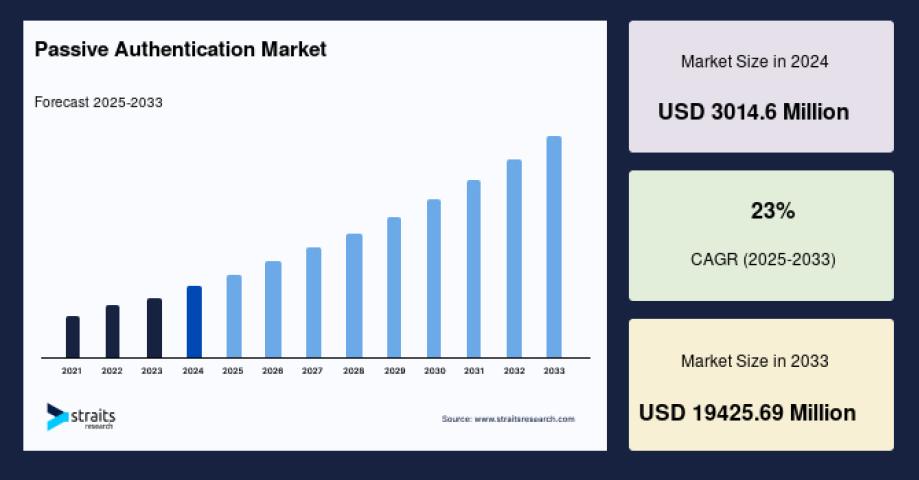
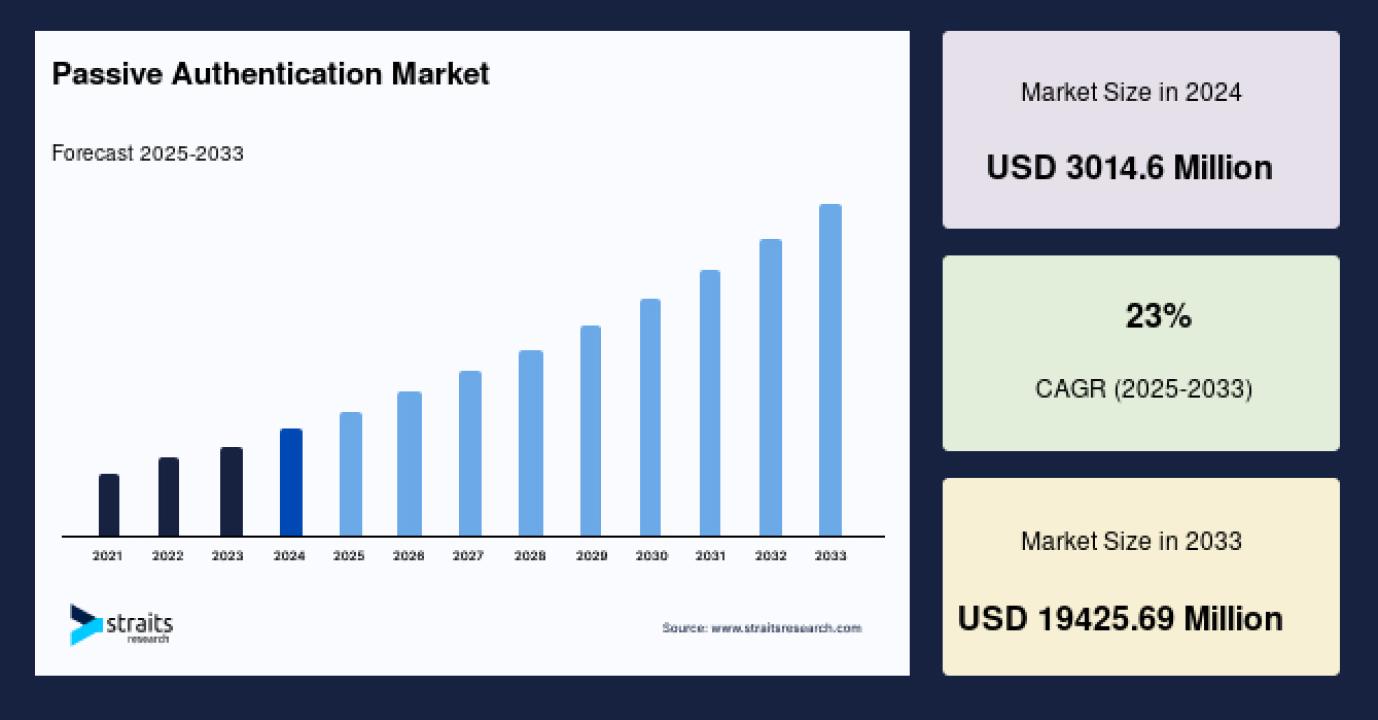
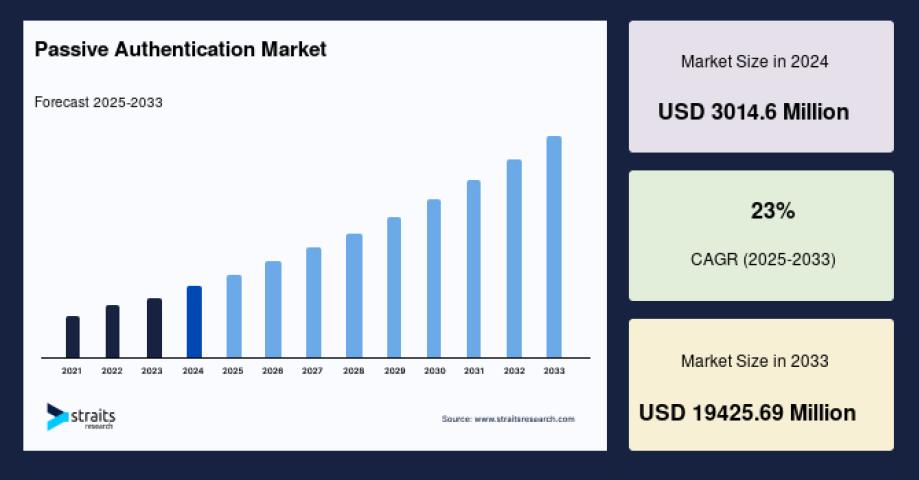
Market Size 2024 — USD 3,014.6 million
Market Size 2025 — USD 3,707.96 million
Market Size 2033 — USD 19,425.69 million
CAGR (2025–2033) — 23%
For detailed insights and in-depth analysis, one can request a sample report here: https://straitsresearch.com/report/passive-authentication-market/request-sample
Market Drivers
The increase in cyberattacks globally has heightened the need for robust authentication methods that protect sensitive data while maintaining user convenience. Passive authentication eliminates the need for passwords and reduces reliance on traditional, error-prone verification steps.
The widespread adoption of smartphones and other personal devices equipped with sensors facilitates the collection of biometric and behavioral data seamlessly, contributing to market growth. Enterprises are embracing this technology to improve fraud prevention while enhancing customer experience.
Additionally, regulatory compliance requirements in sectors such as BFSI and healthcare mandate stronger identity verification, increasing the adoption of passive authentication solutions.
Cloud computing and IoT proliferation add complexity to security infrastructure, making efficient and adaptive authentication systems essential. Passive authentication’s ability to continuously verify identity through multiple parameters supports these needs.
Market Challenges
Privacy concerns regarding continuous behavioral monitoring can create resistance among consumers wary of data misuse or surveillance. Organizations must balance security with transparency and trust-building.
High implementation costs and complexity in integration with existing legacy systems can deter small and medium enterprises from adopting passive authentication.
Furthermore, evolving cyber threats require regular updates and improvements in algorithms and sensor technology. Maintaining high accuracy while minimizing false positives or negatives is critical but challenging.
Market Segmentation
The passive authentication market segmentation includes components, functions, deployment models, organization size, industry verticals, and regions:
By Component:
- Solutions: Leading contributor, comprising the software that enables behavioral analysis, biometric processing, and fraud detection. Solutions integrate voice, facial biometrics, typing patterns, and device identification.
- Services: Includes consulting, implementation, integration, and support services, growing due to increasing adoption and need for expert deployment.
By Function:
- Compliance Management: Dominates the market by ensuring organizations meet regulatory identity and data privacy standards.
- Marketing Management: Secures marketing tools and data from fraud and unauthorized access.
- Risk Management: Fastest growing segment, focusing on risk-based authentication and real-time fraud prevention using behavioral biometrics.
By Deployment Model:
- On-premise: Preferred for high-security environments offering customization and control.
- Cloud-based: Fastest growing, favored for scalability and ease of integration in digital-first enterprises.
By Organization Size:
- Small and Medium Enterprises (SMEs): Largest segment, adopting passive authentication to reduce fraud risks affordably.
- Large Enterprises: Fastest growing due to complex security needs and vast data handling.
By Industry Vertical:
- BFSI: Largest market share driven by need for advanced authentication for financial transactions.
- Telecom & IT: Significant growth fueled by digital service expansion and cloud adoption.
- Healthcare: Fastest growing sector due to rising data breaches and regulatory mandates.
- Retail & Consumer Goods
- Government
- Media & Entertainment
- Others (Education, Travel, hospitality)
By Region:
- North America: Largest and most developed market due to technological advancement and regulatory pressures.
- Asia Pacific: Fastest growing region projected to become a lucrative market due to digital adoption and SME growth.
- Europe: Substantial growth driven by data protection laws and cloud services.
- LAMEA: Emerging market with rising IT infrastructure investment.
For a complete segmentation overview and detailed data, the report is available for purchase here: https://straitsresearch.com/buy-now/passive-authentication-market
Top Players Analysis
Leading companies steering the passive authentication market include:
- Purilock
- Plurilock ADAPT
- Unified
- NuData Security Inc. (A Mastercard company)
- BehavioSec AB
- BioCatch
- TypingDNA
- SecuredTouch (Part of Visa)
- TypingInsights
- CallSign
These players focus on integrating artificial intelligence with biometric and behavioral analytics, enhancing fraud detection, and improving user experience. Innovations include invisible multi-factor authentication, continuous identity verification, and seamless user onboarding across digital platforms.
Companies strategically partner with banks, telecom operators, and government agencies to scale solutions, ensuring compliance with evolving regulations globally.
Straits Research is a market intelligence company providing global business information reports and services. Our exclusive blend of quantitative forecasting and trends analysis provides forward-looking insight for thousands of decision-makers. Straits Research Pvt. Ltd. provides actionable market research data, especially designed and presented for decision making and ROI.
Frequently Asked Questions (FAQs)
What is the global passive authentication market size for 2024 and forecast for 2033?
Market Size 2024 — USD 3,014.6 million
Market Size 2025 — USD 3,707.96 million
Market Size 2033 — USD 19,425.69 million
CAGR (2025–2033) — 23%
What drives the adoption of passive authentication?
Increasing cyberattacks, need for frictionless security, mobile device penetration, and regulatory compliance.
Which industries are major users of passive authentication?
BFSI, healthcare, telecom & IT, retail, government, and media.
What are the common challenges facing the market?
Privacy concerns, high costs, integration complexity, and evolving threats.
What deployment models are used for passive authentication?
On-premise for control and customization; cloud-based for scalability and digital integration.
Who are the leading companies in the passive authentication market?
Purilock, Plurilock, Unified, NuData Security, BehavioSec, BioCatch, TypingDNA, SecuredTouch, TypingInsights, CallSign.