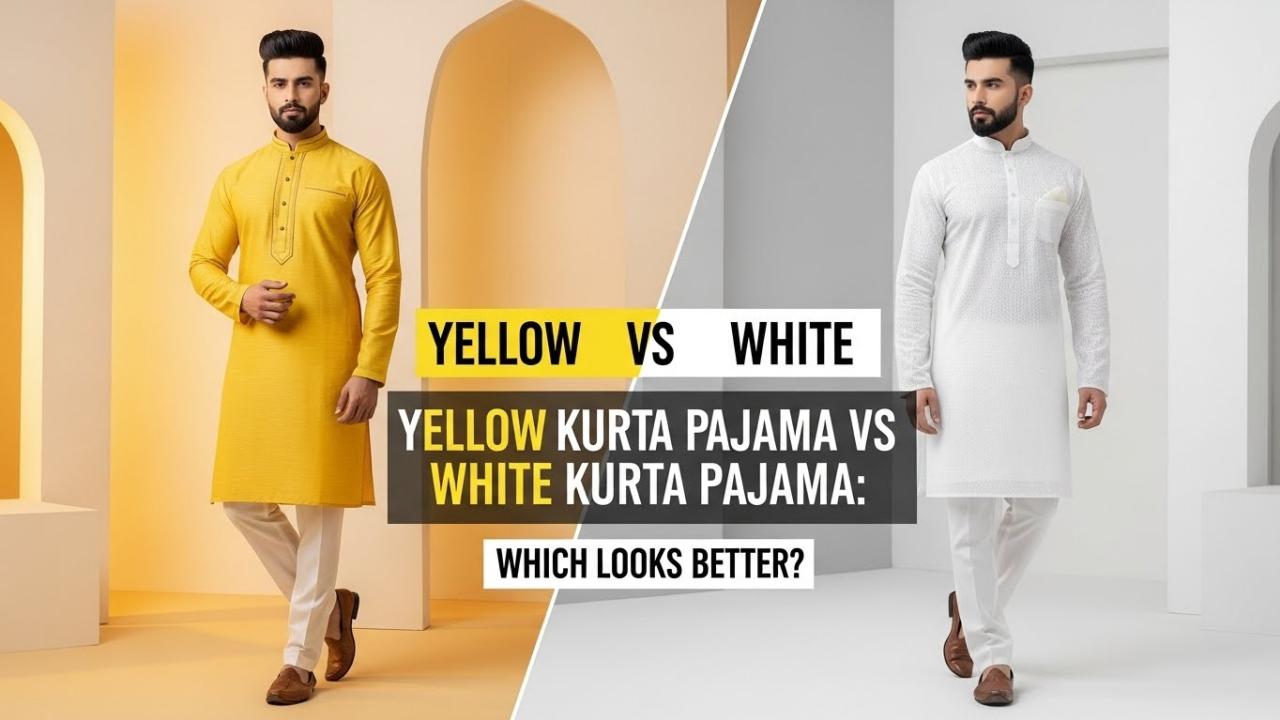
At first glance, comparing yellow kurta pajama with white kurta pajama appears cosmetic. One feels festive, the other restrained. One announces presence, the other suggests composure. Yet beneath this surface contrast lies a deeper question about how men in India navigate tradition, visibility, and social expectation through clothing.
Both yellow and white occupy culturally elevated positions in men’s ethnic wear. Neither is accidental. Both are chosen deliberately for moments that matter. When men hesitate between these two colours, they are often negotiating context rather than taste.
This comparison matters because it reflects how Indian menswear has evolved. Clothing is no longer selected only for ritual correctness. It is selected for photographs, social interpretation, repeat usability, and personal comfort within public settings. Yellow and white perform differently across all these dimensions.
Understanding which looks better therefore depends on where, how, and why it is worn — not on the colour itself.
Why Yellow and White Are Often Compared in Men’s Ethnic Wear
Yellow and white share a unique overlap in Indian cultural usage. Both are associated with purity, beginnings, and ceremonial significance. Both appear frequently in weddings, religious events, and seasonal gatherings. This overlap creates inevitable comparison.
Historically, white kurta pajama symbolized neutrality and authority. It allowed the wearer to remain present without dominating attention. Yellow, conversely, carried ritual emphasis, particularly in pre-wedding ceremonies and auspicious occasions tied to prosperity and renewal.
As men’s ethnic wear modernized, these distinctions blurred. Designers began offering yellow kurta pajama for men beyond haldi rituals, while white kurta pajama adopted richer fabrics, embroidery, and structured silhouettes. The result is a shared territory where both colours compete for relevance.
This competition is not stylistic. It is contextual. Men compare yellow and white because both promise appropriateness — but deliver it differently.
What Men Usually Choose Between Yellow and White (And Why)
Observed purchasing behavior reveals a pattern. Men tend to default to white kurta pajama when uncertainty exists. White feels safe. It rarely offends, rarely fails, and rarely demands explanation. This makes it a common first choice for formal gatherings and family events.
Yellow kurta pajama, however, is chosen intentionally. Men select it when participation is expected rather than neutrality. A yellow kurta pajama for haldi or festive functions signals alignment with the occasion, not distance from it.
Age and social role influence this decision strongly. Younger men gravitate toward yellow when they want visibility. Older men often return to white for its understated authority. Neither choice is arbitrary; both reflect self-positioning within the social setting.
What appears to be a colour preference is often a judgment call about how much presence the wearer wishes to project.
The Visual Difference: How Yellow and White Feel at First Glance
The immediate visual impact of yellow and white could not be more different. Yellow engages. It draws the eye, absorbs attention, and communicates energy. White withdraws. It creates space, signals restraint, and allows surroundings to frame the wearer.
A yellow colour kurta for men feels warm even before context is processed. It carries emotional temperature. White, by contrast, feels cool and composed, offering clarity rather than expression.
This distinction explains why yellow kurta pajama often appears celebratory even in simple silhouettes, while white kurta for men requires fabric quality and tailoring to avoid appearing plain. Yellow brings presence by default. White demands precision to achieve the same effect.
First impressions matter, especially in social environments where visual hierarchy forms quickly. The choice between yellow and white sets that hierarchy in motion.
How Yellow Kurta Pajama Looks in Daytime Settings
Daylight amplifies yellow. Natural light enhances warmth, depth, and texture, making yellow kurta for men particularly effective in outdoor or daytime events. Under the sun, even subtle shades such as lemon yellow kurta or mustard yellow kurta appear lively without effort.
This visual strength explains yellow’s dominance in daytime ceremonies, especially haldi functions and cultural gatherings. The colour interacts positively with floral décor, marigold tones, and natural surroundings, reinforcing the celebratory environment.
However, daylight also exposes execution flaws. Poor fabric choice, uneven dyeing, or excessive sheen become immediately visible. When yellow is handled casually, it appears loud rather than refined.
Well-executed yellow kurta pajama succeeds in daylight because it harmonizes with the environment rather than competing with it.
How White Kurta Pajama Looks in Daytime Settings
White behaves differently under the same light. It reflects rather than absorbs, creating a sense of clarity and formality. In daytime settings, white kurta pajama reads clean, composed, and controlled.
This makes white particularly effective in structured environments such as family functions, formal rituals, or gatherings where visual neutrality is preferred. White does not escalate emotion; it stabilizes it.
Yet white’s success depends heavily on fabric and fit. Inferior cotton, poor tailoring, or lack of structure becomes obvious in bright light. A white kurta pajama that lacks substance appears flat, even careless.
When executed properly, white conveys quiet authority during the day — a contrast to yellow’s expressive warmth.
How Yellow and White Perform Under Evening Lighting and Photography
Evening lighting dismantles assumptions formed during the day. Artificial light reshapes colour hierarchy, exaggerates reflectivity, and exposes fabric weaknesses with unforgiving precision. Yellow and white respond to this shift in radically different ways.
Yellow kurta pajama under warm indoor lighting deepens in tone. Mustard yellow kurta and darker yellow kurta for men often gain visual richness after sunset, absorbing ambient light rather than bouncing it. This creates depth, especially in fabrics with texture or matte finishes. When executed well, yellow photographs with warmth and dimensionality.
White kurta pajama behaves oppositely. Under evening lighting, it reflects aggressively. This can convey sharpness and clarity, yet it also risks overexposure in photography. Details flatten easily, especially in smooth fabrics, causing the garment to appear less structured on camera.
The implication is practical. For events heavily documented through photography and video, yellow often delivers stronger visual presence. White requires careful fabric selection and lighting control to avoid visual dilution.
Occasions Where Yellow Clearly Works Better Than White
Certain occasions demand participation rather than restraint. Yellow excels in these environments because it aligns visually and culturally with celebration.
Pre-wedding functions remain the clearest example. A yellow kurta for haldi ceremony integrates seamlessly with ritual symbolism, décor, and collective colour themes. White, while acceptable, appears detached in comparison.
Festive daytime gatherings also favor yellow. Events tied to harvest, renewal, or seasonal celebration benefit from colour warmth. A yellow kurta pajama for men enhances atmosphere without relying on embellishment.
Even informal cultural gatherings increasingly see yellow outperform white. Men seeking visibility without extravagance often find that yellow communicates involvement more effectively. In such contexts, white risks appearing observational rather than engaged.
Yellow works better wherever emotion, ritual, and visual energy converge.
Occasions Where White Clearly Outperforms Yellow
White dominates when authority, neutrality, or formality defines the setting. Its strength lies in its ability to recede while retaining dignity.
Formal religious observances often favor white kurta pajama. The colour aligns with solemnity, discipline, and restraint. Yellow, in such environments, may feel visually excessive.
Professional or semi-formal gatherings also lean toward white. Events involving elders, institutional presence, or hierarchical settings benefit from white’s visual composure. It allows the wearer to remain present without drawing undue attention.
White also excels in evening functions requiring understatement. Where yellow introduces warmth, white introduces clarity. In spaces where decor is already elaborate, white stabilizes rather than competes.
These contexts demonstrate that white performs best where control matters more than expression.
How Skin Tone Influences the Yellow vs White Choice
Skin tone quietly shapes how both colours register. Yellow interacts directly with undertones, while white creates contrast.
Men with warmer undertones often find yellow colour kurta for men enhances complexion, especially in mustard or golden shades. Lighter yellows such as lemon yellow kurta can work effectively when fabric quality prevents glare.
White, however, behaves universally yet differently. On deeper skin tones, white offers striking contrast and authority. On lighter skin tones, it risks blending unless offset through texture, layering, or tailored structure.
This dynamic explains why some men feel more confident in yellow while others default to white. The decision is less about fashion and more about how colour collaborates with complexion under varied lighting conditions.
Understanding this interaction reduces trial-and-error purchases significantly.
The Role of Fabric in Deciding Between Yellow and White
Fabric choice often determines whether yellow or white succeeds. The same silhouette in different materials can invert outcomes.
In yellow kurta pajama for men, fabric density controls saturation. Loose weaves expose dye inconsistencies, while structured cotton or silk stabilizes colour depth. This is why cotton yellow kurta for men and yellow silk kurta sets outperform synthetic alternatives consistently.
White demands texture. Flat fabrics appear clinical under light, while textured weaves, jacquards, or subtle embroidery introduce depth. Without this, white kurta pajama risks appearing unfinished.
Fabric therefore becomes the deciding factor when colour preference remains unclear. Men unsure between yellow and white often resolve the choice unconsciously through tactile response rather than visual analysis.
Styling Flexibility: Which Color Adapts More Easily
White offers broader styling flexibility. It pairs effortlessly with varied footwear, dupattas, jackets, and accessories. Its neutrality allows adaptation across contexts with minimal adjustment.
Yellow is more selective. Accessories must complement rather than compete. Footwear choices narrow. Layering requires restraint. Yet when >
This distinction matters for wardrobe planning. Men seeking a single kurta pajama adaptable across multiple settings often choose white. Those building occasion-specific wardrobes lean toward yellow for its expressive advantage.
Neither colour dominates universally. Each adapts differently, rewarding different priorities.
Why Yellow Feels More Festive — And White Feels More Authoritative
Festiveness is not decorative; it is psychological. Yellow activates emotional cues associated with participation, warmth, and social openness. When a man wears a yellow kurta pajama, the colour communicates involvement before conversation begins.
White operates differently. It signals distance without disengagement. Authority in white does not come from dominance but from composure. The wearer appears anchored, observant, and composed, particularly in settings where hierarchy or seniority exists.
This contrast explains why yellow appears repeatedly in celebratory rituals while white persists in formal environments. Yellow amplifies mood. White stabilizes it. Neither is superior in isolation; each performs a specific social function.
Men instinctively understand this distinction even when they articulate it as preference rather than intention.
The Repeat-Wear Factor: Which Color Gets Used More Often
Repeat usage exposes practicality. White kurta pajama typically sees higher frequency of wear because it integrates easily into varied contexts. It becomes a default garment, returning season after season with minimal adaptation.
Yellow kurta pajama, while powerful, is worn selectively. Its strength lies in specificity. A mustard yellow kurta set or yellow kurta pajama for men often reappears at similar types of events rather than across unrelated occasions.
However, this does not reduce its value. In fact, selective usage preserves relevance. Yellow garments often retain emotional association with meaningful events, reinforcing their importance within a wardrobe.
White accumulates utility. Yellow accumulates significance. Repeat wear follows those trajectories.
Where Men Commonly Go Wrong When Choosing Between Yellow and White
The most frequent mistake is ignoring context. Men choose yellow for formal evening events where restraint is expected, or white for highly celebratory daytime functions where presence matters. Both choices misalign intention and environment.
Another error lies in fabric neglect. Men assume colour alone carries the garment, overlooking how cotton, silk, or blends influence performance. A poorly constructed white kurta pajama appears careless. A poorly dyed yellow kurta appears aggressive.
Fit errors amplify these mistakes. White exposes tailoring flaws under light. Yellow exaggerates silhouette imbalance. Choosing colour without addressing construction leads to dissatisfaction regardless of preference.
These missteps are avoidable, yet common, because colour decisions are often made hastily.
How Many Men End Up Owning Both (And Why That Makes Sense)
Over time, many men arrive at the same conclusion: yellow and white serve different purposes and coexist rather than compete. Ownership of both reflects maturity in wardrobe planning rather than indecision.
White kurta pajama becomes the anchor piece, used across formal, religious, and neutral settings. Yellow kurta pajama occupies the celebratory tier, reserved for moments requiring expression and alignment with ritual energy.
This dual ownership reduces compromise. Men no longer force one colour into inappropriate contexts. Instead, they select deliberately, increasing satisfaction and confidence.
The decision to own both emerges naturally once experience replaces assumption.
Where Men Usually Explore Both Styles Before Deciding
Physical retail remains the primary decision environment for this comparison. Men often rely on tactile assessment, lighting variation, and mirror evaluation to judge yellow and white accurately.
Stores that offer both colours across multiple fabrics allow men to observe how yellow kurta pajama reacts under light compared to white kurta pajama. This side-by-side evaluation resolves uncertainty quickly.
Retail environments with knowledgeable staff further reduce confusion by guiding choices based on occasion and skin tone rather than trend. This experiential process explains why men often finalize colour decisions only after in-store exploration.
Digital browsing initiates interest. Physical interaction finalizes commitment.
Where Men Usually Explore Both Styles Before Deciding
For most men, the decision between yellow kurta pajama and white kurta pajama rarely happens in isolation. It unfolds through exposure, comparison, and correction. Online browsing initiates curiosity, but certainty usually arrives only when the garment is physically encountered.
Seeing yellow and white side by side under the same lighting immediately clarifies differences that photographs flatten. Yellow reveals warmth and presence. White reveals structure and restraint. Men adjust posture, move under light, and test comfort, unconsciously measuring how each colour behaves on their body rather than how it appears in abstraction.
This is why multi-option retail environments matter. Places that stock only white or only festive colours skew perception. When both exist across fabrics, cuts, and tones, men make more confident decisions and experience fewer post-purchase regrets.
The choice, ultimately, is felt before it is rationalized.
Yellow and White Kurta Pajama Options at Nawab Parker
Nawab Parker approaches this comparison pragmatically rather than competitively. The brand does not position yellow and white as rivals, but as parallel essentials designed for different social demands.
White kurta pajama options emphasize fabric quality, structure, and longevity. These pieces function as wardrobe anchors, appropriate across formal gatherings, religious settings, and occasions where neutrality carries authority. Texture, weave, and fit do the work that colour intentionally avoids.
Yellow kurta pajama collections, by contrast, are segmented by tone and purpose. Lemon yellow, mustard, golden, and deeper yellow variants are offered across cotton and silk bases, allowing buyers to select according to occasion rather than assumption. Yellow kurta pajama for haldi ceremonies sit alongside designs that extend comfortably into festive and family events.
Because Nawab Parker operates as both a retailer and a manufacturer supplying across North India, consistency across these categories remains intact. Men encounter predictable quality whether purchasing from a kurta shop in Patna or through partner outlets serving broader regions. This structural reliability simplifies the decision process.
The availability of both colours, executed with equal seriousness, reinforces a central truth: the right choice depends on context, not hierarchy.
Conclusion
Asking whether yellow kurta pajama looks better than white kurta pajama simplifies a decision that is inherently situational. Each colour performs a distinct role within men’s ethnic wear, shaped by context, lighting, fabric, and social expectation.
Yellow excels where participation, warmth, and visual energy matter. It aligns naturally with celebration, ritual, and emotional visibility. White succeeds where restraint, authority, and neutrality are required. It stabilizes presence without demanding attention.
Men who understand this distinction stop framing the choice as an either-or decision. They select deliberately, sometimes owning both, sometimes choosing one based on circumstance rather than habit. This shift reflects maturity in dressing, not indecision.
Nawab Parker’s strength lies in recognizing and respecting this nuance. By offering yellow and white kurta pajama options built on fabric integrity, controlled palettes, and consistent construction, the brand allows men to choose with clarity rather than compromise.
In that clarity, the question answers itself.
FAQs
Which looks better for daytime events, yellow or white kurta pajama?
Yellow kurta pajama generally performs better in daytime settings, especially for festive or ritual occasions, as it harmonizes with natural light and celebratory environments.
Is white kurta pajama always the safer choice?
White feels safer in formal or authoritative settings, but safety depends on fabric quality and fit. Poor execution weakens white more visibly than many expect.
Can yellow kurta pajama be worn beyond haldi ceremonies?
Yes. When tone and fabric are chosen carefully, yellow kurta pajama adapts well to festivals, family gatherings, and cultural events beyond pre-wedding rituals.
Does skin tone affect the yellow vs white decision?
Yes. Yellow interacts directly with skin undertones, while white creates contrast. This interaction influences how each colour appears under different lighting conditions.
Should men own both yellow and white kurta pajama?
Many do. White offers versatility and repeat wear, while yellow delivers occasion-specific impact. Owning both reduces compromise and improves wardrobe flexibility.