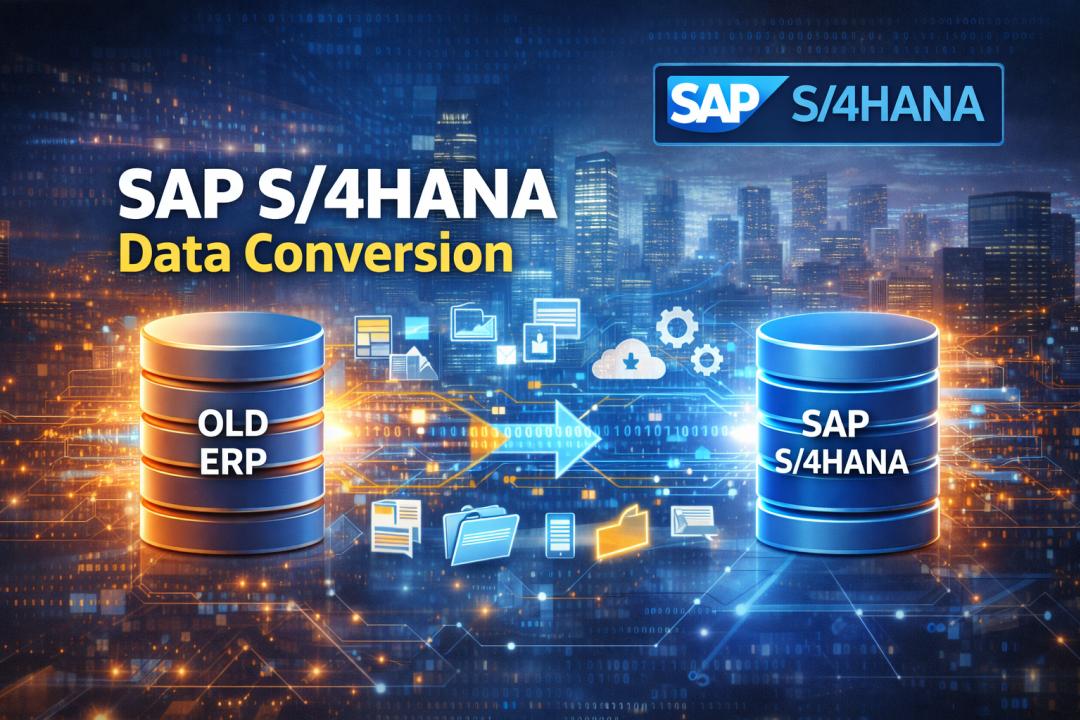
The transition to SAP S/4HANA represents a fundamental shift from legacy ERP architectures to a simplified, high-performance platform built around the in-memory database. This strategic upgrade is essential for organizations looking to integrate advanced analytics, automation, and emerging digital capabilities.
A key driver for this project is the lifecycle management of existing SAP systems. The standard maintenance phase for SAP ECC 6.0 concludes on December 31, 2027. While extended maintenance offers a temporary reprieve until 2030 at an additional cost, delaying the migration introduces significant business risk. Operating without full vendor support means a lack of essential security patches, compliance updates, and access to new innovations, creating a compelling case for a planned migration project well before the deadline.
Successfully executing this migration requires foresight and expertise to manage system complexity, custom code compatibility, and data integrity.
TYPES OF S/4HANA MIGRATION
Three Migration Approaches: Tailoring the Path to Your Business Needs
SAP provides a few core strategies for adoption, offering flexibility based on an organization's appetite for change and existing system health:
- Greenfield (Clean Slate Deployment)
What it is: Implementing a completely new S/4HANA system from scratch. Existing configurations are discarded in favor of modern SAP best practices and a simplified "clean core" architecture.
Best suited for: Businesses seeking substantial process re-engineering, those with heavily customized legacy systems, or entirely new SAP customers.
Pros and cons: Achieves maximum standardization and rapid innovation capture but demands intensive data migration efforts and significant organizational change management.
- Brownfield (In-Place Conversion)
What it is: A technical system upgrade that converts the existing ECC landscape to S/4HANA while retaining current processes, configurations, and historical data.
Best suited for: Organizations prioritizing business continuity and speed of transition, aiming for minimal disruption to existing workflows.
Pros and cons: Faster execution with less user training required, but necessitates significant effort in adapting all existing custom code to the new data structure.
- Bluefield (Selective Transition)
What it is: A hybrid methodology that uses specialized automation tools to move specific data or business units in a phased, tailored approach, allowing for consolidation of multiple systems.
Best suited for: Large, complex enterprises with multiple disparate ERP systems seeking harmonization without a full "big bang" implementation.
Pros and cons: Offers flexibility to modernize incrementally, but requires expert methodology and specific toolsets to manage the selective data scope effectively.
KEY BENEFITS OF S/4HANA MIGRATION
The Strategic Advantages of Moving to S/4HANA
The shift to S/4HANA migration offers transformational benefits that future-proof your enterprise technology stack:
- Instantaneous analytics and insights: The high-speed in-memory database allows for operational reporting directly on transactional data, eliminating time-consuming data warehousing cycles.
- Streamlined data architecture: By eliminating redundant data tables, S/4HANA simplifies the data model, drastically reducing data volume (footprint) and associated storage costs.
- Intuitive user interface (Fiori): The role-based SAP Fiori UX provides a consistent, modern, and responsive experience across desktops and mobile devices, boosting productivity.
- Flexible cloud options: S/4HANA accommodates various deployment strategies—public cloud, private cloud, or on-premise—providing agility to align with corporate IT strategy.
- Embedded smart technologies: The platform natively supports AI and machine learning capabilities, enabling intelligent automation of routine tasks and predictive capabilities not possible in ECC.
- Superior performance: Transaction processing and complex reporting speeds are dramatically improved, often by factors of 10x or more, leading to faster operational execution.
MIGRATION CHALLENGES & CONSIDERATIONS
Common Roadblocks and Mitigation Strategies
While the benefits are clear, teams must anticipate several common hurdles to ensure a smooth transition:
- Custom code conflicts: Proprietary ABAP code developed for ECC often needs revision to function in the S/4HANA environment.
Mitigation: Use automated analysis tools like the SAP Custom Code Migration App to identify and adapt necessary code before deployment.
- Data quality issues: Migrating poor-quality data only transfers existing problems to the new system.
Mitigation: Implement rigorous data governance and cleansing procedures well in advance of the data load phase.
- Complex integrations: Modern APIs replace older interface methods, requiring redesign of connections to third-party systems.
Mitigation: Perform a comprehensive mapping of all inter-system dependencies during the initial assessment phase.
- Minimizing operational downtime: The moment of cutover from the old system to the new one must be managed meticulously to avoid business halts.
Mitigation: Execute multiple mock go-lives and leverage near-zero downtime migration techniques where feasible.
- Change management: The new interface and processes require user adaptation and training.
Mitigation: Develop a strong change management program and role-specific training modules to ensure user buy-in.
- Budgeting accurately: Unforeseen complexities often lead to cost overruns.
Mitigation: Partner with experienced consultants who can provide precise assessments and manage scope creep effectively.
STEP-BY-STEP MIGRATION PROCESS
The S/4HANA Migration Journey: A Structured Roadmap
We follow a defined methodology, built on industry best practices, to guide your organization through the transformation:
Discovery & Assessment:
- Evaluate the current IT landscape and business functions.
- Run official SAP Readiness Checks to identify technical gaps.
Planning & Strategy:
- Define the optimal migration path (Greenfield, Brownfield, or Bluefield).
- Develop a comprehensive project roadmap, timeline, and resource plan.
Preparation:
- Analyze and remediate custom ABAP code.
- Execute data cleansing and validation procedures.
Execution:
- System build, configuration, and data migration/conversion activities.
- Rigorous testing cycles, including UAT (User Acceptance Testing) and integration testing.
Go-Live & Support:
- Manage the final cutover with minimal business disruption.
- Provide dedicated "hypercare" support immediately following activation to resolve immediate post-launch issues.
INDUSTRY-SPECIFIC CONSIDERATIONS
S/4HANA Migration Across Industries
The generic framework must be adapted to sector-specific requirements:
Manufacturing considerations: Optimizing production planning and inventory management for real-time visibility is paramount.
Retail & distribution specifics: Focus on seamless integration of supply chain and customer experience platforms, streamlining the order-to-cash process.
Healthcare & life sciences: Stringent focus on data security, regulatory compliance (e.g., GxP validation), and audit trails within the new system.
Oil & gas sector needs: Addressing geographically dispersed operations and complex asset management requirements using embedded predictive maintenance features.
WHY CHOOSE SCM CHAMPS
Why Enterprises Partner with SCM Champs for S/4HANA Migration
SCM Champs is your expert guide in navigating the complexity of SAP transformation. We minimize risk, manage timelines effectively, and guarantee predictable outcomes.
Our Expertise
Years of experience: Deep roots in the SAP ecosystem.
Successful migrations: [Insert Number] successful S/4HANA transformations completed.
Certified consultants: A team of highly accredited SAP S/4HANA specialists.
Our Approach
Proven methodology: A structured, de-risked approach based on SAP Activate principles.
Risk mitigation: Proactive issue identification (data quality, custom code) early in the lifecycle.
Minimal downtime guarantee: Leveraging advanced techniques to ensure business continuity during cutover.
Success Metrics
Client success stories: Brief examples (e.g., "Achieved 25% operational efficiency improvement for a global distributor").
Implementation speed: Efficient project timelines averaging 4-8 months for single-system migrations.
ROI delivered: Typical payback periods of 18–36 months post-migration.
Comprehensive Services
- Pre-migration assessment: Detailed analysis using the official SAP Readiness Check tool.
- Custom code remediation: Automated adaptation and optimization of custom ABAP objects.
- Data migration: Seamless data transition using the SAP Migration Cockpit and advanced tools.
- Testing & validation: Robust testing protocols to ensure system stability.
- Post-migration support: Dedicated hypercare and ongoing managed services.
CASE STUDY/SUCCESS STORY
Real Results: A Successful S/4HANA Transformation
Client Challenge: A large retail and distribution enterprise was struggling with performance bottlenecks in their legacy ECC system and needed to consolidate three regional systems while managing over 2,000 custom reports.
Solution Approach: SCM Champs deployed a Selective Data Transition (Bluefield) approach, consolidating the three disparate systems into one global S/4HANA instance. We automated the remediation of their custom code where possible and used a phased go-live strategy to mitigate risk and minimize business disruption.
Results Achieved:
73% reduction in total database size.
99.7% data accuracy validated post-migration.
Go-live completed 2 weeks ahead of schedule with negligible production downtime.
Reporting speeds improved by over 1500x in critical financial modules.
S/4HANA Migration FAQs:
- How long does S/4HANA migration typically take?
Project timelines usually fall between 6 and 18 months, dependent on existing system complexity, data volume, and your chosen migration strategy.
- What is the estimated cost range for migration?
Costs fluctuate widely based on the system size and customization complexity, typically ranging from hundreds of thousands of dollars into the millions. A tailored assessment can provide an accurate estimate.
- Can we migrate in phases?
Yes, phased migration is a highly effective strategy for risk management. You can migrate specific modules (e.g., Central Finance) or business units incrementally using the Bluefield approach.
- What happens to our existing customizations?
All customizations are analyzed using the SAP ATC tool. Some will be incompatible with the new data model and must be refactored or discarded entirely, while others can be adapted to align with the S/4HANA "clean core" principle.
- Do we need to migrate before 2027?
The planning phase should commence now to ensure completion before the December 31, 2027, maintenance deadline for SAP ECC 6.0. We recommend starting the project at least 18–24 months in advance.
- Cloud vs. on-premise considerations
Cloud offers agility, scalability, and simplified maintenance. On-premise provides maximum control over infrastructure and data residency. The choice depends on your specific regulatory and control requirements.
- Ready to Begin Your S/4HANA Migration Journey?
Don't wait for the impending deadline to force a rushed transition. The move to S/4HANA is a strategic opportunity to build an intelligent, agile enterprise capable of real-time decision-making. Partner with SCM Champs for a seamless, de-risked migration that delivers measurable ROI.
Contact Information:info@scmchamps.com