Generative artificial intelligence is rapidly transforming how businesses create content, automate operations, enhance customer interactions, and accelerate innovation. From AI-powered chatbots and virtual assistants to automated code generation and personalized marketing content, generative AI is reshaping enterprise ecosystems. However, implementing generative AI successfully requires more than adopting a pre-trained model. It demands strategy, governance, infrastructure readiness, and continuous optimization.
This is where generative artificial intelligence consulting services become essential. These services help organizations identify high-impact use cases, build scalable AI architectures, and deploy secure, compliant, and business-aligned solutions.
Understanding Generative Artificial Intelligence
Generative AI refers to advanced machine learning models capable of producing new content such as text, images, audio, code, and simulations. Unlike traditional AI systems that classify or predict outcomes, generative models create original outputs based on patterns learned from large datasets.
These capabilities enable businesses to automate report generation, develop AI copilots, create marketing campaigns, design product prototypes, and improve customer engagement at scale. However, without proper guidance, implementation can lead to security vulnerabilities, inconsistent outputs, and integration challenges.
Why Businesses Need Generative AI Consulting
Adopting generative AI is not simply a technical upgrade; it is a strategic transformation. Organizations often face challenges such as unclear ROI, lack of data readiness, regulatory compliance risks, and infrastructure limitations.
Generative artificial intelligence consulting services address these challenges by providing structured roadmaps and implementation frameworks. Consultants evaluate existing systems, define AI maturity levels, and align generative AI initiatives with measurable business objectives. This ensures that AI investments generate tangible value rather than experimental outcomes.
Strategic Use Case Identification
One of the first steps in consulting is identifying where generative AI can create the highest impact. Businesses may benefit from AI-powered document automation, personalized customer communication, automated product descriptions, intelligent knowledge management systems, or AI-driven analytics summaries.
Consultants analyze workflows and operational bottlenecks to determine which processes can be enhanced through generative automation. This targeted approach prevents unnecessary spending and focuses on scalable value creation.
Custom Model Development and Fine-Tuning
Off-the-shelf AI models may not always meet enterprise requirements. Consulting services often include custom model fine-tuning using proprietary datasets to ensure accuracy, contextual understanding, and brand alignment.
For example, financial institutions may require AI systems trained on regulatory terminology, while healthcare organizations need models aligned with medical standards. Customization improves reliability and reduces the risk of inaccurate outputs.
Secure and Scalable Architecture Design
Generative AI applications require robust infrastructure capable of handling large data volumes and real-time processing. Consulting services focus on building secure cloud-native architectures with proper encryption, API integrations, and access control mechanisms.
A well-designed architecture ensures that AI solutions integrate seamlessly with existing CRM, ERP, and enterprise systems. Scalability planning also prepares organizations for future growth and increased usage.
Governance, Compliance, and Responsible AI
As generative AI systems become more autonomous, governance becomes critical. Organizations must address data privacy regulations, intellectual property concerns, and potential biases in AI outputs.
Consulting services help establish ethical AI frameworks that promote transparency, fairness, and accountability. This includes implementing monitoring systems to detect model drift, bias, or performance degradation. Responsible AI governance builds trust among customers and stakeholders.
Enhancing Operational Efficiency
Generative AI consulting services enable businesses to automate repetitive tasks and streamline workflows. For instance, AI can generate meeting summaries, draft legal documents, create marketing copy, and support customer service interactions.
By reducing manual workloads, organizations improve productivity and allow employees to focus on strategic and creative tasks. The result is faster decision-making and improved operational efficiency.
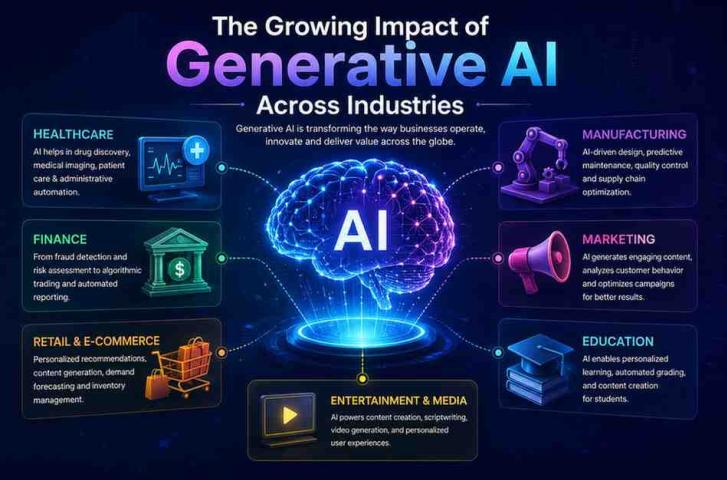
Industry Applications
Generative AI consulting is relevant across multiple industries.
In banking and financial services, AI supports automated reporting, customer communication, and fraud documentation analysis.
In retail and e-commerce, generative AI powers personalized product descriptions, targeted marketing campaigns, and intelligent recommendation systems.
Healthcare organizations use AI to generate clinical summaries and enhance patient communication platforms.
Technology companies leverage generative AI for code generation, product documentation, and AI-powered support assistants.
These applications demonstrate the versatility and transformative potential of generative AI.
Overcoming Implementation Challenges
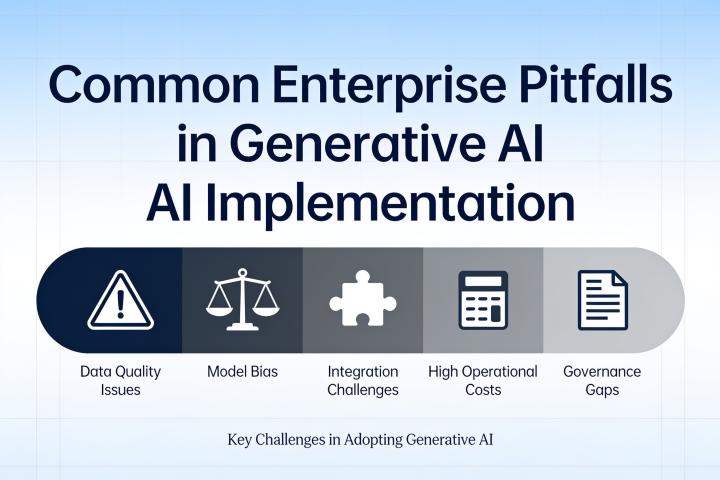
Despite its promise, generative AI adoption can present challenges such as data quality issues, integration complexity, infrastructure costs, and talent shortages.
Consulting partners mitigate these risks through phased implementation strategies, pilot testing, performance validation, and continuous optimization. A structured rollout ensures smooth adoption and measurable results.
Continuous Optimization and Scaling
Generative AI systems require ongoing monitoring and refinement. Consulting services include performance analytics, user feedback analysis, and iterative improvements to maintain accuracy and efficiency.
As business needs evolve, AI systems can be expanded to cover additional use cases, departments, or regions. Continuous optimization ensures long-term sustainability and adaptability.
Choosing the Right Consulting Partner
Successful generative AI implementation requires expertise in machine learning engineering, cloud infrastructure, cybersecurity, and enterprise integration. Partnering with experienced technology firms accelerates development and reduces operational risks.
Companies like Appinventiv support enterprises in designing and deploying scalable generative AI solutions tailored to their strategic goals. From roadmap planning to model deployment and governance frameworks, expert guidance ensures responsible and impactful AI adoption.
The Future of Generative AI in Enterprises
As generative AI models become more advanced, businesses will witness deeper automation and personalization. AI copilots will assist employees across departments, content generation will become fully contextual, and decision-support systems will provide intelligent recommendations in real time.
Organizations that invest in generative artificial intelligence consulting services today position themselves for sustainable growth, operational excellence, and competitive differentiation in the evolving digital economy.
Conclusion
Generative artificial intelligence consulting services play a pivotal role in helping businesses move from experimentation to enterprise-scale implementation. By combining strategy, technical expertise, governance, and scalability planning, these services unlock the true potential of generative AI.
Companies that approach adoption with structured consulting support can achieve innovation, efficiency, and long-term resilience—ensuring that generative AI becomes a powerful driver of transformation rather than a temporary trend.