When people talk about launching an AI influencer in the adult industry, the conversation usually revolves around income screenshots, viral reach, and overnight success stories. I see this narrative everywhere. However, when we step back and actually look at what it takes to run an AI influencer day after day, the numbers start telling a very different story.
I want to be clear from the start. This article is written purely for informational and private purposes. We are not pitching shortcuts or selling dreams. We are talking about real expenses, real effort, and real decisions that shape whether an AI influencer becomes sustainable or quietly fades away.
We often assume automation removes cost. In reality, automation shifts cost. Instead of paying photographers, models, or studio rentals, we pay for infrastructure, tools, data, and ongoing refinement. So, let’s talk honestly about where the money goes, why it goes there, and what creators should realistically expect when they decide to operate an AI influencer in an adult-focused space.
Why the initial setup feels cheap but rarely stays that way
Initially, running an AI influencer can feel affordable. We sign up for a few tools, generate visuals, write scripts, and publish content within days. That early momentum creates confidence. Still, as weeks pass, cracks begin to appear.
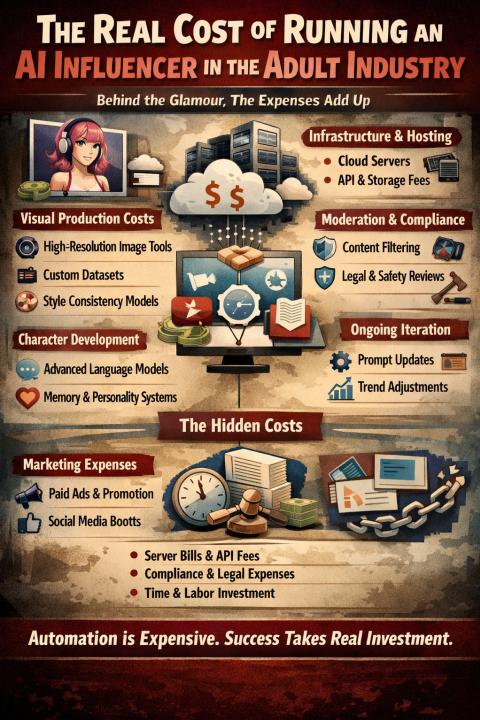
In particular, the first setup phase hides several layered costs:
- Visual generation tools with limited free credits
- Character design systems that charge for high-resolution output
- Early testing subscriptions that quickly stack up
Although the first month might cost very little, subsequent months often look very different. In comparison to human creators, we avoid travel and physical production, but we take on continuous digital expenses instead.
Clearly, the low entry point is real. However, maintaining quality is where the true financial commitment begins.
Visual production expenses that never really stop
Visuals sit at the center of every successful AI influencer. Without consistent, appealing imagery, engagement drops. Algorithms notice. Audiences move on.
Initially, we may rely on basic image generation. Eventually, we realize that repetition kills interest. As a result, we start paying for:
- Higher image resolution
- Style consistency models
- Custom datasets for unique looks
Not only do these upgrades cost more, but they also demand experimentation. Some outputs fail. Others need regeneration. So we are paying not just for success, but also for trial and error.
Specifically, adult audiences notice small flaws quickly. Hands, facial symmetry, and lighting errors reduce trust. Thus, visual refinement becomes a recurring line item rather than a one-time purchase.
Character depth costs more than just visuals
An AI influencer without personality feels hollow. We all know this. So we invest in conversational depth, emotional continuity, and contextual memory.
This is where language models and memory systems come into play. In the same way visuals need consistency, conversations need coherence. That requires:
- Advanced language model access
- Persistent memory systems
- Ongoing prompt optimization
Admittedly, basic chat feels cheap. However, once users expect personalized replies, remembered preferences, and evolving tone, the cost increases.
At this stage, many creators introduce experiences similar to an ai japanese girlfriend, where emotional tone and cultural nuance matter. This approach adds depth, but it also adds complexity and cost, especially when accuracy and long-term interaction are expected.
Infrastructure and hosting costs creators often underestimate
Behind every AI influencer, there is infrastructure. Servers handle image requests. APIs process chat responses. Storage holds thousands of generated assets.
Initially, shared hosting works. Eventually, traffic increases. Latency becomes noticeable. Users complain. Thus, creators move toward more reliable solutions.
Common infrastructure expenses include:
- Scalable cloud servers
- API usage fees per interaction
- Secure asset storage
Despite appearing invisible, these costs grow steadily. In spite of automation, usage-based pricing means success directly increases expenses. Ironically, more engagement often equals higher monthly bills.
Content moderation and safety systems are not optional
In the adult industry, safety is not a suggestion. It is mandatory. An AI influencer that produces or responds incorrectly can cause serious issues.
So, creators invest in moderation layers that filter outputs before users see them. These systems add cost, but they protect long-term viability.
Typically, this includes:
- Keyword filtering systems
- Response validation tools
- Manual review processes
Although automation handles much of this, human oversight often becomes necessary. Especially when content crosses emotional or legal boundaries, review time increases.
Thus, moderation becomes a hidden yet essential expense that many overlook at the start.
Marketing expenses rise faster than most expect
Even the most refined AI influencer fails without visibility. Organic reach helps, but it rarely sustains growth alone.
So we turn to paid promotion, collaborations, and content amplification. Marketing budgets often include:
- Paid traffic testing
- Landing page optimization
- Social platform boosts
In comparison to traditional advertising, adult-focused promotion faces restrictions. As a result, costs per click are often higher. Additionally, trial campaigns fail frequently before finding traction.
Still, visibility remains necessary. Without it, even the best system sits unnoticed.
Ongoing iteration becomes a permanent cost center
One of the biggest misconceptions is that an AI influencer runs itself after launch. That simply does not happen.
Algorithms change. Audience preferences shift. Visual trends evolve. So we iterate constantly.
This involves:
- Updating prompts
- Adjusting visual >
- Testing new interaction flows
Similarly to software products, AI personas require updates. Each update consumes time and money. Eventually, iteration becomes part of the monthly baseline rather than a growth expense.
Subscription fatigue quietly impacts profit margins
Users love subscriptions until they don’t. As competition grows, audience expectations rise. They want more content, more interaction, and more realism for the same price.
Creators respond by adding features, which raises operational cost. However, raising subscription prices risks churn.
Thus, profit margins tighten. Even though revenue appears strong on paper, expenses erode net income gradually.
Eventually, we realize that sustaining an AI influencer means balancing value perception with financial reality.
Platform dependency introduces long-term financial risk
Many creators rely on external ecosystems for distribution or monetization. These platforms offer reach but also impose rules, fees, and sudden changes.
For example, creators using platforms like Sugarlab AI benefit from built-in tools and audience access. However, reliance introduces dependency. Pricing changes, policy updates, or feature shifts directly affect cost structure.
Thus, diversification becomes necessary. But diversification itself costs money, time, and coordination.
Comparing AI personas to traditional adult creators
It’s tempting to compare an AI influencer to only fans models and conclude that AI is cheaper. In some ways, that comparison holds. There are no physical shoots or travel expenses.
However, AI replaces physical labor with digital upkeep. Instead of human fatigue, we manage computational load. Instead of creative burnout, we handle prompt drift and model decay.
In comparison to human creators, AI offers scalability. But scalability amplifies both gains and costs. The larger the audience, the higher the infrastructure and moderation expenses.
Interactive experiences increase engagement but raise costs
As audiences seek deeper interaction, many creators introduce conversational systems similar to an AI chat bot. These systems drive engagement and retention.
However, interaction-heavy models consume more compute per user. Every message costs something. Over time, high engagement directly increases monthly operating expenses.
Thus, creators must calculate whether engagement depth aligns with revenue per user. Otherwise, popularity becomes financially unsustainable.
Legal review and compliance add another layer of expense
Adult content exists within strict boundaries. Even when content is virtual, compliance still applies.
Creators often pay for:
- Legal consultations
- Terms and policy drafting
- Age verification systems
Although these costs may feel indirect, they protect the entire operation. Skipping them might save money short-term, but risks far greater losses later.
Eventually, compliance becomes part of the fixed cost of operating an AI influencer responsibly.
Time investment still has monetary value
Even though AI automates many tasks, creators still invest significant time. Time spent testing, refining, moderating, and marketing has opportunity cost.
If we value our hours honestly, labor becomes another expense. Especially for solo creators, time often becomes the most expensive input of all.
Thus, running an AI influencer is not passive. It is active management disguised as automation.
Long-term sustainability depends on financial discipline
Over time, successful creators treat their AI influencer like a business, not a novelty. They track expenses. They project usage costs. They plan for scale.
This mindset separates sustainable projects from short-lived experiments. Without financial discipline, even high revenue cannot guarantee stability.
Final thoughts on what the numbers truly show
Running an AI influencer in the adult industry is neither cheap nor effortless. It replaces traditional costs with digital ones, creative labor with technical upkeep, and physical presence with computational demand.
Although the barriers to entry are lower than ever, long-term success demands realistic budgeting and continuous attention. We must accept that automation changes the shape of work, not its value.
Eventually, those who treat cost management as seriously as content creation are the ones who last. They don’t just build an AI influencer. They operate a system designed to adapt, endure, and grow within real financial limits.