Solar energy adoption is rising fast, but confusion around on-grid and off-grid solar systems is still common. Many buyers make decisions based on half-information, sales talk, or assumptions. This guide strips it down to fundamentals—how each system works, where each fits, and what trade-offs actually matter—so you can choose with confidence.
What Is an On-Grid Solar System?
An on-grid (grid-tied) solar system is connected directly to the utility electricity grid.
How it works (step-by-step)
Solar panels generate DC power from sunlight.
A grid-tied inverter converts DC to AC.
Your home uses solar power first.
Excess electricity flows to the grid through net metering.
When solar isn’t enough (night, cloudy days), power is drawn from the grid.
Key components
Solar panels
Grid-tied inverter
Net meter
No batteries
Advantages
Lower upfront cost (no batteries)
High efficiency (less energy loss)
Eligible for government subsidies (in many regions)
Reduced electricity bills through net metering
Limitations (often misunderstood)
No power during grid failure
Even if the sun is shining, the inverter shuts down for safety.
Full dependency on grid availability
Reality check: On-grid systems are financially smart but not backup solutions.
What Is an Off-Grid Solar System?
An off-grid solar system operates independently, without any connection to the utility grid.
How it works
1.Panels generate electricity.
2.Power is used by the home in real time.
3.Excess energy charges batteries.
4.At night or during low sunlight, batteries supply power.
Key components
Solar panels
Off-grid inverter
Battery bank
Charge controller
Advantages
Complete energy independence
Works during blackouts
Ideal for remote or unreliable-grid locations
Limitations
High upfront cost (batteries are expensive)Batteries have limited lifespan (typically 5–10 years)
Energy must be carefully managed to avoid deep discharge
Reality check: Off-grid systems provide freedom, but at a cost—financial and operational.
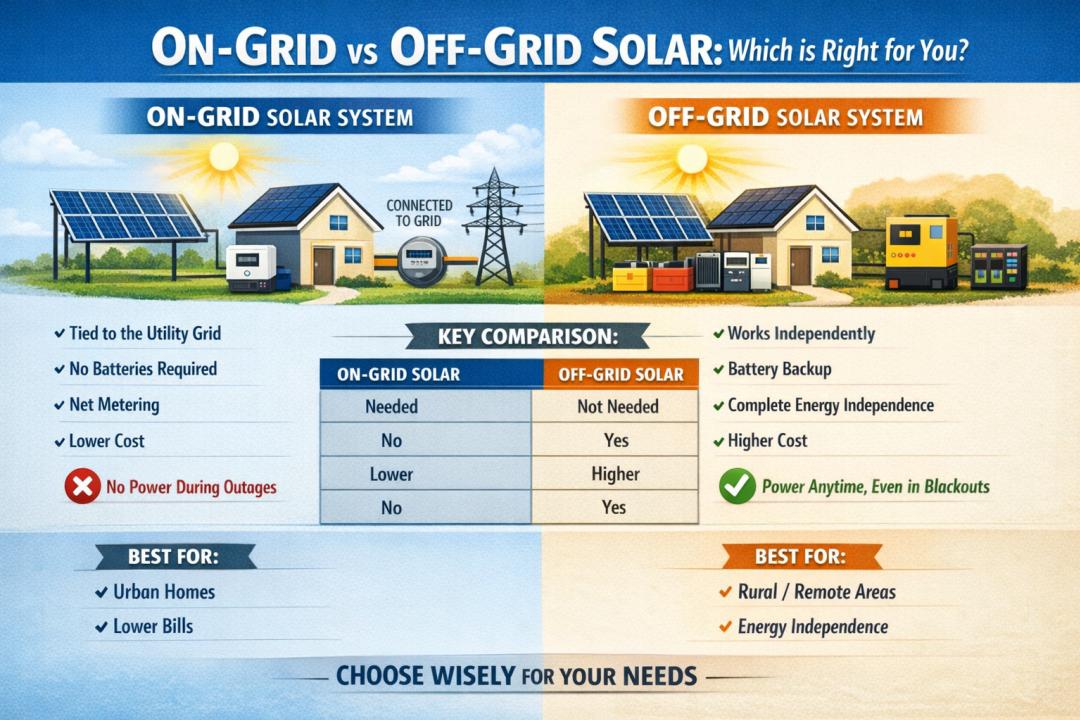
On-Grid vs Off-Grid: Side-by-Side Comparison
| Factor | On-Grid Solar | Off-Grid Solar |
|---|---|---|
| Grid connection | Required | Not required |
| Batteries | ❌ No | ✅ Yes |
| Power during outage | ❌ No | ✅ Yes |
| Initial cost | Lower | Higher |
| Maintenance | Minimal | Moderate–High |
| Best for | Urban homes | Remote / backup needs |
Which One Is Right for You?
Choose On-Grid Solar if:
You have reliable electricity supply
Your main goal is lower monthly bills
You want subsidies and faster ROI
You don’t need backup power
Choose Off-Grid Solar if:
Power cuts are frequent or severe
Grid connection is unavailable or unreliable
You value independence over cost
You can manage energy usage carefully
Common Myths—Clarified
Myth 1: On-grid solar works during power cuts
❌ False. Safety shutdown is mandatory.
Myth 2: Off-grid means unlimited power
❌ False. Battery capacity strictly limits usage.
Myth 3: Batteries are optional in off-grid systems
❌ False. Without batteries, it’s not off-grid.
Myth 4: Bigger system = always better
❌ False. System design must match usage patterns, not just load size.
A Practical Middle Path: Hybrid Systems (Brief Note)
Some homeowners opt for hybrid solar systems, combining grid connection with batteries. These offer:
Backup during outages
Lower battery size than full off-grid
Higher cost than on-grid, lower than full off-grid
Hybrid systems make sense only when outages are frequent but not constant.
Final Thoughts: Make a Decision Based on Reality, Not Marketing
Solar is not one-size-fits-all.
On-grid solar is a financial tool.
Off-grid solar is a reliability tool.
Before deciding, assess:Daily electricity consumption
Frequency and duration of power cuts
Budget for upfront cost and long-term maintenance
Local grid reliability and policy support
A well-designed system—matched to real needs—will outperform an oversized or poorly chosen one every time.