Solar energy is often marketed as “install once, enjoy free power forever.”
That statement is partially true and partially misleading.
Solar does reduce electricity bills and long-term costs—but only when homeowners understand a few critical technical and practical details before installation. This blog covers the less-discussed but essential facts that directly affect performance, savings, and lifespan of a solar system.
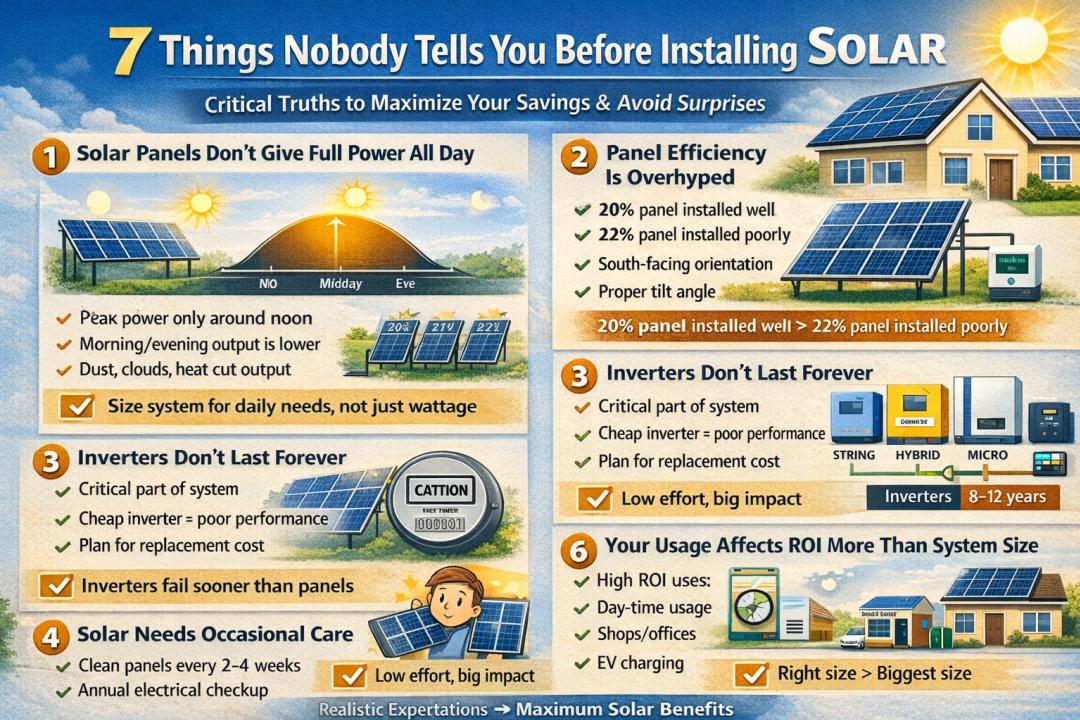
1. Solar Panels Don’t Produce the Same Power All Day
A common assumption is that solar panels generate their rated capacity continuously. This is incorrect.
Reality:
Panels produce peak output only around noon
Morning and evening generation is much lower
Cloud cover, dust, heat, and angle reduce output
2. Panel Efficiency Is Not the Most Important Factor
Many buyers obsess over panel efficiency numbers (20%, 21%, 22%).
Efficiency matters—but not as much as you think.
What matters more:
Roof orientation (south-facing is best in India)
Shadow-free installation
Inverter quality
Proper tilt angle
Installer design accuracy
A 20% efficient panel installed correctly can outperform a 22% panel installed poorly.
Truth:
Installation quality > Brand hype > Efficiency marketing.
3. Inverters Decide How Smart Your Solar System Is
Panels generate power.
Inverters decide how well you use it.
Main inverter types:
String inverter – cost-effective, common
Micro inverters – panel-level control, higher cost
Hybrid inverters – future battery-ready
Important but ignored facts:
A cheap inverter can limit panel output
Inverter failure = system downtime
Inverter lifespan is usually shorter than panels
Panels last ~25 years
Inverters last ~8–12 years
Planning tip:
Always plan for inverter replacement cost in long-term ROI.
4. Solar Needs Maintenance (But Not Much)
Another myth: “Solar is maintenance-free.”
This is false, but the maintenance is simple.
Basic maintenance:
Panel cleaning every 2–4 weeks (dust reduces output)
Annual electrical inspection
Checking inverter error logs
What happens if you ignore cleaning?
10–25% power loss is common
Long-term hotspot damage possible
Good news:
Maintenance is low effort and low cost—but skipping it reduces savings silently.
5. Net Metering Is a Policy, Not a Guarantee
Many people install solar assuming net metering is permanent.
Reality:
Net metering rules are policy-based
They can change by state or utility
Export limits may apply in future
What stays constant:
Self-consumption (using solar power directly) is always beneficial.
Design systems to use solar during daytime, not only export it.
6. Solar ROI Depends on Usage Pattern, Not Just System Size
Two homes with identical systems can have very different savings.
High ROI homes:
Daytime appliance usage
Work-from-home setups
Shops, clinics, offices
Homes with EV charging or water pumps
Lower ROI homes:
Heavy night-time usage only
Low electricity consumption
Conclusion:
Solar rewards how you use power, not just how much you install.
7. Bigger Is Not Always Better
Oversizing a system can:
Increase payback period
Cause export restrictions
Waste unused generation
Undersizing can:
Miss subsidy optimization
Limit future expansion
Correct sizing requires:
Last 12 months electricity data
Future load planning (EV, AC, appliances)
Roof availability and shadow study
Solar design is engineering, not guesswork.
Final Takeaway: Solar Works Best When Expectations Are Realistic
Solar energy is one of the smartest long-term investments—but only when decisions are made with clarity, not assumptions.
Remember:
Panels don’t fail often, designs do
Cheap installs cost more later
Knowledge saves more money than discounts