If you follow the news even a little bit, you have probably felt this already: There is no shortage of information - there is too much of it, spread across too many places.
One update appears in a major publication. Another shows up on a smaller site. The same story gets rewritten five different ways. By the time you have skimmed a few headlines, you are already behind again.
A news aggregator exists because of that exact problem.
What people usually mean when they say “news aggregator”
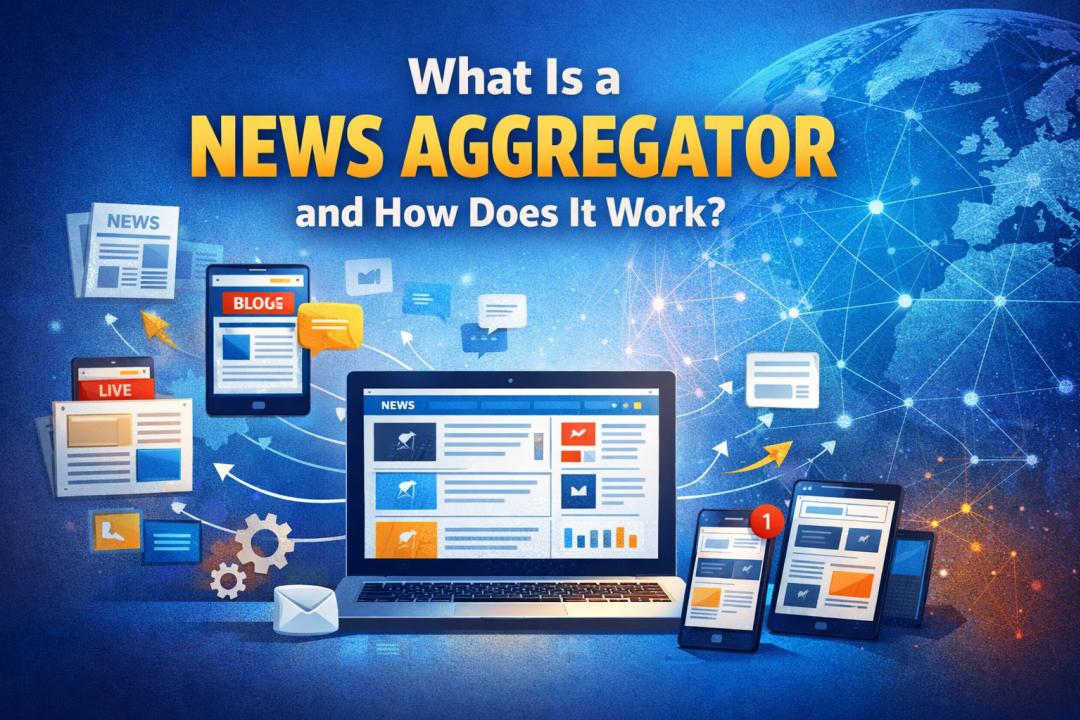
At a basic level, a news aggregator is a system that collects news from multiple sources and brings it together in one place.
That place can look very different depending on the use case. Sometimes it is a public website. Sometimes it is an internal dashboard. Sometimes it is not visible at all - it is just a backend service feeding data into alerts, analytics, or product features.
The common idea is simple: instead of checking many sources manually, you rely on one system to do that work for you.
Why news aggregation became necessary
The internet didn’t simplify news. It fragmented it.
Every publisher has its own platform, schedule, and priorities. Big stories get repeated everywhere, while smaller but important updates can slip through unnoticed. For a while, you can keep up by bookmarking sites or setting a few alerts.
Eventually, that breaks down.
Once news starts affecting decisions - product planning, investments, partnerships, or strategy - relying on manual tracking becomes risky. That’s when aggregation stops being a convenience and starts becoming infrastructure.
What actually happens behind the scenes
From the outside, news aggregation looks straightforward. Behind the scenes, it’s mostly about handling mess.
First, the system needs access to news from different sources. This can come from feeds, partnerships, or APIs, but the goal is always the same: receive news in a form that machines can process reliably.
Once the data starts coming in, the real work begins. Different sources describe the same event in different ways. Dates don’t match. Some articles have summaries, others don’t. Categories are inconsistent. A large part of aggregation is simply making everything look and behave consistently.
Then there’s duplication. When something important happens, dozens of similar articles arrive at once. Without logic to detect overlap, the feed quickly becomes noisy and hard to use.
Only after cleaning, grouping, and filtering does the output start to feel useful instead of overwhelming.
Why many teams don’t build aggregators from scratch
It is possible to build an aggregation pipeline yourself. Many teams try it at least once.
Most eventually realize that maintaining it takes more time than expected. Feeds change. Edge cases pile up. Things don’t break loudly - they break quietly, which is worse.
That’s why many products choose to rely on existing news data platforms instead of owning the entire process.
For example, some teams use Newsdata.io to access structured, real-time and historical news from a wide range of sources. The value isn’t novelty — it’s reducing ongoing maintenance and treating news like data instead of something fragile.
In real projects, reliability tends to matter more than control.
How news aggregators are actually used
Not everyone uses a news aggregator just to read headlines.
Some teams use them to monitor competitors or industries. Others rely on them for alerts when specific topics or companies appear in the news. Many products quietly use aggregated news to add context to dashboards, reports, or analytics.
In all of these cases, aggregation isn’t the product itself — it’s the layer that makes timely information usable.
What a good news aggregator really provides
A good news aggregator doesn’t try to show you everything.
It reduces noise.
It saves time.
It makes sure important updates don’t get missed.
Once that foundation is in place, people and products can focus on interpretation and action instead of collection.
Final thoughts
A news aggregator is not about consuming more news. It’s about handling information in a way that doesn’t fall apart as volume increases.
As the amount of published content keeps growing, aggregation becomes less of a nice-to-have and more of a necessity. Understanding how it works helps teams decide whether to build their own solution or rely on existing tools - and how to do it without creating more problems than it solves.