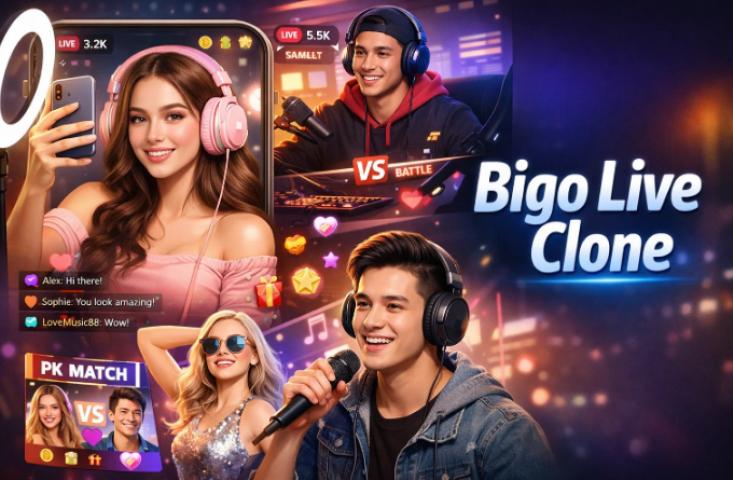

Live streaming is among the most profitable industries in the online environment. As the popularity of platforms such as Bigo Live grows, a lot of entrepreneurs and developers are thinking of developing their own Bigo Live Clone so as to take advantage of this trend. In case you are considering the development of a live streaming application, which can potentially rock the market, this guide will take you through the key steps and factors in the development of Bigo Live Clone that would potentially rocket your profits in 2026.
Why Choose to Build a Bigo Live Clone?
Before we go into the technicalities, we should first know why Bigo Live Clone apps are becoming popular. Live streaming applications have experienced a rocket-like growth due to many influences like social media trends, user-generated content and the rising demand for interactive digital entertainment.
By constructing a clone of Bigo Live, you can enter a market that is already successful. With its enormous number of users and interaction system, Bigo Live is the best example of how to develop your own live streaming platform. However, it is just that you can recreate the same kind of app with a Bigo Live Clone script, almost the same, but free. This method radically shortens both the development time and cost without compromising the basic functionalities that are anticipated by the users.
Key Features to Include in Your Bigo Live Clone
There are some essential aspects to be taken into account when creating a clone of Bigo Live, such as making sure that your application is competitive and appealing to consumers. Such characteristics not only provide a better user experience but also help to boost the possibilities of monetization. These are the key features that we would like to discuss.
1. Real-Time Live Streaming
Video streaming in real-time is the primary characteristic of any clone of the live streaming app. Your Bigo Live Clone should enable users to go live, either alone or in a group. It is important to implement a high-quality and low-latency streaming protocol, such as WebRTC or RTMP, in order to transmit high-quality video material. The application should also provide a functionality of allowing users to stream live what other users are doing.
2. Interactive Features
Bigo Live is interactive in nature, which is one of its key attractions. The user is not only able to observe the streams but also to communicate with streamers by commenting on the live stream, sending them gifts and providing virtual rewards. These features will be added to your Bigo Live Clone to make it feel more like a community and keep the users active. Think about features like:
- Live Chat and Comments: This feature will enable the user to chat with the streamers and other viewers in real time.
- Virtual Gifting: Watchers may send virtual gifts as a way of expressing their gratitude to the streamers as part of monetization efforts.
- Reactions and Emojis: The users have access to quick reactions, including hearts or thumbs-ups, when they want to show their attitude towards the stream.
3. Monetization Options
Your Bigo Live Clone must offer multiple revenue streams. These could include:
- In-App Purchases: Users can purchase virtual gifts, emojis, and other premium content.
- Subscription Models: Offer premium memberships that unlock exclusive content, ad-free viewing, or special interaction features.
- Ad Revenue: Include display ads or video ads as a means to generate revenue from both users and content creators.
4. User Profiles and Customization
Permit the user to make elaborate profiles with bio information, streaming preferences, as well as social media integrations. Such a degree of individualization will make the app more personal and assist the user in associating with other people. Add features of customization of streamers: backgrounds, filters, and special effects can be added and contribute to the visual quality of streams.
5. Moderation and Safety Features
Ensuring a safe environment is key to the success of your Bigo Live Clone. Implement moderation tools that allow both automatic and manual filtering of inappropriate content. Features like content reporting, blocking, and muting should be part of the app. Integrating AI-driven content moderation tools can also help in detecting inappropriate behavior or language in real time, ensuring that the platform remains safe for users of all ages.
Technology Stack for Building Your Bigo Live Clone
The selection of the technology stack is also essential in developing a powerful and scalable Bigo Live Clone. We are going to decompose the major technologies that you are going to require in the project.
1. Frontend Development
Your Bigo Live Clone must have a user interface (UI) that is easy to use and is appealing to the eyes. React Native or Flutter technologies may be used as great frontends to create cross-platform applications. These platforms enable you to build high-performing, responsive applications that can work well on Android and iOS platforms.
- React Native: This is an open-source model that enables the creation of native applications on mobile platforms using a single codebase. It is quick, productive, and popular in the creation of scalable applications.
- Flutter: A UI toolkit from Google for crafting natively compiled applications for mobile, web, and desktop. Flutter’s flexibility and speed make it a good choice for live streaming apps.
2. Backend Development
To support the backend, you will require an aggressive and scalable server setup to support the colossal data inbound generated by live streaming applications. Other alternatives like Node.js, Python or Ruby on Rails are fantastic to create a robust backend that can handle real-time connections and streaming solutions.
- Node.js: It is a blistering and scalable system that is perfect for processing real-time data, including the case of live video streaming. It is frequently combined with such technologies as Socket.IO to address real-time communication.
- Python/Django: Python and Django are known to be easy to learn and fast to develop. The Python framework can be used to perform backend tasks, such as user authentication, database, and logistics streaming.
3. Streaming Protocols
The selection of the appropriate streaming protocol is among the most crucial factors in developing a clone of live streaming. To make live streaming smooth, low-latency and high quality, a stable streaming protocol will be required. The two technologies that are most commonly used in the industry are RTMP (Real-Time Messaging Protocol) and WebRTC.
- RTMP: RTMP is usually employed to distribute video to such platforms as YouTube, Facebook, and Twitch. It is a stable and low-latency product.
- WebRTC: Perfect for peer-to-peer video streaming and video calls between one person. WebRTC has less latency and is highly quality-based, yet it needs greater management of infrastructure.
4. Database and Cloud Storage
You will need a stable database system in order to save user data, video media and chat records, as well as streaming metadata. User profiles, transactions, and settings of the app can be managed using MongoDB or MySQL. To store and process video, you can utilize the services of the cloud, such as Amazon Web Services (AWS) or Google Cloud Platform (GCP), to provide a scalable and affordable solution to storing video material and processing it with transcoding.
5. Security and Data Encryption
Security is paramount, particularly in terms of user information, financial operations, and video streaming on the fly. It is important to implement data security measures, such as the use of encryption like the use of the SSL/TLS encryption technology. There will also be a strong user authentication process (such as OAuth or JWT tokens) so that only those people who are authorized can access premium features or post content.
Development Process for Your Bigo Live Clone
A Bigo Live Clone can be built using a series of steps, such as planning, deployment and support after deployment. This is how the overall process of development looks.
1. Market Research and Planning
First, do serious market research before you actually start with the development process. Know your target audience, competitors and what allows apps such as Bigo Live to succeed. Establish a clear roadmap to your app and describe all the most important features and functionality you wish to include.
2. Design and Prototyping
The second step after having a proper knowledge about the market is designing of the UI/UX. An aesthetic and tidy design is a fundamental tool of attracting users. Design wireframes and prototypes in order to visualize the app user experience (UX) and flow. Figma or Sketch are useful tools in this phase.
3. Development and Testing
During this phase, the developers start to write some code and incorporate the features required. It is essential to have constant testing so that the app is performing as it should. It should focus on load testing, security testing and real-time performance testing in order to prevent problems when the app going live.
4. Deployment and Marketing
Upon the creation and testing of the app, it is time to make it available on such platforms as Google Play and Apple App Store. Marketing is significant in the success of the app; thus, come up with a detailed strategy that consists of social media campaigns, influencer marketing, and promotions.
Conclusion
Development of a Bigo Live Clone has huge potential for profit in the live streaming market that is flourishing. With such important elements as real-time streaming, interaction tools, and monetization options, you can develop an application that will be appealing to users and content creators. A well-placed technology stack and development process will have you well on the path to creating an app that will be competing with the industry leaders.
So, when you are willing to make a jump and make your Bigo Live Clone come true, now is the right moment to start. The popularity of live streaming platforms will continue to increase.