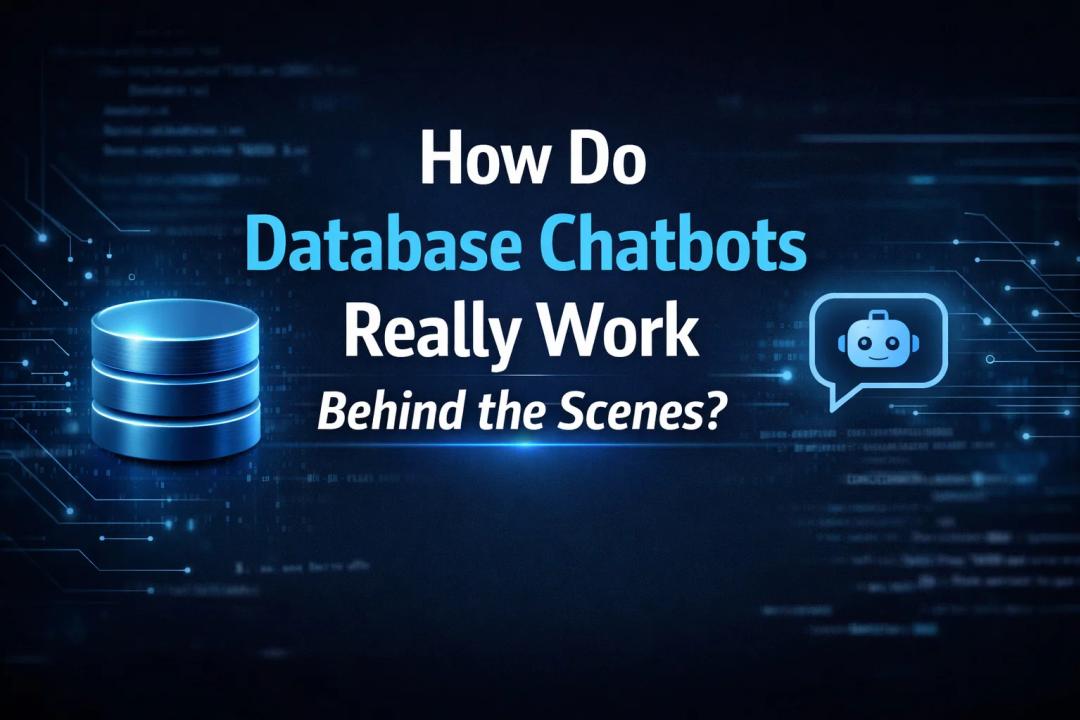
Businesses today are under constant pressure to deliver instant, accurate, and personalized responses. Traditional chatbots struggle when conversations go beyond predefined scripts. This is where database chatbots step in.
According to industry research, over 70% of customer interactions now involve data-driven queries, such as order status, account details, inventory availability, or analytics insights. Database chatbots are designed to handle exactly these scenarios—by connecting directly with structured data sources and responding in real time.
In this blog, we explain how database chatbots actually work behind the scenes, breaking down the technology, architecture, and logic that power them.
What Is a Database Chatbot? (Quick Refresher)
A database chatbot is an AI-powered conversational system that can retrieve, process, and respond using data stored in databases rather than relying only on static answers.
Instead of replying with pre-written messages, we design database chatbots to:
Understand user intent
Convert questions into database queries
Fetch live data
Deliver accurate, contextual responses
These chatbots are commonly used in customer support, internal tools, analytics dashboards, CRMs, ERPs, and SaaS platforms.
Core Components of a Database Chatbot
Behind every intelligent database chatbot, there is a well-orchestrated system of components working together.
1. User Interface
This is where users interact with the chatbot—web apps, mobile apps, dashboards, or messaging platforms.
2. Natural Language Processing (NLP) Engine
The NLP layer interprets user input, identifies intent, extracts entities, and understands context.
3. Business Logic Layer
This layer decides what action to take based on the user’s intent—whether to query a database, call an API, or apply validation rules.
4. Database or Data Source
The chatbot connects to SQL databases, NoSQL systems, CRMs, data warehouses, or third-party APIs.
5. Response Generator
Once data is retrieved, the chatbot converts raw results into a human-friendly response.
How Database Chatbots Process User Queries
Let’s break down what happens when a user types a question.
-
User submits a query
Example: “What is my last order status?” -
Intent recognition
The NLP engine identifies intent such as order tracking and extracts entities like user ID. -
Query mapping
The system maps the intent to a predefined or dynamic database query. -
Database execution
The chatbot securely executes the query on the database. -
Result processing
Retrieved data is filtered, formatted, and validated. -
Response delivery
The chatbot replies with a clear, conversational answer.
All of this happens within milliseconds.
How Database Chatbots Connect with Databases
Database chatbots can connect to different data sources depending on the use case.
SQL Databases
Used for structured data like orders, users, payments, and inventory.
NoSQL Databases
Ideal for unstructured or semi-structured data such as logs, events, and documents.
APIs and Microservices
Many chatbots interact with backend systems through APIs instead of direct database access for security and scalability.
At Triple Minds, we always implement role-based access, query validation, and encryption to ensure data safety.
Role of NLP and AI in Database Chatbots
AI is what makes database chatbots feel intelligent instead of robotic.
We use NLP models to:
Understand variations in user language
Handle incomplete or ambiguous questions
Maintain conversational context
Improve accuracy over time using training data
Advanced AI models can even generate dynamic queries, summarize data, and answer analytical questions like:
“Show last month’s sales performance”
“Which products are running low on stock?”
Real-Time Data Retrieval and Response Generation
One major advantage of database chatbots is real-time accuracy.
Instead of relying on cached answers, the chatbot:
Fetches the latest data
Applies logic rules
Formats the response dynamically
This ensures users always see up-to-date and reliable information, which is critical for business decision-making.
Common Use Cases of Database Chatbots
Database chatbots are used across industries and departments.
Customer Support
Order tracking
Account information
Subscription details
Internal Business Tools
HR data access
Sales dashboards
Performance reports
SaaS Platforms
User analytics
Feature usage data
System status updates
E-commerce & Fintech
Payment history
Refund status
Inventory availability
Benefits of Using Database Chatbots for Businesses
Implementing a database chatbot delivers measurable advantages.
Faster response times
Reduced support workload
Improved data accessibility
Better customer experience
Scalable automation
Consistent and accurate answers
For many businesses, database chatbots reduce operational costs while increasing efficiency.
Challenges in Building Database Chatbots
Despite their benefits, database chatbots come with challenges.
Handling complex queries
Ensuring data security and compliance
Managing ambiguous user inputs
Scaling performance under high traffic
Maintaining accuracy across large datasets
This is why expert architecture and AI tuning are essential.
How We Build Scalable Database Chatbots at Triple Minds
At Triple Minds, we don’t build generic chatbots—we build business-ready database chatbots.
Our approach includes:
Deep requirement analysis
Secure database architecture
AI-powered NLP models
API-first integrations
Role-based access control
Performance optimization
Ongoing training and improvements
We design every chatbot to align with business goals, data sensitivity, and long-term scalability.
Final Thoughts
Database chatbots are not just conversational tools—they are intelligent data access systems that bridge the gap between users and complex databases.
When built correctly, they transform how businesses interact with data, automate workflows, and deliver real-time insights.
If you’re planning to implement a database chatbot for your product or operations, choosing the right architecture and development partner makes all the difference.
At Triple Minds, we help businesses turn their data into smart conversations—securely, efficiently, and at scale.