Building a cryptocurrency wallet has become more accessible than ever, but that accessibility comes with a catch. The market is flooded with options, each claiming to offer the perfect solution for launching your digital asset platform. If you're researching crypto wallet development, you've likely noticed that not all solutions deliver what they promise.
Understanding the real differences between basic clone scripts and comprehensive wallet solutions can save you from costly mistakes and security headaches down the road. Let's explore what you actually need to know before making this critical decision.
What Exactly Is a Trust Wallet Clone Script?
A Trust Wallet clone script refers to pre-built software that mirrors the functionality of Trust Wallet, one of the most popular decentralized cryptocurrency wallets available today. Think of it as a template that provides the basic framework for wallet operations—storing private keys, managing multiple cryptocurrencies, and executing transactions.
The appeal is obvious. Instead of spending months or years developing wallet infrastructure from scratch, you can theoretically launch in weeks. However, the quality and capabilities of these scripts vary so dramatically that treating them as interchangeable products would be a serious mistake.
The Reality Behind Most Clone Script Offerings
When you search for crypto wallet like Trust Wallet solutions, you'll encounter providers offering remarkably similar feature lists at vastly different price points. This discrepancy isn't random—it reflects fundamental differences in code quality, security implementation, and long-term viability.
Many clone scripts on the market are essentially recycled code that's been repackaged and resold repeatedly. The original developers may have moved on years ago, leaving behind software that hasn't been updated to address new security threats or integrate emerging blockchain networks.
Code quality matters more in cryptocurrency applications than almost any other software category. A vulnerability that might cause minor inconvenience in a social media app could result in catastrophic financial losses in a wallet application. Yet basic clone scripts rarely undergo rigorous security audits or penetration testing.
Security Considerations You Can't Afford to Ignore
The cryptocurrency space has witnessed numerous high-profile hacks and exploits, many stemming from inadequate wallet security. When evaluating any Trust Wallet clone script, security architecture should be your primary concern—not an afterthought.
Generic solutions often implement basic encryption without considering the full threat landscape. They might secure data in transit but leave vulnerabilities in how private keys are stored locally. Some fail to implement proper session management, creating opportunities for unauthorized access.
A comprehensive wallet solution incorporates multiple security layers: secure enclave technology for key storage, optional hardware wallet integration, transaction signing verification, and real-time monitoring for suspicious activity patterns. These features aren't luxuries—they're necessities in an environment where users' financial assets are at stake.
Blockchain Network Support: Breadth and Depth
The cryptocurrency ecosystem has expanded far beyond Bitcoin and Ethereum. Users now hold assets across dozens of blockchain networks, from layer-one protocols like Solana and Cardano to layer-two scaling solutions like Polygon and Arbitrum.
Basic clone scripts typically support a handful of major networks, requiring significant development work to add new chains. This limitation becomes problematic as the market evolves. When a new blockchain gains popularity, your users will expect support for it—and if your wallet can't deliver, they'll migrate to one that can.
Advanced crypto wallet development approaches build blockchain integration as a modular, extensible system. Adding support for new networks becomes a matter of configuration rather than fundamental code changes. This architectural decision might seem technical, but it has direct implications for your platform's competitiveness and longevity.
User Experience Design Philosophy
Cryptocurrency wallets serve two distinct user groups with different needs. Newcomers require intuitive interfaces that abstract away technical complexity, while experienced users demand advanced features and granular control. Balancing these requirements separates exceptional wallets from merely functional ones.
Most clone scripts treat user experience as a visual design problem—applying a fresh coat of paint to the interface without addressing underlying usability issues. They replicate Trust Wallet's screens without understanding the intentional design decisions behind each element.
Thoughtful wallet solutions consider the complete user journey: onboarding new users who've never held cryptocurrency, helping them secure their recovery phrases, guiding them through their first transactions, and progressively revealing advanced features as they gain confidence. This approach requires expertise in both cryptocurrency protocols and human-computer interaction.
DeFi Integration and Web3 Functionality
The distinction between a simple cryptocurrency wallet and a comprehensive Web3 platform has become increasingly important. Users no longer just want to send and receive tokens—they want to participate in decentralized finance protocols, trade NFTs, interact with blockchain-based applications, and access emerging opportunities.
A basic crypto wallet like Trust Wallet might allow users to view token balances and make transfers. An advanced solution provides a built-in dApp browser, seamless integration with decentralized exchanges, staking interfaces for proof-of-stake networks, and the ability to interact with smart contracts directly.
These capabilities determine whether your wallet becomes a destination platform that users open daily or merely a storage solution they access occasionally. The difference has direct implications for user retention, engagement metrics, and ultimately the success of your platform.
Technical Architecture and Scalability Planning
Many entrepreneurs underestimate how quickly a successful cryptocurrency platform can grow. You might launch with modest expectations of a few hundred users, only to find yourself onboarding thousands within months if you've tapped into the right market opportunity.
Clone scripts built without scalability considerations work adequately at small scale but experience performance degradation as usage increases. Transaction processing slows down, API responses lag, and the application becomes unstable during peak usage periods. By the time these issues surface, you're in crisis mode trying to rebuild core infrastructure while managing an expanding user base.
Modern crypto wallet development utilizes cloud-native architecture that scales horizontally. Rather than upgrading to larger servers when demand increases, the system automatically distributes load across multiple instances. This approach maintains consistent performance whether you're serving 100 or 100,000 users.
Customization Capabilities and Technical Flexibility
Every cryptocurrency wallet provider claims their solution is "fully customizable," but this phrase often means very different things. Some providers allow you to change colors, logos, and text—superficial modifications that don't address functional differentiation.
Meaningful customization requires modular architecture where frontend components are decoupled from backend logic. This separation allows you to modify user interfaces, add unique features, and implement custom workflows without disrupting core wallet functionality.
Consider specific use cases: perhaps you're targeting a niche market that needs industry-specific features, or you want to implement unique tokenomics that reward users for certain behaviors. A rigid clone script forces you to work around its limitations or invest in expensive redevelopment. A flexible platform makes these modifications straightforward.
The Support and Documentation Gap
The relationship with your wallet solution provider doesn't end at purchase—it's just beginning. During implementation, you'll encounter technical questions. During customization, you'll need guidance on best practices. When issues arise, you'll need responsive support.
Many clone script vendors provide minimal documentation consisting of basic setup instructions. When you encounter problems or need to implement custom features, you're left searching developer forums or hiring expensive consultants to decipher undocumented code.
Comprehensive solutions include detailed technical documentation, integration guides, code examples, and video walkthroughs. More importantly, they provide access to developers who understand the codebase intimately and can guide you through complex implementations.
Updates, Maintenance, and Long-Term Viability
The blockchain industry evolves rapidly. New security vulnerabilities are discovered, blockchain networks upgrade their protocols, regulatory requirements change, and user expectations shift. Your wallet needs to evolve alongside these changes or risk becoming obsolete.
Basic Trust Wallet clone scripts are often sold as one-time purchases with no ongoing update commitment. The provider delivers the initial code and moves on, leaving you responsible for all future maintenance and security patches. This approach might seem economical initially, but it transfers enormous technical debt to your team.
Active development and regular updates ensure your wallet remains secure, compatible with evolving blockchain networks, and aligned with current best practices. This ongoing relationship provides long-term value that far exceeds the initial cost differential between basic and comprehensive solutions.
Compliance Features and Regulatory Readiness
Cryptocurrency regulation is evolving rapidly across jurisdictions worldwide. What's legally acceptable today might require compliance features tomorrow. Wallet providers increasingly need to implement Know Your Customer (KYC) verification, transaction monitoring, and reporting capabilities to operate in regulated markets.
Basic clone scripts rarely include compliance infrastructure, forcing you to bolt on third-party solutions later. This retrofit approach is expensive, time-consuming, and can create integration challenges that degrade user experience.
Forward-thinking crypto wallet development incorporates modular compliance features that can be activated based on your operational jurisdiction and regulatory requirements. This flexibility allows you to launch quickly in permissive environments while maintaining the ability to enable compliance features as needed for expansion into regulated markets.
Real-World Performance and Reliability
Theoretical feature lists matter less than real-world performance. A wallet can promise comprehensive blockchain support, but if transactions fail frequently, confirmation times are unreliable, or the application crashes during high network activity, users will abandon it regardless of its feature set.
Rigorous testing under various conditions—high transaction volumes, network congestion, poor connectivity scenarios—reveals how wallet solutions perform when it matters most. Basic clone scripts often lack this testing rigor, leading to frustrating user experiences when real-world conditions diverge from ideal scenarios.
Professional wallet solutions undergo extensive quality assurance, including automated testing suites, manual QA processes, beta testing with real users, and stress testing that simulates extreme conditions. This investment in quality creates reliability that builds user trust and reduces support burden.
Making an Informed Decision
Choosing a Trust Wallet clone script or comprehensive wallet solution requires evaluating factors beyond initial price. Consider the total cost of ownership including security audits, ongoing maintenance, feature additions, compliance implementations, and support resources.
Think about your timeline and technical capabilities. Do you have experienced blockchain developers who can address security vulnerabilities, add blockchain integrations, and implement custom features? Or do you need a solution that works reliably out of the box with minimal technical intervention?
Consider your long-term vision. Are you building a simple wallet for a specific niche, or do you envision expanding into a comprehensive Web3 platform? Your choice today will either enable or constrain your future growth trajectory.
Conclusion
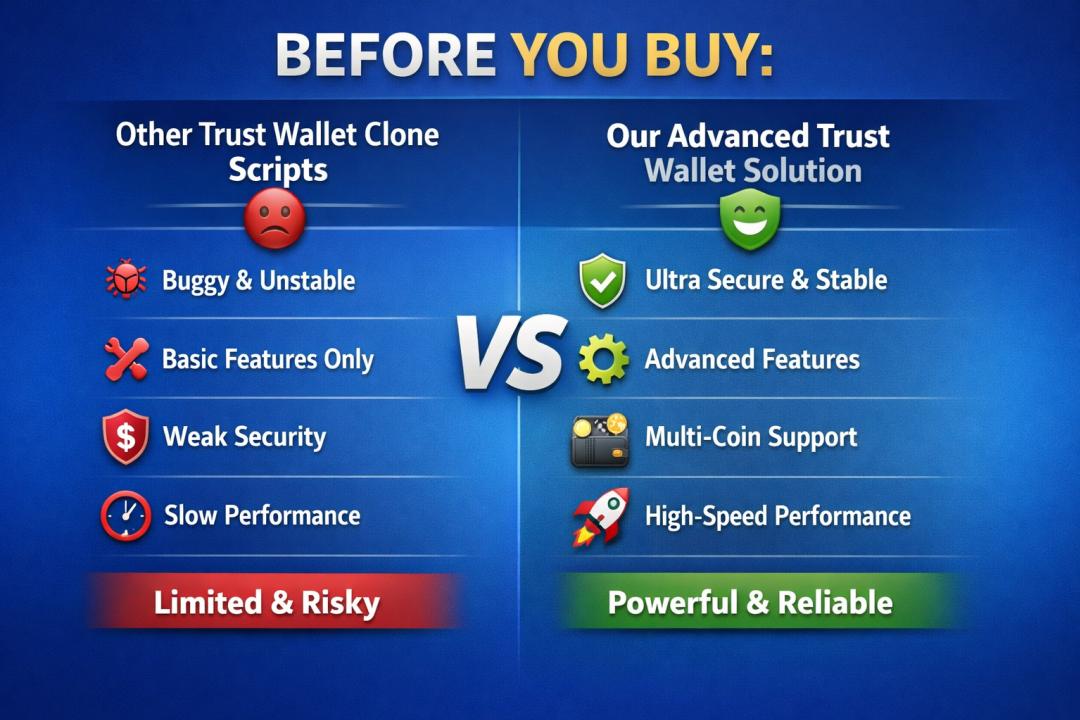
The cryptocurrency wallet market offers options ranging from bare-bones clone scripts to comprehensive platform solutions. While basic Trust Wallet clone scripts might serve specific limited use cases, they rarely provide the security, scalability, and feature completeness needed for serious commercial deployment.
Building a successful crypto wallet like Trust Wallet requires more than replicating surface-level functionality. It demands robust security architecture, thoughtful user experience design, comprehensive blockchain support, and ongoing commitment to updates and improvements.
The difference between adequate and exceptional crypto wallet development ultimately comes down to understanding that you're not just buying code—you're choosing a foundation for your business. That foundation will either support your growth and protect your users, or it will crumble under pressure, taking your reputation and business with it. Choose wisely, because in cryptocurrency, there are no second chances when it comes to security and trust.