Introduction: The Problem With "Just Automating Things"
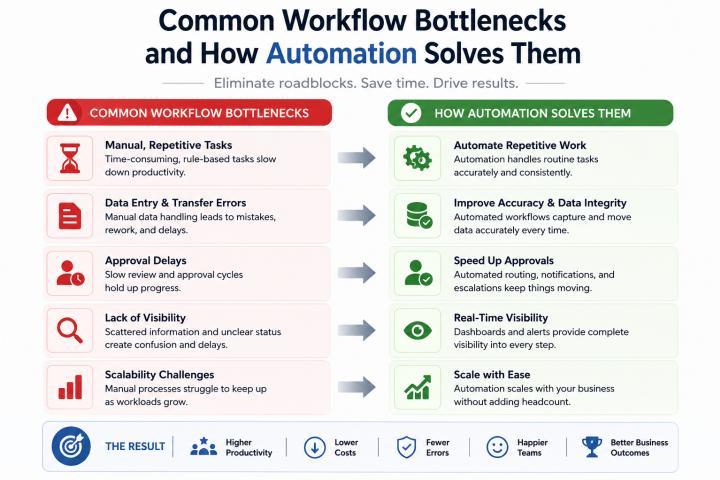
Many business owners have heard the promise of automation: save time, reduce costs, eliminate errors, scale faster. And it is a promise that automation genuinely delivers on — when implemented correctly.
But here is the challenge most businesses run into: they start automating tasks without a plan. They automate one workflow here, another there, and before long they have a patchwork of disconnected tools that create more confusion than clarity. Productivity improves in one area and deteriorates in another. The ROI never materializes the way it should.
This is precisely why working with a skilled business automation consultant is so different from simply purchasing automation software. A consultant does not just help you automate — they build a comprehensive, strategic roadmap that aligns every automation initiative with your broader business goals.
At Starters' CFO, our business process automation services are built around this philosophy. We do not hand you a tool and walk away. We design a custom automation roadmap that serves as the foundation for sustainable, scalable growth. In this article, we walk you through exactly how that roadmap gets built — step by step.
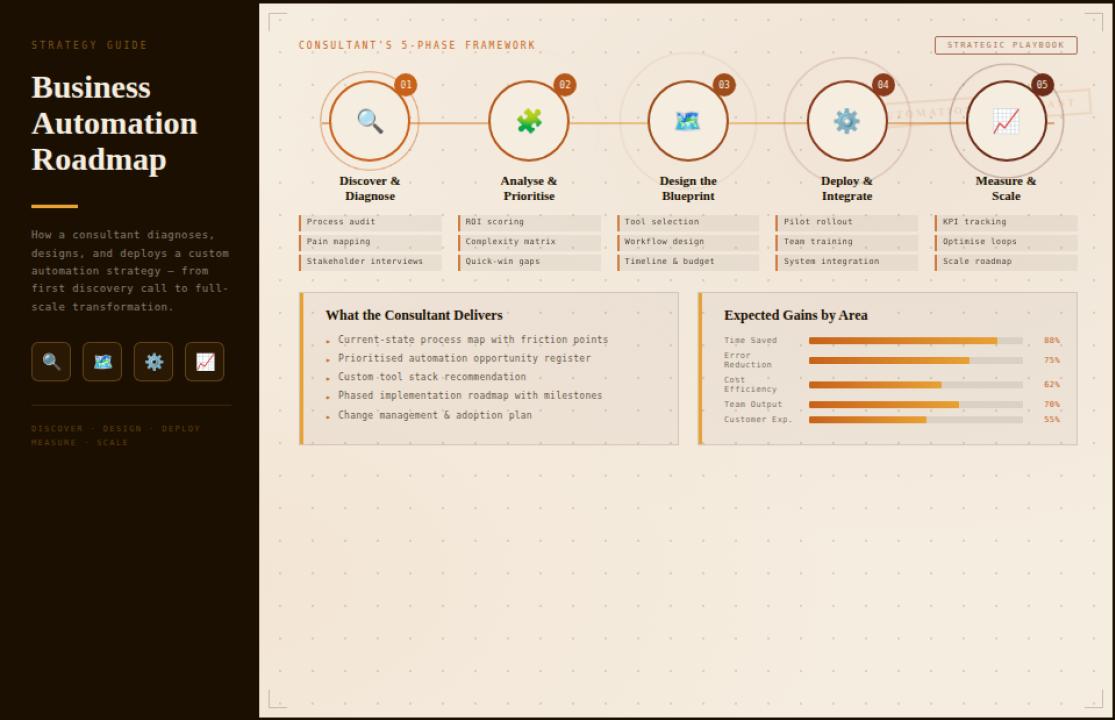
Step 1: Discovery — Understanding Your Business Before Touching a Single Tool
Every great automation roadmap begins not with technology, but with deep understanding. Before a business automation consultant recommends a single platform or workflow, they must first develop a thorough picture of how your business actually operates today.
This discovery phase typically involves:
Stakeholder Interviews
Your team members — from frontline employees to department heads — are the people living inside your current processes every day. A business process automation consultant conducts structured interviews to surface the bottlenecks, frustrations, and inefficiencies that may not be visible from the outside.
Process Mapping
Every key business process is documented in detail: who does what, when, in what sequence, using which tools. This process mapping exercise often reveals surprising redundancies — tasks being done twice, approvals that slow everything down, and handoffs between teams that cause information to fall through the cracks.
Data and Systems Audit
A thorough audit of the tools, platforms, and data sources your business currently uses is essential. Understanding what already exists — and what is working versus what is not — prevents the common mistake of automating broken processes rather than fixing them first.
Goal Alignment
Critically, the discovery phase surfaces your actual business goals: Are you trying to reduce operational costs? Scale your team without adding headcount? Improve customer response times? Increase revenue per employee? The answers to these questions will determine which automation initiatives belong at the top of the roadmap.
At Starters' CFO, our discovery process is one of the most thorough in the industry. We believe that the quality of the roadmap is entirely determined by the quality of the insight gathered at this stage.
Step 2: Process Assessment — Identifying What Should (and Should Not) Be Automated
Not every business process should be automated. One of the most valuable things an experienced business automation consultant brings to the table is the judgment to distinguish between processes that are strong candidates for automation and those that require a different approach.
The assessment phase evaluates each identified process against a set of key criteria:
Volume and Frequency
Processes that happen repeatedly — daily invoicing, weekly reports, recurring client communications — offer the highest return on automation investment. Low-frequency, one-off tasks generally do not.
Rule-Based vs. Judgment-Based
Automation excels at rule-based processes: tasks with clear inputs, defined steps, and predictable outputs. Processes that require nuanced human judgment, relationship management, or creative thinking are generally not suitable for full automation — though they may benefit from automation-assisted workflows.
Error Rate and Risk
Processes where human error is frequent or costly are strong automation candidates. Data entry, compliance reporting, and financial reconciliation, for example, are areas where automation dramatically reduces risk.
Impact on Customer or Employee Experience
Some processes, if automated poorly, can damage the customer experience or frustrate employees. A skilled business process automation consultant carefully evaluates the human impact of every proposed automation before proceeding.
The output of this assessment is a prioritized list of automation opportunities — ranked by potential impact, implementation complexity, and alignment with business goals. This list becomes the foundation of the roadmap.
Starters' CFO's assessment methodology has been refined across dozens of engagements. We use a proprietary scoring framework that ensures our clients invest in the automations that move the needle — not just the ones that are easy to build.
Step 3: Roadmap Design — Building a Phased, Strategic Automation Plan
With a clear picture of your business processes and a prioritized list of opportunities, the business automation consultant now designs the roadmap itself. This is where strategy meets execution.
A well-designed business process automation roadmap is structured in phases:
Phase 1: Quick Wins (Weeks 1–4)
The roadmap typically begins with high-impact, lower-complexity automations that can be implemented quickly. These quick wins serve two purposes: they deliver immediate, tangible value to the business, and they build organizational confidence in the automation initiative. Common quick wins include automated email follow-ups, digital form submissions that trigger workflow actions, and basic data synchronization between tools.
Phase 2: Core Process Automation (Months 2–4)
The second phase tackles the business's most critical operational workflows — the processes that drive the most revenue or consume the most resources. This typically includes CRM automation, financial reporting workflows, customer onboarding sequences, and operational task management. These are the automations that fundamentally change how the business operates day to day.
Phase 3: Integration and Intelligence (Months 4–8)
The third phase focuses on connecting the automated workflows built in previous phases into a cohesive, integrated ecosystem. This is where business process automation services move beyond individual tasks and begin to create genuinely intelligent business operations — systems where data flows seamlessly between departments, decisions are informed by real-time analytics, and exceptions are flagged automatically for human review.
Phase 4: Optimization and Scaling (Ongoing)
A great automation roadmap is never truly finished. The fourth phase builds in a continuous cycle of monitoring, optimization, and expansion. As the business grows and evolves, the automation infrastructure grows with it — adapting to new processes, incorporating new tools, and consistently identifying new opportunities for efficiency.
Step 4: Tool Selection — Choosing the Right Automation Stack for Your Business
One of the most consequential decisions in any business process automation engagement is selecting the right tools. The automation technology landscape is vast and rapidly evolving, and the wrong choices can create technical debt, integration nightmares, and user adoption challenges that undermine the entire initiative.
A business automation consultant evaluates tools against several critical dimensions:
• Compatibility with your existing technology stack
• Scalability as your business grows
• Ease of use for non-technical team members
• Total cost of ownership, including licensing, implementation, and maintenance
• Quality of vendor support and platform stability
• Data security and compliance capabilities
Depending on the nature of your operations, your automation stack might include workflow automation platforms (such as Make, Zapier, or n8n), CRM automation tools, AI-powered document processing solutions, financial automation software, or custom-built integrations via API connections.
Critically, a good business automation consultant is tool-agnostic. Their recommendations are driven by what is right for your business — not by vendor partnerships or platform familiarity. The goal is always to build the most effective, sustainable automation stack for your specific situation.
At Starters' CFO, we work across the full spectrum of business process automation tools. Our team stays current with the latest platform developments so that our clients always have access to the best available options — and the honest guidance to choose wisely among them.
Step 5: Implementation — Bringing the Roadmap to Life
With the roadmap designed and the tools selected, the business automation consultant moves into the implementation phase. This is where the strategy becomes reality.
Effective implementation of business process automation services involves several parallel workstreams:
Workflow Architecture and Build
The actual automation workflows are designed, built, and tested. This includes defining trigger conditions, mapping data flows between systems, building logic branches for exception handling, and ensuring that each automated process performs reliably under real-world conditions.
Integration Development
Where off-the-shelf connectors are insufficient, custom integrations are developed to bridge the gaps between the business's systems. This may involve API development, webhook configurations, or middleware solutions that allow disparate platforms to communicate seamlessly.
Testing and Quality Assurance
Every automation is rigorously tested before going live. This includes unit testing of individual workflow components, end-to-end testing of complete process flows, and user acceptance testing with the team members who will work alongside the automation daily.
Team Training and Change Management
Technology implementation is only half the equation. The most sophisticated automation in the world will underperform if the people working with it do not understand or trust it. A business automation consultant provides structured training and change management support to ensure smooth adoption across the organization.
This is an area where Starters' CFO consistently differentiates itself. Our implementation process is designed to bring your team along on the journey — so that when the automation goes live, your people are confident, prepared, and genuinely excited about what it enables them to do.
Step 6: Monitoring, Optimization, and Ongoing Support
The automation roadmap does not end at go-live. In many ways, go-live is just the beginning.
In the weeks and months following implementation, a business automation consultant monitors performance closely, tracking key metrics such as:
• Time saved per process relative to pre-automation benchmarks
• Error rates and exception volumes
• User adoption rates and team feedback
• Impact on downstream business metrics (revenue, customer satisfaction, operational costs)
This monitoring data feeds directly into a continuous optimization cycle. Automations are refined based on real-world performance. Edge cases that were not anticipated during design are addressed. As team members become more comfortable with the new workflows, additional automation opportunities naturally emerge — and the roadmap evolves accordingly.
The most successful business process automation engagements are ongoing partnerships, not one-time projects. Businesses that treat automation as a living, evolving capability — rather than a fixed implementation — are the ones that realize the greatest long-term value.
At Starters' CFO, we offer flexible ongoing support and optimization retainers for clients who want a trusted business automation partner for the long term. We grow with our clients — continuously identifying new opportunities, incorporating new tools, and ensuring that their automation infrastructure remains at the cutting edge.
What Makes a Great Business Automation Roadmap? Key Principles
Having walked through the six steps, it is worth stepping back to identify the principles that distinguish a truly great automation roadmap from a mediocre one.
• Business-first, technology-second: The roadmap is driven by business outcomes, not by what the technology can do. Tools serve strategy — never the other way around.
• Phased and realistic: A great roadmap respects the organization's capacity to absorb change. Ambition is tempered by pragmatism.
• People-centered: Automation is ultimately about empowering people to do their best work. The roadmap accounts for the human dimension at every stage.
• Measurable: Every automation initiative has defined success metrics. Progress is tracked and reported transparently.
• Adaptive: The roadmap is a living document. It evolves as the business evolves, as new tools emerge, and as lessons are learned from implementation.
Why Starters' CFO? Expert Business Process Automation Services Built for Growth
Starters' CFO was founded to help businesses unlock their full potential through smart, strategic use of technology. Our business automation consulting practice is built on a simple conviction: automation should make your business more human — freeing your people from repetitive, low-value tasks so they can focus on the work that truly matters.
Our approach to business process automation services is comprehensive, collaborative, and deeply personalized. We do not offer cookie-cutter solutions. Every roadmap we build is custom-designed for the specific business, industry, goals, and growth stage of the client in front of us.
When you work with Starters' CFO as your business automation consultant, you get:
• A dedicated automation consultant who becomes a true partner in your business
• A proven six-step roadmap methodology refined across diverse industries and business models
• Full-spectrum business process automation services from discovery through implementation and ongoing optimization
• Tool-agnostic recommendations driven entirely by what is right for your business
• Transparent communication and measurable outcomes at every stage of the engagement
Whether you are just beginning to explore automation or looking to elevate an existing automation stack to the next level, Starters' CFO has the expertise, the methodology, and the commitment to help you get there.
Conclusion
A business automation roadmap is not a luxury reserved for large enterprises with massive technology budgets. In today's competitive landscape, businesses of every size need a clear, strategic plan for how they will use automation to operate more efficiently, serve customers more effectively, and scale more sustainably.
But building that roadmap requires more than ambition. It requires deep business understanding, process expertise, technology knowledge, and change management skill. It requires a trusted business automation consultant who can translate the promise of automation into a concrete, achievable plan tailored specifically to your company.
That is what Starters' CFO does — every day, for businesses just like yours.