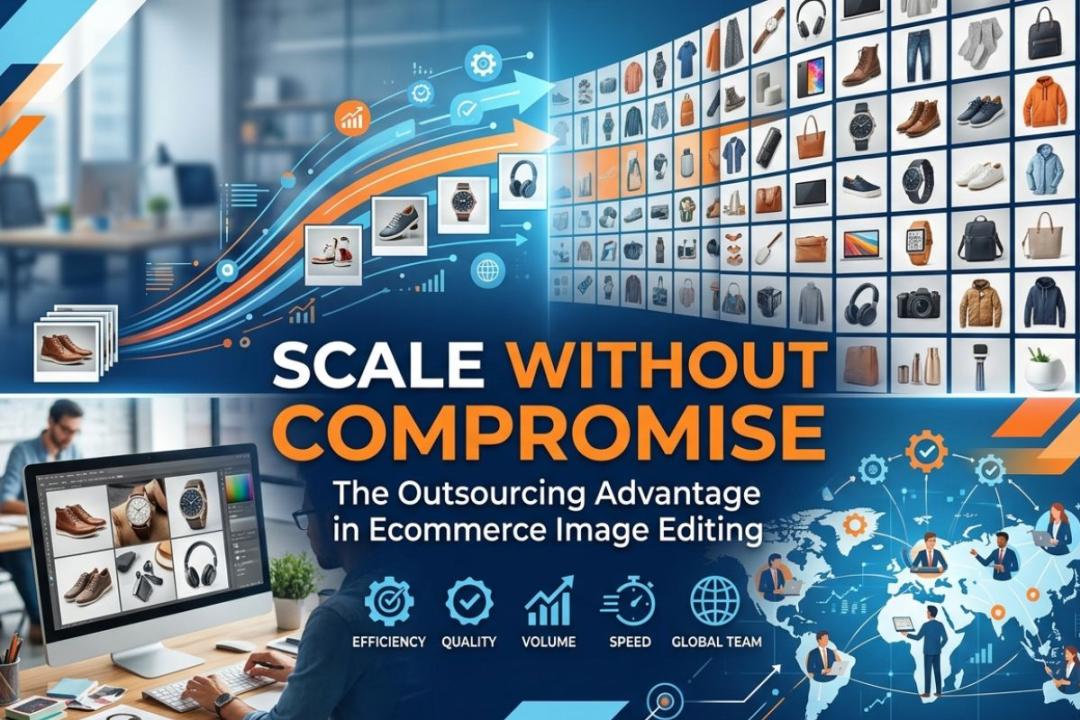
Every growing ecommerce brand hits the same wall eventually. The catalog expands, the product shoots multiply, and the internal team that handled fifty SKUs a month is suddenly staring down five hundred. Quality slips. Deadlines slide. Inconsistencies creep into product pages. What was once a manageable workflow becomes an operational liability — and it shows up directly in conversion rates.
The brands that break through this ceiling share a common decision: they stop treating image editing as an internal function and start treating it as a strategic partnership. Here's why that shift is the smartest move in ecommerce operations right now.
Why Professional Product Editing Is the Real Revenue Driver
There's a persistent misconception in ecommerce that image editing is a support function — something that happens after the real work of photography and merchandising is done. The data tells a different story. Buyers make purchase decisions in under a second, before a single word of product copy has been read, and the visual quality of a listing determines whether that decision goes in your favor or your competitor's.
This is precisely why professional product editing is the real sales booster in ecommerce — not a cosmetic add-on but a conversion mechanism. Clean edges, accurate color, controlled lighting, and consistent presentation are the visual signals that tell a shopper this brand is trustworthy, this product is worth the price, and this purchase is safe to make. Every compromise in editing quality is a quiet erosion of the trust that drives revenue.
Why Bulk Clipping Path Is the Smart Choice at Scale
For high-volume catalogs, the challenge isn't just quality — it's maintaining quality across hundreds or thousands of images simultaneously. Automated tools handle simple backgrounds adequately but consistently fail on the complex edges that high-value products demand: jewelry chains, garment textures, transparent packaging, reflective surfaces. These require human precision, and human precision at scale requires a purpose-built operation.
Understanding why bulk clipping path is the smart choice for high-volume image editing comes down to three compounding advantages. Per-image costs drop significantly at volume, eliminating the cost bloat of in-house software licenses and overtime. Turnaround times compress because specialist teams process batches in parallel rather than sequentially. And critically, visual consistency across the entire catalog is maintained at a standard that internal ad-hoc editing never achieves at the same pace.
"Consistency isn't a visual preference — it's a brand asset. When every image in a catalog looks like it belongs together, shoppers feel the professionalism before they consciously register it."
How Outsourcing Image Clipping Improves Visual Standards Across Entire Catalogs
Consistency is one of those qualities that shoppers don't consciously notice when it's present — but immediately sense when it's absent. A product grid where images vary in background tone, shadow depth, margin spacing, or color rendering looks unpolished in a way that erodes the credibility of every individual listing, regardless of how good any single image might be on its own.
This is the core operational case for outsourcing image clipping services to improve consistency at scale. Professional providers apply standardized processes — fixed margin ratios, matched background treatments, consistent shadow handling — across every image in a batch. The result isn't just cleaner individual images; it's a coherent visual identity that communicates brand-level professionalism to every shopper who visits more than one product page.
Moving From In-House Editing to Outsourcing Background Removal
Many brands resist outsourcing out of a belief that keeping editing in-house gives them control. In practice, the opposite is often true. Internal teams working under catalog volume pressure make rushed decisions — slightly inconsistent crops, background tones that don't quite match, shadows that are close but not identical. The control that felt protective becomes the source of the inconsistency problem.
The transition from in-house editing to outsourcing background removal with clipping path services frees internal creative teams to focus on the work that genuinely requires their contextual knowledge — art direction, brand evolution, campaign concepting — while the high-volume, process-driven editing work is handled by specialists who do nothing else. It's not a loss of control; it's a reallocation of creative capacity toward the decisions that actually require it.
Brands that outsource image editing don't just get better images — they get their teams back.
How Background Removal and Retouching Directly Increase Sales
The business case for professional image editing ultimately rests on revenue, not aesthetics. Two identical products, identical pricing, identical copy — the one with professionally edited imagery consistently outperforms. Background clutter increases cognitive friction. Cognitive friction delays decisions. Delayed decisions abandon carts. The chain from image quality to conversion rate is direct and measurable.
The evidence that background removal and retouching increase ecommerce sales isn't theoretical. Clean, isolated product images reduce the mental work shoppers have to do to evaluate what they're looking at. Professional retouching that accurately represents color, texture, and material detail reduces the return rates that follow when customers receive a product that doesn't match what they thought they were buying. Every dollar invested in editing quality has a downstream effect on conversion, returns, and repeat purchase rates — the three metrics that determine whether an ecommerce brand scales profitably or merely grows expensively.
The Operating Principle
What connects professional editing, bulk processing efficiency, catalog consistency, the in-house-to-outsource transition, and the direct link between image quality and sales? They are all expressions of a single operating principle: in ecommerce, visual infrastructure is business infrastructure. The brands treating it accordingly — investing in professional editing partnerships, building repeatable workflows, and measuring the revenue impact of image quality — are the ones compounding advantages that their competitors, still treating editing as an afterthought, will spend years trying to close.