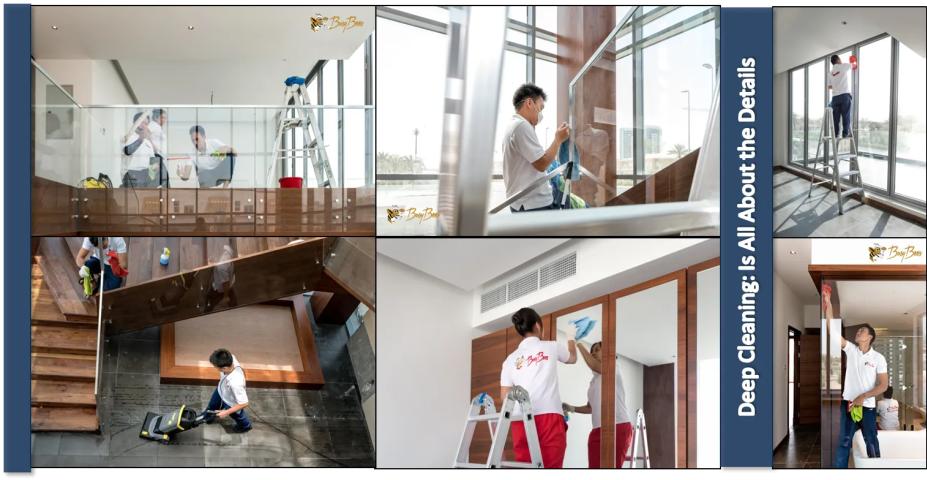
If you have moved to Dubai from Europe, Asia, or North America, you have probably noticed something strange: your home gets dirty faster here. Surfaces you cleaned just days ago are already dusty. Your bathroom taps have a white chalky residue. Your air conditioning has a faint musty smell. The tiles look dull even though you have been mopping regularly.
This is not your imagination, and it is not a problem with your cleaning habits. It is a product of Dubai's unique environment — one that makes deep cleaning not just a luxury, but a genuine health and maintenance necessity.
1. Desert Dust and Sand — The Constant Battle
Dubai sits on the edge of the Arabian Desert, one of the largest and most arid desert regions on Earth. Fine sand and dust particles are a daily reality for every home in the city. During shamal (seasonal windstorms), which can last 24–72 hours, dust concentrations in Dubai's air can reach hazardous levels — sometimes exceeding 1,000 micrograms per cubic metre, compared to the WHO's recommended limit of just 15 micrograms.
This dust does not just settle on surfaces. It infiltrates through window seals, under doors, into AC vents, between tile grout lines, inside wardrobes, and deep into carpets and upholstery. Standard weekly cleaning removes surface-level dust, but the particles that have settled into fabrics, filters, and porous surfaces require a deep clean to fully address.
Research from Dubai's Environment, Health and Safety department has consistently identified indoor airborne particulate matter (PM2.5 and PM10) as a significant health concern in UAE households — one that can trigger or worsen respiratory conditions, allergies, and asthma.
2. Limescale Buildup from Hard Water
Dubai's tap water is primarily desalinated seawater processed through reverse osmosis plants — a massive and sophisticated operation that serves the emirate's entire population of over 3.6 million people. While the water meets WHO safety standards for drinking, it has a notably high mineral content — particularly calcium and magnesium — which causes limescale.
According to studies on UAE water quality, Dubai's tap water hardness typically ranges from 200 to 500 mg/L (measured as calcium carbonate), which is classified as hard to very hard. For context, soft water is considered below 60 mg/L.
In practical terms, this means:
- Shower screens and tiles develop white or yellowish crusty deposits within weeks
- Taps and showerheads accumulate mineral scale that restricts water flow
- Washing machines and dishwashers are at higher risk of scale damage and reduced efficiency
- Kettles and coffee machines require more frequent descaling
Regular wiping cannot remove established limescale — it requires acidic cleaning agents or steam treatment, both of which are standard components of a professional deep clean.
3. Mould and Mildew from High Humidity
Dubai experiences a humidity season from May through September, when sea humidity combines with extreme temperatures (regularly exceeding 40°C) to create conditions in which mould and mildew thrive. Bathroom corners, behind toilets, under sinks, inside AC units, and in grout lines are all common mould growth areas in Dubai apartments.
According to the World Health Organization, indoor mould exposure is linked to respiratory tract symptoms, allergic reactions, and in severe cases, fungal infections — particularly in immunocompromised individuals. Studies have found that approximately 10% of the global population is allergic to common indoor mould species, and Dubai's humid summers create ideal conditions for their proliferation.
Deep cleaning — particularly steam cleaning and grout scrubbing — is the most effective non-chemical way to eliminate mould colonies in Dubai bathrooms and kitchens.
4. Air Conditioning — A Year-Round Source of Indoor Pollution
Dubai's air conditioning is not seasonal — it runs for approximately 10–11 months of the year in most homes. This extended use means that AC filters, vents, and ducts accumulate dust, pet dander, pollen, and in some cases mould spores at an accelerated rate.
A study by the American Society of Heating, Refrigerating and Air-Conditioning Engineers (ASHRAE) found that poorly maintained AC systems can decrease indoor air quality by recirculating captured pollutants — including dust mites, bacteria, and allergens — back into living spaces.
In Dubai specifically, AC filters should be cleaned every 2–3 months. Full duct cleaning is recommended annually. Both are services included in professional deep cleaning packages and are particularly important for households with children, the elderly, or anyone with respiratory conditions.
5. The Open-Door Culture and High Guest Frequency
Dubai's diverse and sociable population — over 200 nationalities live in the city — creates a culture of frequent hosting and entertaining. Family visits, dinners, and Majlis->
Frequent foot traffic from outdoor spaces — particularly from marble and tile lobbies that trap sand — transfers significant amounts of dirt and debris into homes. Without regular deep cleaning, this accumulates in carpet fibres and tile grout, creating permanent staining over time.
6. Post-Construction and New Property Handovers
Dubai is one of the most active construction markets in the world. The emirate consistently ranks among the top global cities for real estate development volume. Every year, thousands of new apartments, townhouses, and villas are handed over to buyers and tenants.
Post-construction cleaning — which involves removing cement dust, grout residue, paint splatters, plaster particles, and protective film from surfaces — is a specialised type of deep clean that is essential before moving into a new property in Dubai. This is not optional: construction particles are abrasive and can permanently damage flooring, sanitary ware, and glass if not removed promptly.
Post-construction cleaning in Dubai is priced separately from standard deep cleaning, typically at AED 1.5 to AED 3.5 per square foot, reflecting the additional labour and specialist equipment required.
7. Maintaining Property Value in a Competitive Rental Market
Dubai's rental market is one of the most competitive in the world. With annual rents averaging between AED 40,000 for a one-bedroom apartment in areas like Al Qusais and AED 150,000+ for a villa in Emirates Hills, maintaining the condition of a property is directly linked to its rental value and speed of re-letting.
Landlords who invest in regular deep cleaning between tenancies consistently command higher rents and experience shorter vacancy periods. Cleaning companies across Dubai report strong demand for tenancy deep cleans, and many property management firms now include professional cleaning as a standard part of their handover process.
Final Word
Dubai's environment is demanding on homes in ways that are genuinely unique to this city. Desert dust, hard water, year-round AC use, high humidity, and a busy social life>