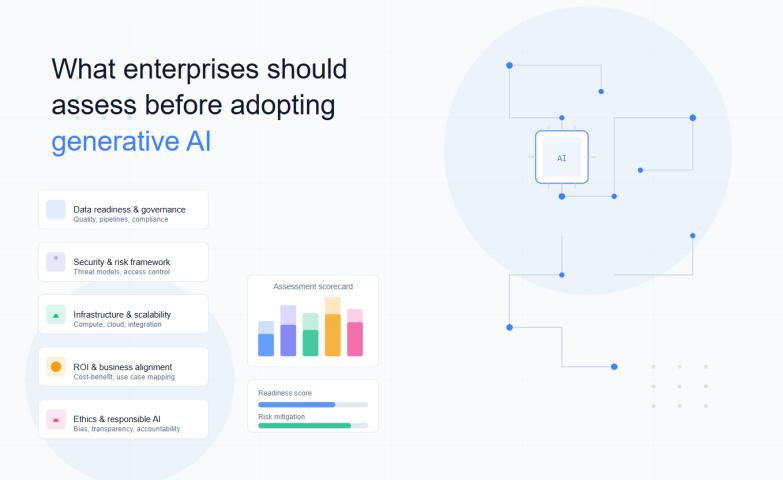
Generative AI has long since left the hype phase. It is actively implemented across industries by organizations to speed up content creation, automate complex workflows, and scale decision-making. However, in the case of enterprises and start-ups in the growth stage, it is not a matter of whether to use generative AI or not. Whether your organization is prepared to do it in a responsible and profitable way.
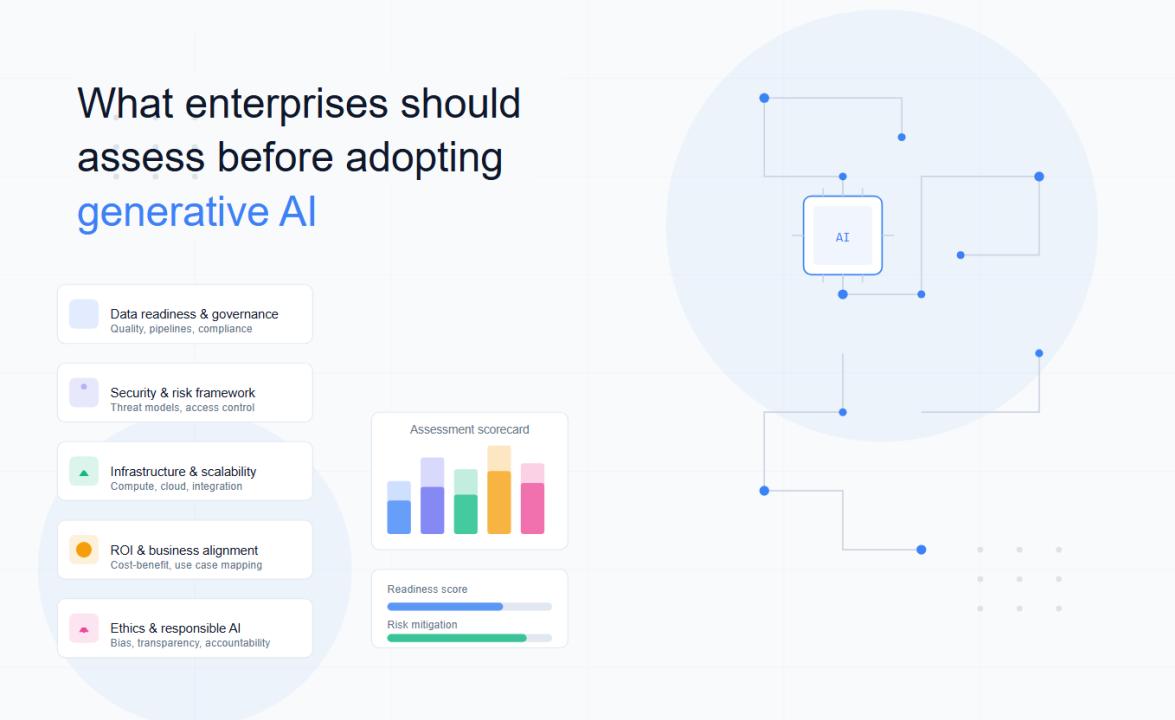
Rushing into adoption without proper groundwork is how AI investments go sideways. Before engaging a Generative AI development company or signing off on a deployment roadmap, there are critical areas every enterprise decision-maker should evaluate.
1. Clarity on Business Objectives
Generative AI is a wide range of capabilities, not a one-solution tool. It has the ability to produce text, code, artificial data, images, audio, etc. Unless you clearly define the problem that you are solving, it is easy to waste a lot of money on infrastructure that will yield not much measurable value.
Begin by the use case. Do you want to shorten the manual content production cycles? Automate customer support? Accelerate internal knowledge retrieval? Every situation needs another architecture, another training data, and another measure of success.
Organizations with the highest ROI of the Generative AI solutions usually initiate with a well-scoped pilot and proceed to test the model performance against the specified KPIs and continue to scale it up. Technology is not a strategy but a strategy is technology.
2. Data Readiness and Governance
All generative models are as good as the data they are trained on or finetuned with. Your internal data landscape should be audited honestly before you use any Generative AI Integration Services.
The right questions: Does your proprietary data exist as structured data? Does it have data silos that would restrict model training or retrieving context? Are you aware of data governance policies that provide an understanding of who owns what, and how to use it? What are your regulatory requirements related to data, specifically when you work in the fields of healthcare, finance, or legal services?
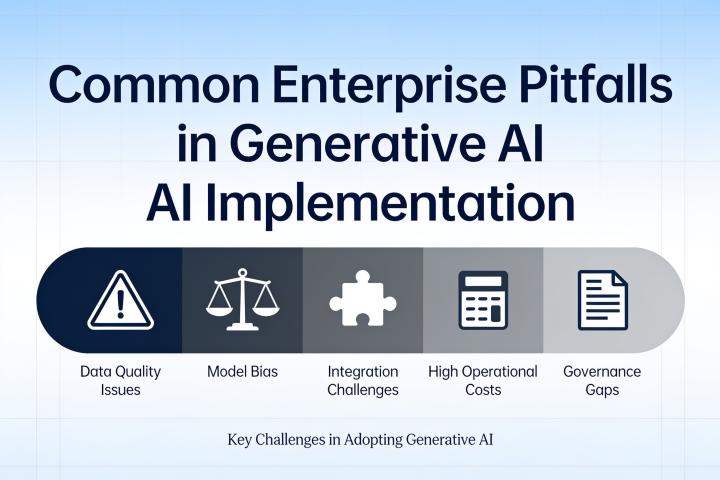
These are not hypotheticals. Poor data quality is reported as one of the most common causes of AI project failure to achieve anticipated results according to industry research. Those enterprises which invest in data infrastructure prior to model development always have shorter deployment schedules and more trustworthy results.
3. Infrastructure and Integration Complexity
Running a generative model in a demonstration setting is radically different than running it at enterprise scale in a dependable manner. Prior to going any further with Custom Generative Model Development, analyze your current technology stack.
The most important factors are the choice of cloud or on-premise deployment, compatibility with an API gateway, latency constraints of real-time applications, and the cost of inference at scale. In case the workflows are based on legacy systems, the complexity of integration increases dramatically.
An early collaboration with a competent Generative AI development firm can assist you in determining the architectural limits before they turn into blockers that are costly to manage. The appropriate partner will not only develop the model, he or she will make sure that it integrates well with your current systems. Professional Generative AI Development Services will teach you more about how this works.
4. Security, Compliance, and Risk Assessment
Generative AI presents dangers that most organizations do not anticipate when conducting the assessment phase. The output of models can be erratic. Injection on the fly attacks are increasingly becoming worrying. When there is a fine-tuning of a model using sensitive internal data, there is a possibility of unintended exposure of data when there is a lack of proper access controls.
Businesses that operate in regulated sectors are further subject to question. The implications of AI systems development, deployment, and auditing can be found in the EU AI Act, GDPR, HIPAA, and industry-specific frameworks.
Your legal, compliance and security teams should be at the table before any development commences. The reason why a risk and compliance workshop are a common part of a Generative AI Consulting engagement is in the fact that these problems are going to become expensive surprises later, unless they are addressed early on.
5. Build vs. Buy vs. Partner
Not all businesses would have to develop a foundation model. To most, it is better to fine-tune an already existing model using proprietary data at a fraction of the cost. Whether to build, purchase, or partner is based on the particular use case, your own AI knowledge, your budget, and the extent to which, the AI capability itself, will provide a competitive advantage.
When the application is very specialized, in terms of terminology, workflow logic or output format, Custom Generative Model Development is frequently the way to go. Your use case will not require domain fluency of the generic off-the-shelf models.
Conversely, when a relatively normal internal process is being assisted by generative AI, it might be adequate to add a pre-existing API and have it properly guardrailed. The team of specialists in Generative AI Integration Services can assist you in making this call basing on actual data, not on the positioning of the vendors.
6. Organizational Readiness and Change Management
Technology is not all there is. Businesses often overlook the human aspect of AI implementation. The employees should learn to use AI tools and know their limitations, as well as the workflow changes.
There is actual resistance to the use of AI, especially among groups of individuals who consider the technology a threat to their jobs. Directly tackling this by training, communicating clearly and engaging the teams in the design process can go a long way in improving the rate of adoption.
Change management strategy must not be an afterthought to your technical roadmap, but rather formulated alongside.
7. Vendor and Partner Evaluation
Not all AI development partners have the depth to support enterprise-grade deployments. Go beyond portfolio decks when considering vendors. Questions to ask include: How have they dealt with regulated industries, how they evaluate and test their models, their post-deployment support model, and what they do about model drift over time.
Companies who view Generative AI Consulting as a strategic partnership, and not a vendor transaction, always do better in the long run. The right partner evolves with your AI maturity, aiding you to iterate, enhance, and scale responsibly.
Discuss what an organized process of Generative AI Development Services would appear like to organizations at various levels of readiness.
Final Thought
Generative AI can generate real competitive advantage, but it is only possible when the adoption process is based on the sincere organizational evaluation. The businesses that have achieved tangible benefits through this technology are not necessarily the ones that were the quickest. It is them that posed the right questions prior to their commencement.
Evaluate your goals, review your information, learn about your risks, and select your collaborators. The technology will provide. The actual labor is to ensure that your organization is constructed to accept it.