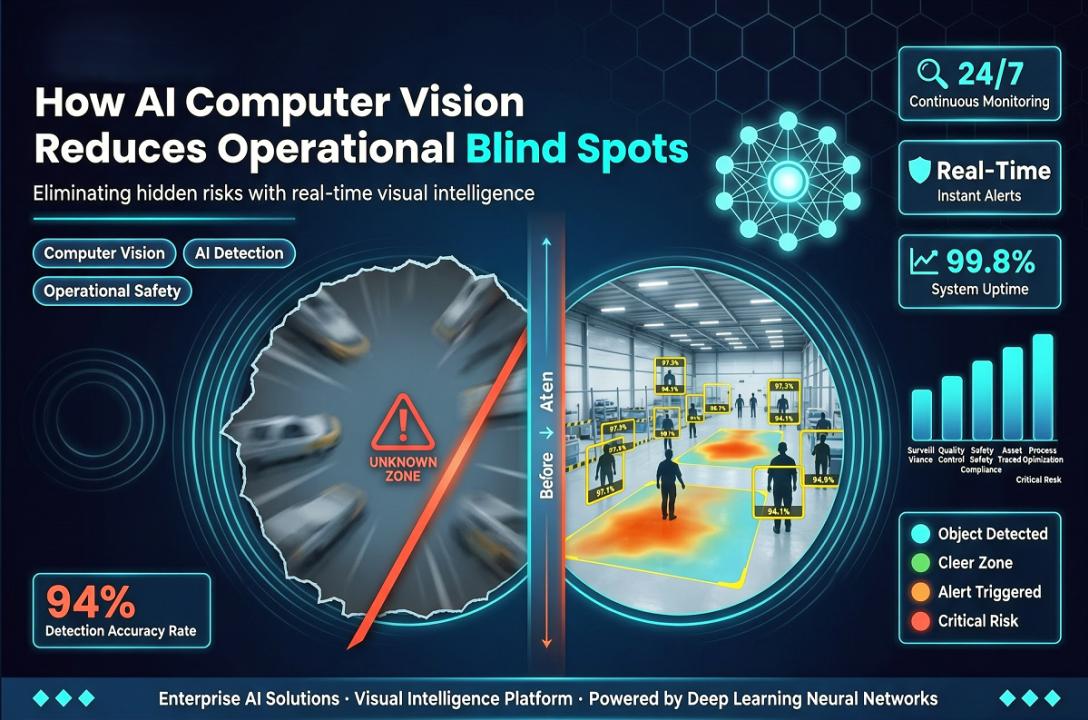
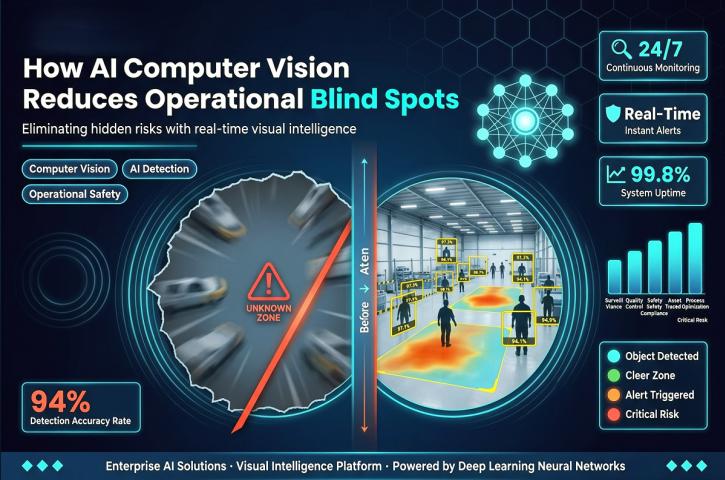
Operational blind spots are hardly noticeable until they start to impact the revenue, compliance, or customer confidence. In the case of enterprises and high-growth startups, such gaps can be found in physical processes, visual inspection, and real-time monitoring that the traditional systems fail to provide. This is where AI computer vision is put to practical use as a business resource and not an experimental technology.
Companies spending on Computer Vision Services are achieving tangible visibility in operations, making it easier to make decisions and have stricter control over risks that were not easily identified before.
Understanding Operational Blind Spots in Modern Businesses
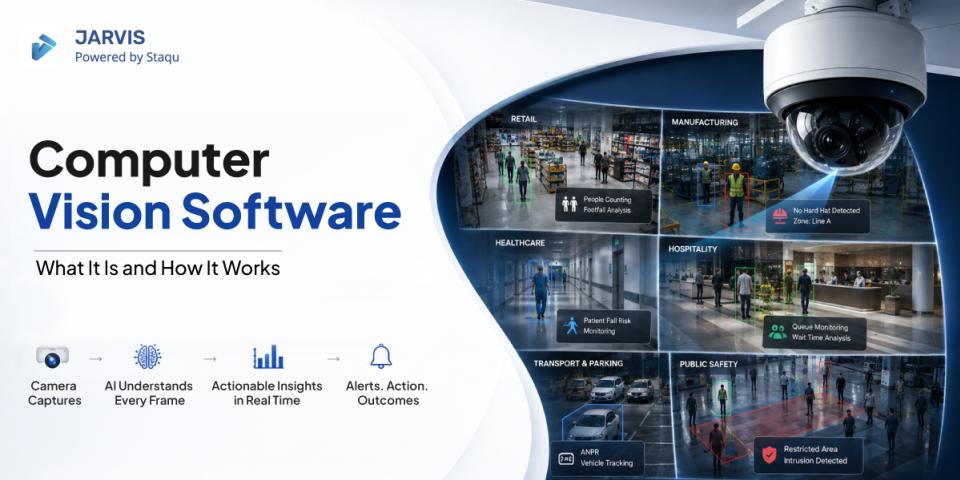
Operational blind spots are defined as the areas of business where the business cannot see what is going on or where the business cannot have accurate data. Such gaps may exist in industries:
- Producing production lines that have no defects.
- Limited customer behavior information in retail settings.
- Poor tracking accuracy of logistics operations.
- Manual image analysis-based healthcare systems.
Despite having powerful ERP and analytics solutions, the use of visual data tends to be underexplored. Enterprise data is largely unstructured with a large amount being in the form of images and video. In the absence of an effective method to process this data, organizations work with partial information.
What AI Computer Vision Actually Solves
AI computer vision enables machines to comprehend and respond to the visual information in real time. It fills the disjunction between the physical and the digital, which can be measured by systems.
A capable Computer Vision Company develops systems that can:
- Detect objects and anomalies
- Monitor movement and behavior.
- Image classification on a scale.
- Get insights out of video streams.
These capabilities reflect into actionable intelligence in operations. Rather than manual checks and delayed reporting, businesses have continuous monitoring and automated decision support.
Key Areas Where Computer Vision Eliminates Blind Spots
1. Manufacturing Quality Control
There is a likelihood of fatigue, inconsistency and human error in manual inspection processes. Any small flaws may result in major losses when they are overlooked.
AI-powered computer vision solutions enable:
- On-the-fly production line defects.
- Quality checks on an intershift basis.
- Early detection of equipment problems.
Automated visual inspection will greatly enhance the accuracy of detection and minimizes overheads of operation associated with manual processes.
2. Retail Intelligence and Loss Prevention
Retail businesses usually have problems in understanding the in-store behavior. The conventional analytics is dependent on sales information but not the patterns of customer interaction.
With AI computer vision, retailers can:
- Examine the movement of feet and customers.
- Identify suspicious activities in real-time.
- Maximize store layouts according to activity.
This kind of visibility will help minimize shrinkage and enhance conversion rates at a relatively low staffing cost.
3. Logistics and Supply Chain Visibility
There are numerous touchpoints in supply chains and visibility may fail. Lack of real-time monitoring can result in missing inventory, delays in shipments, or inefficient routing.
Machine vision solutions provide:
- Visual recognition of packages.
- Real-time warehouse monitoring
- Checking loading and unloading procedures.
Implementing computer vision software in the logistics processes will enable companies to minimize errors and enhance the accuracy of delivery.
4. Workplace Safety and Compliance
The safety compliance in large facilities cannot be achieved with the help of manual supervision. Safety monitoring blind spots may cause severe accidents.
With computer vision development services, organizations can:
- Identify safety hazards like a lack of protective equipment.
- Auto-check restricted areas.
- Identify hazardous conditions in real time
This limits the workplace risks and enhances compliance reporting.
5. Healthcare Imaging and Diagnostics
The healthcare systems produce tremendous imaging data. Manual interpretation is time consuming and can be overseen.
Advanced computer vision consulting services help healthcare providers:
- View medical images more accurately.
- Detect anomalies earlier
- Assist decision-making by supporting clinicians.
This enhances the accuracy of diagnosis improves patient outcomes and lessens the workload on specialists.
Business Impact: From Visibility to Measurable ROI
Improving blind spots is not only a matter of enhanced monitoring. It directly impacts operational efficiency and financial performance.
Enterprises adopting computer vision solutions report:
- Reduced operational errors
- Reduced inspection and monitoring costs.
- Reduced turnaround in reacting to incidents.
- Improved asset utilization
In manufacturing and logistics scenarios, businesses tend to experience significant efficiency gains upon adopting AI-based vision systems.
To decision-makers, it is valuable to be able to convert visual data into quantifiable results.
Why Enterprises Partner with a Computer Vision Company
There is much more than technology selection in implementing AI computer vision at scale. It assumes integration, customization and continuous optimization.
A specialized Computer Vision Company brings:
- Industry-specific expertise
- Scalable architecture design
- Integration with existing enterprise systems.
- Continuous model improvement
This is especially significant to businesses that work with high amounts of data and multidimensional processes.
The use of computer vision consulting services to engage with experienced providers would make sure that solutions are based on business objectives and not isolated technical deployments.
Choosing the Right Computer Vision Services
Not all implementations deliver the same results. Enterprises need to consider providers according to:
Technical Capability
Seek an excellent experience in developing computer vision code that can be used in practice.
Customization
Ready-made tools are not often used to solve specific operational problems. Custom computer vision development services are often necessary.
Scalability
Solutions should be able to scale to large volumes of data and be able to connect with enterprise solutions like ERP and cloud solutions.
ROI Focus
The provider must spell out how the solution saves money, raises efficiency or advances decision-making.
Future Outlook: Expanding Beyond Traditional Use Cases
The computer vision of AI is developing at a fast pace. Emerging capabilities include:
- Quick insights through edge-based processing.
- IoT real-time automation.
- Advanced behavioral analytics
- Autonomous decision systems
The physical operations and digital intelligence divide will continue to narrow as these technologies mature.
Companies that invest in early computer vision solutions are putting themselves in a position to be more precise and flexible in operations.
Final Thoughts
Operational blind spots are not necessarily apparent yet; their effects can be quantified. Unidentified flaws, lack of efficiency, and sluggish decisions would compound to huge losses in the long run.
The AI computer vision alters the way organizations monitor and control their activities. It allows a certain degree of control that was hardly achievable previously by transforming visual information into actionable insights.
Computer Vision Services are no longer the experiment of the future of enterprises and fast-growing startups. It is a sensible move towards establishing more open, effective and sustainable operations.