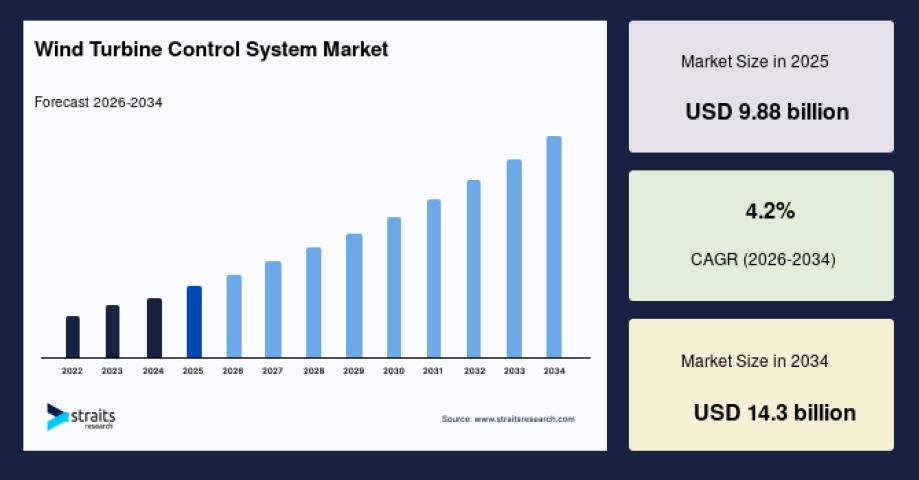
The global Wind Turbine Control System Market is witnessing steady growth, driven by increasing investments in renewable energy, advancements in wind power technologies, and the growing need for efficient energy management systems. According to the latest report by Straits Research, the market was valued at USD 9.48 billion in 2024 and is projected to grow from USD 9.88 billion in 2025 to USD 13.73 billion by 2033, expanding at a compound annual growth rate (CAGR) of 4.2% during the forecast period (2025–2033).
Wind turbine control systems play a critical role in optimizing the performance, safety, and efficiency of wind turbines. These systems regulate turbine operations, including blade pitch, rotor speed, and power output, ensuring maximum energy generation under varying wind conditions. The increasing adoption of wind energy as a sustainable power source is significantly contributing to market expansion.
Market Dynamics
Growing Adoption of Renewable Energy and Wind Power
The increasing global focus on reducing carbon emissions and transitioning to renewable energy sources is a major driver of the wind turbine control system market. Governments and organizations are investing heavily in wind energy projects to meet sustainability goals and reduce dependence on fossil fuels.
Wind turbine control systems are essential for maximizing energy output and ensuring the safe operation of turbines. The expansion of onshore and offshore wind farms is further boosting demand for advanced control systems.
Advancements in Automation and Digital Technologies
Technological advancements in automation, sensors, and digital control systems are enhancing the efficiency and reliability of wind turbines. Modern control systems utilize advanced algorithms, real-time monitoring, and predictive maintenance to optimize performance.
Additionally, the integration of Internet of Things (IoT) and data analytics is enabling remote monitoring and control of wind turbines. These technologies help reduce downtime, improve maintenance efficiency, and increase overall energy production.
Download Free Sample: https://straitsresearch.com/report/wind-turbine-control-system-market/request-sample
Market Segmentation
The wind turbine control system market is segmented based on various parameters, categorized under segmentation code 10122. These segments include system types, components, and applications, enabling manufacturers to cater to diverse industry requirements.
Key segments include pitch control systems, yaw control systems, and supervisory control and data acquisition (SCADA) systems. Among these, pitch control systems hold a significant share due to their critical role in regulating turbine blade angles and optimizing energy generation.
Regional Analysis
Europe holds a dominant share of the global wind turbine control system market, driven by strong government support for renewable energy, extensive wind energy installations, and technological advancements.
North America is also a key market, supported by increasing investments in renewable energy infrastructure and growing adoption of wind power projects.
Asia-Pacific is expected to witness significant growth during the forecast period due to rapid industrialization, increasing energy demand, and expanding wind energy capacity in countries such as China, India, and Japan.
Latin America and the Middle East and Africa are emerging markets, driven by growing interest in renewable energy and improving energy infrastructure.
Competitive Landscape
The global wind turbine control system market is highly competitive, with key players focusing on innovation, technological advancements, and strategic collaborations to strengthen their market presence. Prominent companies operating in the market include:
General Electric
Orbital A/S
DEIF A/S
Siemens
OTT Hydromet GmbH
ABB Limited
Emerson Electric Co.
Moog Inc.
OAT GmbH
Leading Edge Turbines Ltd
SgurrControl
Zhejiang Sandi Electric Co., Ltd
Mita-Teknik
Rockwell Automation, Inc.
Viking Wind ApS
These companies are investing in advanced control technologies, digital solutions, and automation systems to enhance turbine performance and reliability. Strategic partnerships and product innovations are key strategies adopted by market players.
Key Trends and Opportunities
The increasing adoption of smart wind turbines and digital control systems is a major trend shaping the market. These systems enable real-time monitoring, predictive maintenance, and improved operational efficiency.
Additionally, the growing development of offshore wind farms is creating new opportunities for advanced control systems. Offshore installations require highly reliable and efficient control mechanisms to operate under challenging environmental conditions.
Another significant opportunity lies in the integration of artificial intelligence and machine learning in control systems, enabling more accurate performance optimization and fault detection.
Conclusion
The global wind turbine control system market is poised for steady growth, driven by increasing adoption of renewable energy, technological advancements, and expanding wind power capacity. With a projected market size of USD 13.73 billion by 2033 and a CAGR of 4.2%, the market offers significant opportunities for innovation and development.
As the world continues to transition toward sustainable energy solutions, the demand for efficient and reliable wind turbine control systems is expected to rise, supporting long-term market growth.