Market Overview:
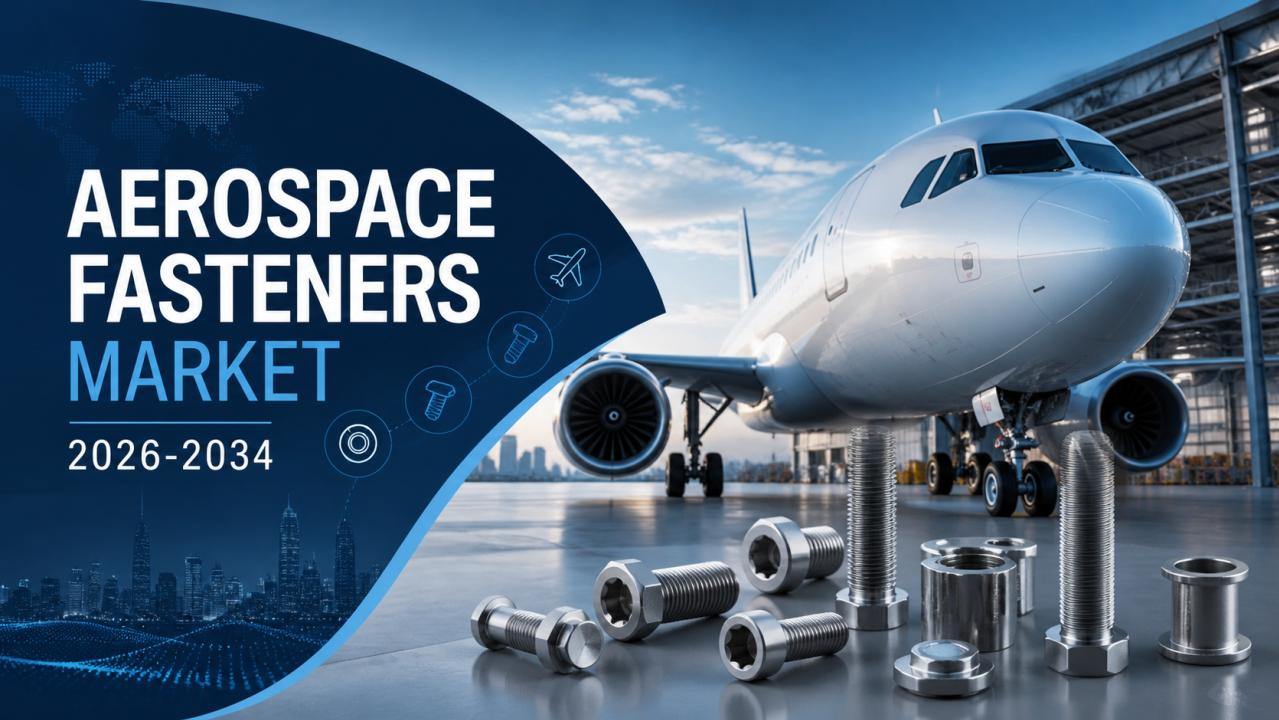
According to IMARC Group's latest research publication, "Aerospace Fasteners Market: Global Industry Trends, Share, Size, Growth, Opportunity and Forecast 2026-2034", The global aerospace fasteners market reached USD 7.8 Billion in 2025, projected to reach USD 12.0 Billion by 2034 at a 4.70% CAGR 2026-2034
This detailed analysis primarily encompasses industry size, business trends, market share, key growth factors, and regional forecasts. The report offers a comprehensive overview and integrates research findings, market assessments, and data from different sources. It also includes pivotal market dynamics like drivers and challenges, while also highlighting growth opportunities, financial insights, technological improvements, emerging trends, and innovations. Besides this, the report provides regional market evaluation, along with a competitive landscape analysis.
How AI is Reshaping the Future of the Aerospace Fasteners Market
- AI-powered robotic fastening systems are transforming aircraft assembly lines, reducing installation errors by up to 30% and significantly improving structural precision across fuselage and wing production for major OEMs such as Boeing and Airbus.
- Government defense agencies, including the U.S. Department of Defense, are integrating AI-driven quality inspection tools to evaluate high-performance titanium fasteners in real time, ensuring compliance with stringent NAS, SAE AS9100, and MIL-SPEC certification standards.
- Companies like Howmet Aerospace and LISI Aerospace use AI-enabled predictive maintenance platforms to forecast fastener wear with more than 95% accuracy, reducing surplus inventory while ensuring on-time availability across critical MRO operations.
- AI-assisted additive manufacturing is enabling rapid prototyping and customized fastener designs for next-generation aircraft structures, cutting development cycles by up to 40% for composite-compatible titanium and superalloy components.
- Smart manufacturing lines powered by AI analytics, such as LISI Aerospace's facility at its Rugby plant in collaboration with the University of Sheffield Advanced Manufacturing Research Centre, are reinventing production methods and boosting competitiveness in a high-precision, high-compliance market.
Grab a sample PDF of this report: https://www.imarcgroup.com/aerospace-fasteners-market/requestsample
Key Trends in the Aerospace Fasteners Market
- Surge in Lightweight Titanium and Composite-Compatible Fasteners: The shift toward fuel-efficient aircraft designs is driving aggressive adoption of titanium fasteners, which offer an exceptional strength-to-weight ratio and full chemical compatibility with carbon fiber composites. New-generation platforms such as the Boeing 787 and Airbus A350 rely heavily on titanium to reduce structural stress, making it the dominant material choice across aerostructure assembly globally.
- Automation and Robotics in Fastener Assembly: Manufacturing processes for fastener assembly are increasingly automated and assisted by robotics, advancing accuracy and productivity across aerospace production. In February 2025, TriMas Corporation and Airbus signed a multi-year worldwide deal specifically for robotic-assembly-ready fasteners covering the A320, A350, and A220 programs, underscoring how automation is now a contractual requirement rather than an optional upgrade.
- Rising Defense Budgets Driving Military Fastener Demand: Escalating geopolitical tensions globally are accelerating government spending on military aircraft modernization. In June 2025, the U.S. Department of Defense awarded IperionX Limited a USD 99 million contract to produce titanium components, including high-performance fasteners, directly supporting domestic titanium production for defense applications. The U.S. Aerospace and Defense sector generated USD 443 billion in revenue in 2024, reflecting 5.4% growth versus the prior year.
- IoT-Enabled Smart Fasteners for Real-Time Monitoring: The demand for fasteners integrated with Internet of Things (IoT) sensors for real-time structural health monitoring is gaining strong traction, particularly in commercial aviation where predictive maintenance is a safety and cost priority. This trend is shortening unscheduled maintenance windows and reducing aircraft-on-ground time across major airline fleets worldwide.
- Expansion of Space Exploration and Satellite Launch Programs: Burgeoning investment in space exploration and satellite launches is creating a new, high-value demand channel for precision aerospace fasteners. The global space economy is on a trajectory to reach USD 1.8 trillion by 2035, opening sustained opportunities for manufacturers of high-performance fastening systems engineered to withstand the extreme thermal and mechanical conditions of launch and orbital operations.
Growth Factors in the Aerospace Fasteners Market
- Burgeoning Commercial Aviation Demand and Fleet Expansion: Rising global passenger traffic is compelling airlines to expand and modernize fleets at record pace. In 2024, total full-year air traffic rose 10.4% compared to 2023, as reported by IATA. Airbus recorded a backlog of 8,658 aircraft with 878 gross commercial orders in 2024, and in July 2025, AirAsia Berhad signed a deal with Airbus worth USD 12.25 billion for 50 A321XLR jets, each requiring millions of fasteners across fuselage, wings, engines, and interior structures.
- Technological Advancements in Fastener Materials and Coatings: Manufacturers are developing advanced surface treatments, including zinc-nickel alloy and chromate conversion coatings, to replace cadmium plating as environmental regulations phase it out. These next-generation coatings deliver superior corrosion resistance in high-stress aviation environments while meeting stringent regulatory compliance, giving manufacturers a competitive advantage in both commercial and defense supply chains.
- Growing MRO Services Sector: The global maintenance, repair, and overhaul market is on track to reach USD 119 billion, lifting recurring consumption of standard fastener parts and driving digital inventory strategies across major aviation hubs. India exemplifies this momentum, with MRO spending expected to quadruple as domestic carriers expand fleets and government incentives support the opening of major repair stations under the Production-Linked Incentive scheme.
- Strategic Partnerships and Supply Chain Integration: Major OEMs are increasingly consolidating supply chains through long-term fastener contracts to ensure reliability and quality. Boeing's USD 4.7 billion acquisition of Spirit AeroSystems highlights the industry imperative to bring critical structures and fastening sub-tiers under tighter OEM control. Boeing alone sources over USD 1.25 billion annually from Indian suppliers, reinforcing the regional depth of the aerospace fasteners supply ecosystem.
- 3D Printing and Additive Manufacturing Adoption: The integration of three-dimensional printing technologies into fastener production is enabling customized designs, rapid prototyping, and cost-effective small-batch manufacturing. This is particularly significant for defense and space applications where bespoke, mission-specific fastening solutions are required at shorter lead times and with tighter dimensional tolerances than conventional manufacturing allows.
Leading Companies Operating in the Global Aerospace Fasteners Industry:
- Arconic Fastening Systems and Rings
- B&B Specialties Inc.
- LISI Aerospace
- 3V Fasteners Company
- National Aerospace Fasteners Corporation
- TriMas Corporation
- Wesco Aircraft Holdings
- CDP Fastener Group
- TFI Aerospace Corporation
- Stanley Engineered Fastening
- Howmet Aerospace Inc.
- Precision Castparts Corp.
Aerospace Fasteners Market Report Segmentation:
Breakup By Product Type:
- Rivets
- Screws
- Nuts and Bolts
- Washers
- Others
Rivets account for the majority of shares owing to their critical role in joining structural components of aircraft, ensuring structural integrity and safety during flight, along with rising demand for lightweight and durable fastening solutions across fuselage, wing, and interior assembly applications.
Breakup By Material Type:
- Aluminium
- Alloy Steel
- Titanium
- Others
Titanium accounts for the majority of shares on account of its exceptional strength-to-weight ratio, corrosion resistance, and full chemical compatibility with carbon fiber composites, making it the preferred material for critical aerostructure components in next-generation commercial and military aircraft.
Breakup By Application:
- Interior
- Control Surfaces
- Fuselage
Fuselage accounts for the majority of shares owing to the intensive use of advanced lightweight materials such as carbon fiber composites and aluminum-lithium alloys in aircraft body construction, requiring high volumes of precision fasteners to maintain structural integrity across the entire airframe lifecycle.
Breakup By Aircraft Type:
- Narrow Body Aircraft
- Wide Body Aircraft
- Very Large Aircraft
- Fighter Jet
- Others
Narrow body aircraft account for the majority of shares, driven by the rapid fleet expansion of low-cost carriers in emerging markets across Asia Pacific and the Middle East and Africa, alongside record order backlogs at Boeing and Airbus for single-aisle platforms including the A320 and 737 MAX families.
Breakup By End-Use Sector:
- Commercial
- Defense
- Others
Commercial aviation dominates the end-use sector owing to sustained growth in global passenger traffic, rising fleet modernization programs, and the structural demand for millions of fasteners per aircraft across assembly and MRO operations. Defense is the fastest-growing end-use segment, propelled by surging military aircraft procurement budgets and multi-year government contracts for high-performance titanium and superalloy fastening systems.
Breakup By Region:
- North America (United States, Canada)
- Asia Pacific (China, Japan, India, South Korea, Australia, Indonesia, Others)
- Europe (Germany, France, United Kingdom, Italy, Spain, Russia, Others)
- Latin America (Brazil, Mexico, Others)
- Middle East and Africa
North America enjoys the leading position owing to the presence of well-established aerospace and defense industry anchors such as Boeing and Lockheed Martin, substantial government investment in defense and space exploration, and a wide, deeply integrated supply chain network. The U.S. Aerospace and Defense sector generated USD 443 billion in 2024, reinforcing the region's structural dominance. Asia Pacific is the fastest-growing region, fueled by expanding aviation infrastructure in China and India, burgeoning aerospace manufacturing capabilities, and rising passenger volumes driving aggressive fleet expansion across low-cost carriers.
Recent News and Developments in the Aerospace Fasteners Market
- June 2025: The U.S. Department of Defense awarded IperionX Limited a USD 99 million contract to produce titanium components, including high-performance aerospace fasteners, supporting domestic titanium supply chain resilience and defense manufacturing capacity.
- July 2025: AirAsia Berhad, fully owned by Capital A Berhad, entered a USD 12.25 billion deal with Airbus for 50 A321XLR jets and rights for 20 additional aircraft, significantly expanding fastener demand across the Asia Pacific narrow-body aircraft assembly pipeline.
- April 2025: NAFCO officially inaugurated its new manufacturing facility in Seremban, Negeri Sembilan, Malaysia, featuring 3,500 sq m of advanced manufacturing space as part of a USD 40 million, 10-year investment commitment to expanding aerospace fastener production capacity in the Asia Pacific region.
- February 2025: TriMas Corporation announced that its Allfast Fastening Systems, Monogram Aerospace Fasteners, and Mac Fasteners brands were awarded a multi-year global contract with Airbus, expanding the company's existing contract scope across all fastener business units and strengthening its position throughout the global Airbus supply chain.
- September 2024: LISI Aerospace successfully installed a smart manufacturing line at its Rugby plant in collaboration with the University of Sheffield Advanced Manufacturing Research Centre, enhancing productivity and reinforcing LISI's competitive position in precision aerospace fastener production.
- July 2024: Howmet Aerospace announced a USD 27.9 million expansion of its operations in Morristown, Tennessee, creating 50 new jobs and reaffirming its commitment to scaling high-performance aerospace fastener manufacturing capacity in North America.
- May 2024: IperionX Limited and Vegas Fastener Manufacturing, LLC collaborated to manufacture titanium alloy fasteners and precision components using IperionX's advanced titanium products, targeting critical sectors including aerospace, naval, and power generation.
- January 2024: MEIDOH Co., Ltd., a Japan-based manufacturer of high-precision fasteners, acquired Pilgrim Aerospace Fasteners to strengthen its market position by expanding into the aerospace segment and integrating Pilgrim's expertise in screws, bolts, and rivets for aerospace and defense clients.
Note: If you require specific details, data, or insights that are not currently included in the scope of this report, we are happy to accommodate your request. As part of our customization service, we will gather and provide the additional information you need, tailored to your specific requirements. Please let us know your exact needs, and we will ensure the report is updated accordingly to meet your expectations.
About Us:
IMARC Group is a global management consulting firm that helps the world's most ambitious changemakers to create a lasting impact. The company provides a comprehensive suite of market entry and expansion services. IMARC offerings include thorough market assessment, feasibility studies, company incorporation assistance, factory setup support, regulatory approvals and licensing navigation, branding, marketing and sales strategies, competitive landscape and benchmarking analyses, pricing and cost research, and procurement research.
Contact Us:
IMARC Group
134 N 4th St. Brooklyn, NY 11249, USA
Email: sales@imarcgroup.com
Tel No: (D) +91 120 433 0800
United States: +1-201971-6302