Modern businesses depend heavily on software efficiency. Whether it is a SaaS platform, enterprise dashboard, AI-powered workflow, marketplace infrastructure, or large-scale internal system, software performance directly impacts operational productivity, customer experience, scalability, and profitability.
However, many B2B companies eventually encounter the same challenge. As their products grow, systems gradually become slower, harder to maintain, and increasingly expensive to scale. Development teams struggle to release updates efficiently, bugs become more frequent, infrastructure costs rise, and architectural complexity starts affecting business agility.
The problem is rarely the product idea itself. In most cases, the issue lies beneath the surface—in the structure and maintainability of the codebase powering the product.
This is why Vibe Coding Cleanup Services are becoming increasingly important for enterprise software environments. Instead of focusing only on feature development, businesses are now investing in architectural optimization strategies that improve software efficiency from the inside out.
As systems become more interconnected, AI-driven, and operationally demanding, companies are beginning to realize that scalable growth depends heavily on clean, structured, and maintainable software foundations.
Why Software Efficiency Is a Critical Business Concern
Software efficiency is no longer purely a technical discussion reserved for engineering teams. For modern B2B companies, inefficient systems directly affect operational performance and long-term scalability.
When enterprise software becomes inefficient, the impact spreads across the entire organization.
This often includes:
- Slower feature development cycles
- Rising cloud infrastructure costs
- Increased operational downtime
- Delayed product innovation
- Reduced engineering productivity
- Scaling instability during growth periods
In highly competitive industries, these inefficiencies create major operational disadvantages. Businesses that cannot release updates quickly or maintain system reliability often struggle to keep pace with faster-moving competitors.
This is one of the primary reasons organizations are increasingly prioritizing software optimization initiatives centered around Vibe Coding Cleanup Services.
How Enterprise Software Becomes Inefficient Over Time
Software inefficiency typically develops gradually. Most enterprise platforms begin with relatively manageable architectures, especially during early product stages when development teams are smaller and systems are less complex.
However, as businesses scale, several factors contribute to architectural deterioration.
Rapid Product Expansion
Growing businesses continuously add new features, integrations, APIs, and workflows. Over time, these additions increase system complexity significantly.
Without structured architectural oversight, codebases become fragmented and difficult to maintain.
Short-Term Development Priorities
Fast-moving businesses often prioritize immediate delivery over long-term maintainability. Temporary fixes, duplicated logic, and rushed implementations gradually accumulate into technical debt.
Scaling Before Optimization
Many systems scale operationally before their infrastructure and architecture are optimized for larger workloads. This creates performance bottlenecks and operational inefficiencies during periods of growth.
Multiple Team Contributions
As engineering teams expand, inconsistent coding patterns and architectural decisions often emerge across different parts of the system.
Over time, these factors collectively reduce software efficiency and increase operational friction across development environments.
Why Traditional Development Approaches Often Fail
One of the biggest misconceptions in enterprise software development is that inefficiency can be solved simply by adding more developers or increasing infrastructure capacity.
In reality, inefficient architecture often becomes the primary bottleneck regardless of team size or server resources.
Many businesses attempt to solve scaling problems through:
- More cloud infrastructure
- Larger engineering teams
- Frequent hotfixes
- Full system rewrites
While these approaches may temporarily relieve symptoms, they rarely solve the structural issues creating inefficiency in the first place.
This is where Vibe Coding Cleanup Services offer a fundamentally different approach.
Instead of masking inefficiencies, Vibe Coding focuses on improving the structural health of the software system itself.
What Are Vibe Coding Cleanup Services?
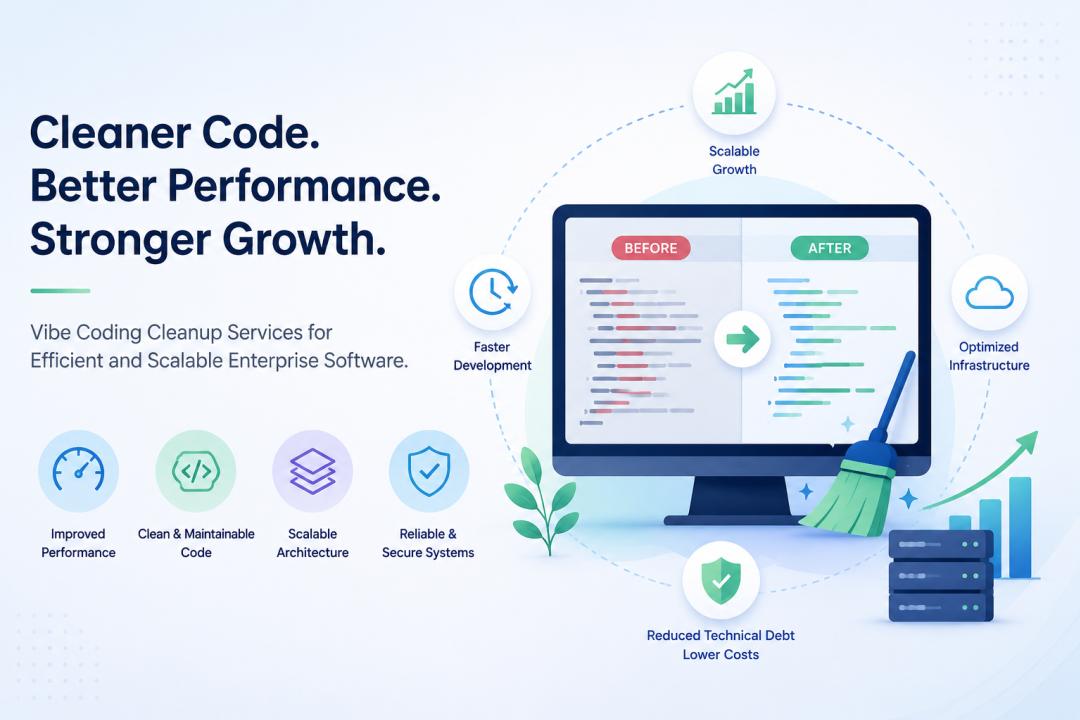
Vibe Coding Cleanup Services focus on optimizing software architecture, maintainability, scalability, and operational clarity within existing systems.
Rather than rebuilding applications from scratch, these services improve the efficiency of the current codebase through structured optimization and architectural refinement.
The primary goal is to create systems that are:
- Easier to maintain
- Faster to scale
- More efficient operationally
- Simpler for development teams to manage
- Better prepared for future technology integrations
This approach has become especially valuable for B2B organizations operating complex enterprise environments where full rebuilds are often too risky and disruptive.
How Vibe Coding Cleanup Services Improve Software Efficiency
1. Reducing Architectural Complexity
One of the biggest causes of inefficiency inside enterprise systems is unnecessary complexity.
As products evolve, many codebases become overloaded with fragmented workflows, duplicated logic, inconsistent modules, and tightly coupled dependencies.
These issues create development friction that slows down entire teams.
Vibe Coding Cleanup Services improve efficiency by simplifying architecture and reducing unnecessary complexity across the system.
This often includes:
- Refactoring outdated workflows
- Removing redundant logic
- Simplifying dependency structures
- Improving modular organization
- Streamlining communication between services
As complexity decreases, systems become significantly easier to scale and maintain.
2. Improving Development Velocity
Inefficient systems reduce development speed dramatically over time.
In many enterprise environments, developers spend large amounts of time:
- Understanding legacy workflows
- Fixing recurring bugs
- Managing unstable deployments
- Navigating unclear architecture
This operational friction slows product innovation and increases development costs.
Structured cleanup helps restore development efficiency by improving code readability, consistency, and maintainability.
When systems become cleaner and more predictable, development teams can:
- Release features faster
- Reduce debugging time
- Improve deployment confidence
- Accelerate onboarding for new developers
This creates a healthier and more scalable development environment.
3. Optimizing Infrastructure Efficiency
Messy software architecture often increases infrastructure costs unnecessarily.
Inefficient workflows, poorly optimized APIs, excessive database operations, and redundant processing logic consume more cloud resources than necessary.
Over time, these inefficiencies significantly increase operational expenses.
Vibe Coding Cleanup Services help optimize infrastructure efficiency by improving how systems process data and handle workloads.
This can lead to:
- Reduced server load
- Faster response times
- Improved resource utilization
- Lower operational costs
- Better scalability under heavy traffic
For enterprise businesses operating large-scale platforms, these improvements can create substantial long-term savings.
4. Supporting AI-Driven Software Environments
AI integration is rapidly increasing across enterprise software ecosystems. Businesses are adopting advanced technologies powered through Claude AI solutions and similar systems to improve automation, customer experiences, and operational intelligence.
However, AI-driven environments place significantly greater pressure on software architecture.
AI systems require:
- Real-time processing
- High-frequency API communication
- Efficient backend orchestration
- Flexible data workflows
- Scalable processing pipelines
Poorly structured systems often struggle to support these requirements efficiently.
This is why many organizations invest in Vibe Coding Cleanup Services before scaling AI capabilities further.
Clean and modular architecture creates a stronger foundation for integrating advanced AI technologies without introducing operational instability.
5. Reducing Technical Debt Systematically
Technical debt is one of the biggest threats to long-term software efficiency.
Over time, temporary solutions, rushed deployments, and fragmented development practices create architectural debt that slows product growth significantly.
The challenge is that technical debt compounds gradually. Many businesses normalize inefficiency because systems continue functioning despite growing operational friction.
However, the long-term consequences become increasingly severe:
- Slower feature delivery
- Higher maintenance costs
- Increased bug frequency
- Reduced scalability
- Greater operational risk
Vibe Coding Cleanup Services help businesses address technical debt systematically instead of reactively.
This creates more sustainable development environments capable of supporting long-term growth.
Why B2B Companies Are Investing in Cleanup Earlier
Traditionally, many organizations waited until systems became unstable before prioritizing architectural optimization.
Today, that mindset is changing.
Modern B2B companies increasingly recognize that proactive optimization is significantly more cost-effective than reacting to large-scale failures later.
Businesses are now investing earlier in:
- Scalable architecture planning
- Technical debt reduction
- Development workflow optimization
- Long-term maintainability improvements
This proactive approach reduces operational risks while improving scalability much earlier in the product lifecycle.
Why Full Rebuilds Are Becoming Less Attractive
For years, many businesses viewed full system rewrites as the default solution to architectural inefficiency.
However, enterprise rebuilds are often:
- Extremely expensive
- Operationally disruptive
- Time-consuming
- Difficult to maintain during transition periods
More importantly, rebuilds frequently recreate the same structural problems if the underlying development philosophy remains unchanged.
This is why optimization-driven approaches are becoming more attractive.
Instead of replacing entire systems, businesses now focus on incrementally improving efficiency through structured cleanup and architectural refinement.
The Long-Term Value of Sustainable Software Systems
The future of enterprise software development will increasingly prioritize sustainability alongside speed.
As software ecosystems become more complex, businesses need systems capable of evolving continuously without creating excessive operational friction.
Sustainable systems allow organizations to:
- Scale more efficiently
- Integrate new technologies faster
- Maintain stronger development velocity
- Reduce long-term operational costs
- Improve overall business agility
This is one of the biggest reasons why demand for Vibe Coding Cleanup Services continues rising across enterprise technology environments.
Conclusion
Software inefficiency is no longer simply a technical inconvenience—it is a direct business challenge affecting scalability, innovation, operational costs, and long-term growth.
As enterprise systems become increasingly complex, businesses require cleaner and more maintainable architectures capable of supporting continuous evolution without creating operational instability.
This is exactly where Vibe Coding Cleanup Services provide long-term value.
By reducing architectural complexity, improving development velocity, optimizing infrastructure efficiency, and supporting scalable AI-driven environments powered through Claude AI solutions, these services help businesses create stronger and more sustainable software foundations.
For modern B2B organizations, investing in software cleanup is no longer optional optimization—it is becoming a critical strategy for maintaining efficiency and scalability in increasingly demanding digital ecosystems.