As cyber threats continue to evolve, organizations need security operations that can detect, investigate, and respond to incidents quickly and efficiently. Businesses today manage increasingly complex environments that include cloud infrastructure, remote workforces, SaaS applications, endpoints, APIs, and hybrid networks.
To manage this growing attack surface, modern Security Operations Centers (SOCs) rely heavily on technologies like SIEM and SOAR.
These two platforms are often discussed together because they play complementary roles in cybersecurity operations. However, they solve different challenges within the SOC workflow.
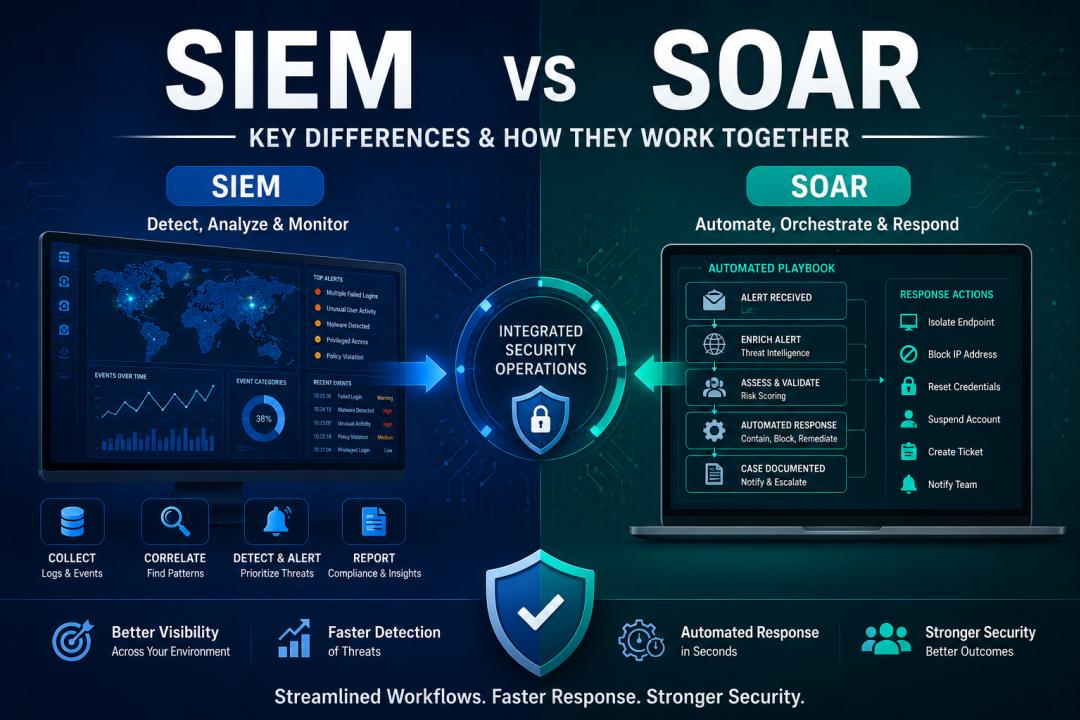
- SIEM focuses on collecting, analyzing, and detecting suspicious activity.
- SOAR focuses on automating and coordinating response actions.
Understanding the difference between SIEM and SOAR is important for organizations planning to:
- Build an internal SOC
- Improve threat detection
- Automate incident response
- Reduce analyst fatigue
- Strengthen compliance
- Evaluate managed SOC providers
In this article, we will explain:
- What SIEM is
- What SOAR is
- How they differ
- How they work together
- Their practical use cases
- Key benefits for organizations
- Best practices for selecting the right platforms
What Is SIEM?
SIEM stands for:
Security Information and Event Management
A SIEM platform acts as the centralized monitoring and analytics engine of a Security Operations Center.
Its primary purpose is to:
- Collect logs and event data
- Correlate activity across systems
- Detect suspicious behavior
- Generate security alerts
- Support investigations and compliance reporting
SIEM tools collect data from:
- Firewalls
- Servers
- Endpoints
- Applications
- Identity systems
- Cloud platforms
- Network devices
- Security appliances
Once the information is collected, the SIEM analyzes events using correlation rules and threat intelligence to identify suspicious patterns.
For example:
- A single failed login attempt may not be unusual.
- Multiple failed logins across several accounts within a short timeframe may indicate a brute-force attack.
The SIEM detects this pattern and generates an alert for security analysts.
Main Functions of a SIEM Platform
Centralized Log Collection
SIEM platforms aggregate logs from different systems into a single location.
This improves:
- Visibility
- Monitoring
- Investigation capabilities
- Audit readiness
Event Correlation and Threat Detection
SIEM analyzes activity across multiple systems to identify indicators of compromise and suspicious behavior patterns.
This helps detect:
- Credential attacks
- Insider threats
- Malware activity
- Unauthorized access
- Lateral movement
Alert Prioritization
The platform prioritizes alerts so analysts can focus on the most critical threats first.
Historical Data Retention
SIEM tools store historical logs for:
- Incident investigations
- Threat hunting
- Compliance audits
- Forensic analysis
Compliance Reporting
Many compliance frameworks require centralized logging and security visibility.
SIEM platforms support reporting for:
- ISO 27001
- PCI DSS
- HIPAA
- SOC 2
- GDPR
What Is SOAR?
SOAR stands for:
Security Orchestration, Automation, and Response
While SIEM focuses on identifying threats, SOAR focuses on what happens after detection.
SOAR platforms automate incident response workflows and coordinate actions across different security tools.
Instead of analysts manually responding to every alert, SOAR automates repetitive tasks using predefined playbooks.
For example, when a suspicious login is detected, the SOAR platform may:
- Query threat intelligence feeds
- Block the malicious IP address
- Disable a compromised account
- Isolate an endpoint
- Create an incident ticket
- Notify the response team
All automatically and within seconds.
This dramatically improves response speed and operational efficiency.
Main Functions of a SOAR Platform
Alert Intake
SOAR platforms receive alerts from:
- SIEM systems
- EDR platforms
- Firewalls
- Cloud security tools
- Threat intelligence platforms
Automated Alert Enrichment
SOAR gathers additional context automatically, including:
- Threat intelligence data
- Asset information
- User activity
- Vulnerability details
This improves investigation quality.
Automated Incident Response
SOAR executes predefined response actions such as:
- Blocking IP addresses
- Resetting passwords
- Disabling user accounts
- Isolating infected devices
- Triggering containment workflows
Workflow Orchestration
SOAR connects multiple security systems together and coordinates response processes across the organization.
Incident Documentation
Every action performed by the platform is documented automatically.
This supports:
- Compliance reporting
- Audit requirements
- Post-incident reviews
- Operational tracking
SIEM vs SOAR: Understanding the Key Differences
Although SIEM and SOAR work closely together, they serve different operational purposes.
| Area | SIEM | SOAR |
|---|---|---|
| Primary Focus | Threat detection and monitoring | Response automation and orchestration |
| Main Input | Logs and event data | Alerts from SIEM and security tools |
| Main Output | Alerts and compliance reports | Automated actions and incident workflows |
| Primary Users | SOC analysts and investigators | Incident response teams |
| Key Benefit | Visibility into threats | Faster response and reduced manual effort |
| Compliance Support | Log retention and audit trails | Response documentation and workflow evidence |
| Limitation Without the Other | Detection remains manual to respond | Lacks reliable detection data to automate |
How SIEM and SOAR Work Together
SIEM and SOAR are most effective when integrated together within a Security Operations Center.
Without SOAR:
- Analysts must manually investigate and respond to every alert.
- High alert volumes create fatigue and slower response times.
Without SIEM:
- SOAR lacks reliable detection data and structured alerts.
Together, they create a complete detection and response workflow.
The Integrated SIEM and SOAR Process
Step 1: Data Collection
The SIEM continuously collects:
- Logs
- Events
- Security telemetry
- User activity
from across the organization.
Step 2: Threat Detection
The SIEM applies correlation rules and identifies suspicious behavior patterns.
Alerts are then generated and prioritized.
Step 3: Alert Transfer to SOAR
The alert is forwarded to the SOAR platform for automated handling.
Step 4: Automated Response
SOAR executes predefined playbooks such as:
- Threat enrichment
- IP blocking
- Endpoint isolation
- Credential suspension
- Ticket creation
Step 5: Analyst Investigation
Analysts receive a fully enriched incident case with detailed context, reducing investigation time.
Step 6: Continuous Improvement
Investigation findings help improve:
- SIEM detection rules
- SOAR workflows
- Alert accuracy
- Automation effectiveness
This creates a continuous operational improvement cycle.
Common SIEM Use Cases
Insider Threat Detection
SIEM platforms monitor:
- Login activity
- File access
- Data transfers
- User behavior
to identify unusual internal activity patterns.
Compliance Reporting
SIEM simplifies compliance audits by maintaining centralized logs and generating structured reports.
Cloud and Hybrid Monitoring
Organizations using:
- AWS
- Azure
- Google Cloud
- Hybrid infrastructure
benefit from centralized visibility across all environments.
Threat Intelligence Correlation
SIEM tools enrich incoming events with indicators of compromise (IoCs) and external threat intelligence feeds.
Common SOAR Use Cases
Phishing Response Automation
SOAR can automatically:
- Analyze suspicious emails
- Block malicious domains
- Search mailboxes for similar emails
- Notify users
- Open incident tickets
without manual intervention.
Ransomware Containment
When ransomware indicators appear, SOAR may:
- Isolate infected endpoints
- Suspend compromised accounts
- Alert response teams
- Capture forensic evidence
This helps reduce the spread of attacks.
Credential Attack Response
SOAR can:
- Reset passwords
- Block malicious IPs
- Trigger MFA
- Disable compromised accounts
within seconds of detection.
Vulnerability Alert Triage
SOAR helps reduce analyst workload by prioritizing vulnerabilities based on:
- Asset criticality
- Existing patch status
- Threat severity
Benefits of Using SIEM and SOAR Together
Organizations that combine SIEM and SOAR gain several operational advantages.
Faster Threat Detection and Response
Integrated workflows help reduce:
- Mean Time to Detect (MTTD)
- Mean Time to Respond (MTTR)
Reduced Analyst Fatigue
Automation reduces repetitive tasks and allows analysts to focus on high-priority investigations.
Improved Operational Efficiency
Security operations become:
- Faster
- More scalable
- More consistent
Better Threat Visibility
SIEM improves monitoring visibility while SOAR improves contextual response capability.
Stronger Compliance Support
Organizations benefit from:
- Centralized logging
- Audit trails
- Incident tracking
- Response documentation
Challenges of SIEM and SOAR Implementation
Despite their benefits, implementation can be complex.
Organizations often face:
- High alert volume
- False positives
- Integration complexity
- Licensing costs
- Limited security resources
- Playbook maintenance requirements
Proper configuration and ongoing tuning are critical for success.
How to Choose the Right SIEM Platform
Organizations should evaluate:
Data Source Coverage
Ensure the platform supports:
- Cloud services
- SaaS applications
- Endpoints
- On-premise systems
- Network devices
Scalability
Understand how pricing scales based on:
- Log volume
- Events per second
- Cloud growth
Detection Quality
Evaluate:
- Built-in detection rules
- Threat intelligence integration
- Customization flexibility
Search and Investigation Features
Fast search capabilities and strong visualization tools improve SOC efficiency.
Compliance Reporting
Verify support for frameworks such as:
- ISO 27001
- HIPAA
- PCI DSS
- SOC 2
- GDPR
How to Choose the Right SOAR Platform
Organizations should evaluate:
Integration Support
The platform should integrate with:
- SIEM
- EDR
- Firewalls
- IAM systems
- Threat intelligence tools
- Ticketing systems
Playbook Development
Evaluate whether workflows use:
- Visual low-code builders
- Custom scripting
- Hybrid approaches
Case Management
Strong incident tracking improves investigation consistency and audit readiness.
Alert Noise Reduction
Machine learning and automated triage features help reduce false positives over time.
Vendor Ecosystem Compatibility
Organizations using ecosystems from:
- Microsoft
- IBM
- Palo Alto Networks
- Splunk Inc.
may benefit from tighter native integrations.
Frequently Asked Questions
Can SIEM and SOAR Be Combined into One Platform?
Yes. Some vendors offer integrated platforms that include:
- Log management
- Threat detection
- Automation
- Incident response
However, many enterprise SOCs still use separate but integrated tools for flexibility and scalability.
Do Mid-Sized Businesses Need Both SIEM and SOAR?
Yes. Mid-sized organizations often benefit greatly from automation because smaller security teams may struggle with high alert volumes.
Managed SOC services frequently include both technologies together.
How Is SOAR Different from EDR?
EDR focuses on:
- Endpoint monitoring
- Endpoint detection
- Device-level response
SOAR coordinates actions across multiple security systems and tools.
Why Is SIEM Important for Compliance?
SIEM provides:
- Centralized log storage
- Audit trails
- Security monitoring
- Compliance reporting
which are essential for many regulatory frameworks.
Final Thoughts
SIEM and SOAR are two of the most important technologies in modern cybersecurity operations. While SIEM provides centralized monitoring and threat detection, SOAR automates response workflows and improves operational efficiency.
Together, they help organizations:
- Detect threats faster
- Respond more efficiently
- Reduce analyst fatigue
- Improve security visibility
- Strengthen compliance readiness
- Build scalable SOC operations
As cyber threats continue evolving, integrated SIEM and SOAR capabilities have become essential for organizations looking to build proactive, resilient, and mature security operations.
About Securis360 Inc.
Securis360 Inc. helps organizations strengthen cybersecurity through managed SOC services, SIEM and SOAR implementation, threat detection, cloud security, compliance support, and advanced incident response solutions. Our experts help businesses build scalable and resilient security operations designed for today’s evolving threat landscape.