When my grandmother passed away last year, my mom inherited a shoebox of family photographs that had been sitting in a closet in my grandmother's apartment for somewhere between forty and seventy years. Most of them were black and white. Some were Polaroids that had taken on that strange green tint Polaroids get when they age. A few were professional studio portraits from the 1940s, on thick cardboard backings that had warped over time. There were photos of my great-grandparents I had never seen. Photos of my grandmother as a young woman in clothes I could not have imagined her wearing. Photos of an entire side of the family that was, until I opened this box, mostly hypothetical to me.
My mom gave me the box. She is not a digital person and has no real plan for these. She said something like, you should have these, do something with them. I took them home, put the box on my desk, and stared at it for about three months.
The problem with old photos is that they are time bombs in slow motion. They fade. They yellow. The paper becomes brittle. Some of the ones in my grandmother's box were already in bad shape, with cracks running through them or whole corners that had separated from the rest of the photo. Many were stuck together. The longer I left them in the closet, the worse they were going to get. But I also did not know what to actually do with them. I am not a photo restoration expert. I do not own a high quality scanner. The idea of paying someone to professionally restore dozens of photos was financially out of the question.
What I ended up doing took about three weeks of evenings and felt completely worth it.
The first step was just scanning everything. I used my phone, not a scanner, because there are now phone apps that do an acceptable job of capturing flat photos with the right lighting. Good light is more important than a fancy scanner for this. I sat near a north-facing window in the afternoon, laid each photo on a plain dark surface, and took a careful photo of each one. For larger photos I sometimes used a tripod and a delay timer to avoid shake. It is not perfect, but the goal at this stage is not perfection. It is getting the data off the paper before the paper degrades further.
The second step was organizing. I made a folder for each decade based on context clues. Some photos had dates written on the back. For others I had to guess based on clothing, hair>
The third step, and this is where it got interesting, was actually restoring the worst ones. There are now AI tools that can fix scratches, recolor black and white photos, and sharpen blurry faces in ways that would have required a Photoshop expert ten years ago. I used a few different services and the results varied. Some were uncanny in a bad way, smoothing faces until they looked like dolls. Others were genuinely beautiful, bringing back details I had not realized were even in the original.
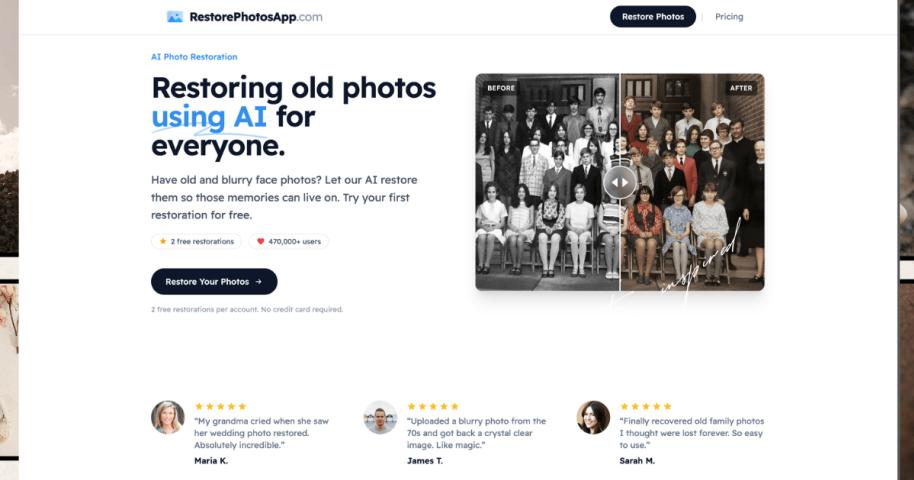
The one I ended up using the most for the older photos was a tool to restore old photos that handled the specific problems of mid-century photography well. It dealt with the fading. It rebuilt the cracked areas without inventing weird new features. It sharpened faces in a way that felt restorative rather than synthetic. For some of the truly damaged photos, the difference between the before and the after was the difference between a photo you would politely glance at and one you would actually stop to look at.
The fourth step was making something with them. I made a small physical photo book with the best of the restored images, with captions that included names and dates where we knew them. I made one copy for my mom and one copy for my dad's family. I also created a digital archive that I shared with my brother and a few cousins, with the original scans and the restored versions both included. The original scans matter. They are the record. The restored versions are nice to look at, but they are interpretations.
The part I did not expect from this whole process was the conversations it started. My mom and I spent hours going through the photos together. She told me stories I had never heard. About her father, about her grandmother, about a sister she was not close to as an adult but had been close to as a child. The photos were the prompt, but the conversations were the actual gift.
If anyone reading this has a box of old family photos somewhere, please do not leave them in the closet. They are not going to get better with time, only worse. You do not need expensive equipment to start. A phone camera, some patience, and a free evening can produce a digital archive that will outlast every printed photograph in the box. And if you have older relatives, go through them together while you can. The photos are only half the value.