Businesses today operate in an environment where speed, efficiency, and scalability are no longer optional. Teams rely on dozens of digital tools every day, CRMs, communication platforms, marketing software, AI applications, payment systems, cloud databases, and project management platforms. While these tools improve productivity individually, they often create operational chaos when disconnected from one another.
That’s why workflow automation has become one of the most important technology investments for modern organizations.
Companies are increasingly looking for ways to eliminate repetitive manual work, automate data movement, improve internal collaboration, and streamline customer experiences. Automation platforms like n8n, Zapier, and Make have emerged as leading solutions in this rapidly growing space, helping businesses connect applications and create intelligent workflows without building custom integrations from scratch.
But choosing the right automation platform is becoming more complicated.
Some businesses prioritize simplicity and fast setup. Others require enterprise-grade scalability, AI integrations, open-source flexibility, or advanced workflow customization. The rise of generative AI and intelligent automation has also changed what companies expect from automation tools. Organizations are no longer just automating repetitive tasks, they are building AI-powered workflows capable of decision-making, personalization, and operational orchestration.
This has made the “n8n vs Zapier vs Make” debate increasingly important for startups, enterprises, SaaS companies, and AI-driven businesses alike.
Each platform offers unique strengths, limitations, pricing structures, and technical capabilities. The right choice depends heavily on your business goals, team expertise, workflow complexity, and scalability requirements.
In this guide, we’ll break down how n8n, Zapier, and Make compare across usability, flexibility, integrations, AI automation, pricing, scalability, and developer-friendliness. We’ll also explore why many businesses now hire n8n developers, and partner with an AI development company to build more advanced automation ecosystems.
Understanding the Core Differences Between n8n, Zapier, and Make
At a high level, all three platforms aim to solve the same problem: automating workflows between software applications. However, the philosophy behind each tool is very different.
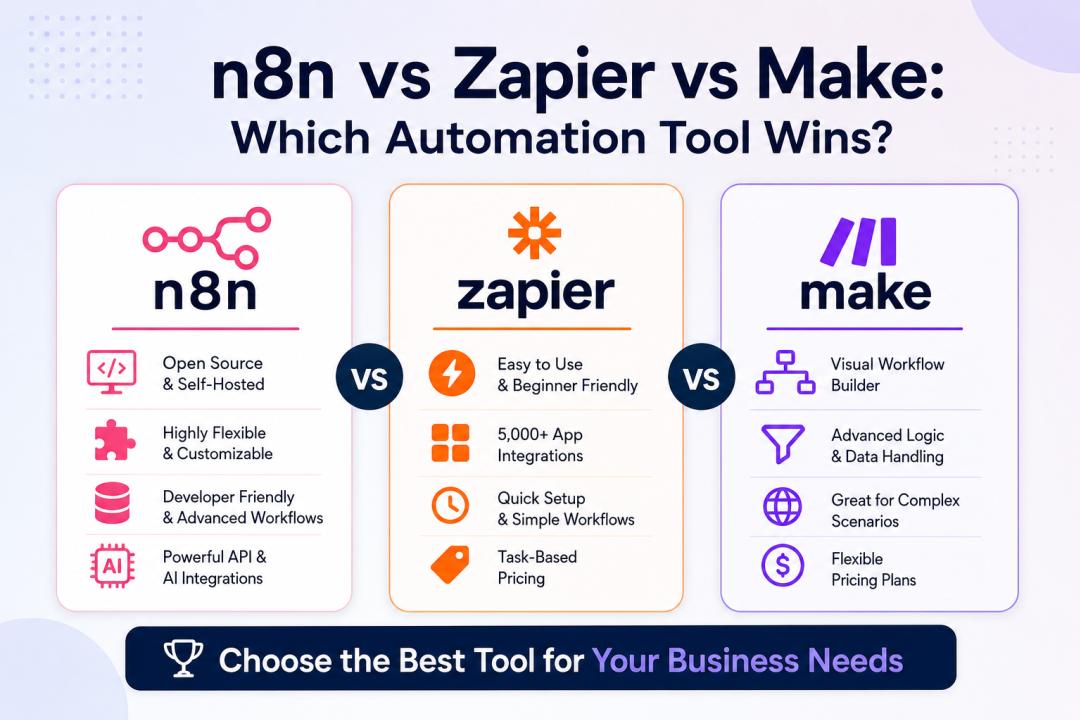
Zapier focuses heavily on simplicity and accessibility for non-technical users. Make emphasizes visual workflow design and flexibility. n8n positions itself as an open-source, developer-friendly automation platform with deeper customization capabilities.
Understanding these foundational differences is critical before selecting the right platform.
What Makes Zapier Popular?
Zapier became one of the most recognized automation tools because of its ease of use.
Businesses can create workflows known as “Zaps” without coding experience. Users simply select a trigger app, define actions, and automate repetitive tasks across thousands of integrations.
For example:
A new lead from Facebook Ads automatically enters HubSpot
Gmail attachments get stored in Google Drive
Slack notifications trigger when support tickets are created
Zapier’s simplicity makes it extremely attractive for small businesses, marketing teams, and operational staff who want fast automation without technical complexity.
However, simplicity can also become a limitation for advanced use cases.
How Make Positions Itself
Make, previously known as Integromat, focuses more heavily on visual workflow orchestration.
Its interface allows users to create highly detailed automation scenarios using visual diagrams, branching logic, filters, routers, and advanced data manipulation tools. Compared to Zapier, Make offers significantly greater flexibility for handling complex workflows.
This makes it popular among operations teams, agencies, and technically inclined users who need more customization without fully relying on developers.
However, Make’s visual complexity can create a steeper learning curve for beginners.
Why n8n Is Gaining Rapid Attention
n8n has emerged as one of the fastest-growing automation platforms because it combines low-code usability with developer-level control.
Unlike Zapier and Make, n8n is open-source and self-hostable. Businesses can fully control their automation infrastructure, customize workflows deeply, integrate proprietary systems, and build AI-powered automation pipelines with fewer restrictions.
This has made n8n particularly attractive for:
SaaS companies
AI startups
Enterprises
Developer teams
Security-conscious organizations
Businesses managing custom APIs and internal systems
As AI automation becomes more sophisticated, many companies now hire n8n developers specifically for advanced automation architecture and intelligent workflow orchestration.
Ease of Use and Workflow Flexibility Compared
Choosing an automation platform often comes down to balancing simplicity with flexibility.
Some businesses need quick workflows with minimal setup. Others require highly customized automation systems capable of scaling across departments and enterprise operations.
Zapier: Best for Simplicity
Zapier remains one of the easiest automation platforms to learn.
Its interface is clean, intuitive, and beginner-friendly. Non-technical users can build basic automations within minutes without understanding APIs, workflow logic, or scripting.
This simplicity is one reason Zapier became highly popular among startups and small businesses.
However, workflow complexity becomes harder to manage as automations scale. Advanced branching logic, conditional workflows, custom scripting, and multi-step orchestration are more limited compared to Make or n8n.
For teams prioritizing ease of adoption over technical depth, Zapier still performs exceptionally well.
Make: Strong Visual Workflow Design
Make offers a more visual and detailed workflow-building experience.
Users can see how data moves between systems in real time, which improves visibility for complex automation scenarios. Its visual editor allows deeper workflow customization, advanced filtering, error handling, and conditional logic.
For example, an eCommerce company could create workflows that:
Process customer orders
Validate payment data
Trigger inventory updates
Notify fulfillment teams
Send AI-generated support responses
Create analytics reports automatically
All within a single visual workflow.
This flexibility makes Make significantly more powerful than Zapier for operationally complex environments.
n8n: Developer-Friendly Flexibility
n8n offers perhaps the highest flexibility of all three platforms.
While its visual interface remains accessible, the platform also allows:
Custom JavaScript execution
Advanced API calls
Self-hosted infrastructure
Custom nodes and integrations
AI model orchestration
Full workflow customization
For businesses managing enterprise systems or AI-powered workflows, this level of control becomes extremely valuable.
The tradeoff is that n8n often requires more technical expertise than Zapier. Businesses without in-house engineering teams may need to hire remote n8n developers or automation specialists to unlock its full capabilities effectively.
AI Automation and Advanced Workflow Capabilities
The rise of AI-powered business automation has changed how companies evaluate automation platforms entirely.
Businesses now want automation systems capable of handling intelligent workflows rather than simple trigger-based tasks.
This is where the gap between these platforms becomes more noticeable.
Zapier’s AI Integrations
Zapier has expanded aggressively into AI integrations and now supports tools like OpenAI and ChatGPT across workflows.
Users can automate tasks such as:
AI-generated email responses
Content summarization
Lead enrichment
Customer support automation
AI-powered notifications
However, Zapier’s AI workflows remain relatively lightweight compared to developer-oriented platforms.
It works well for simple automation but becomes less ideal for highly customized AI orchestration or enterprise-scale AI infrastructure.
Make’s AI Workflow Strengths
Make performs better than Zapier for more advanced AI workflows because of its stronger data-handling and workflow logic capabilities.
Businesses can create sophisticated AI scenarios involving:
Multi-step AI processing
Dynamic branching
API chaining
Data transformation
AI-driven decision trees
This makes Make attractive for operational automation teams experimenting with AI integrations.
However, some limitations still exist around infrastructure ownership and deep backend customization.
Why n8n Leads in AI Workflow Customization
n8n has become especially popular among AI-focused businesses because it allows deeper AI workflow orchestration than many competitors.
Organizations use n8n to:
Build AI agents
Connect large language models
Automate multi-agent systems
Orchestrate enterprise AI workflows
Create internal AI copilots
Manage vector database pipelines
Integrate proprietary AI systems
Its open-source flexibility and developer-level customization make it highly attractive for businesses building AI-first operational systems.
This growing demand explains why companies increasingly hire AI developers alongside automation specialists when implementing n8n-based infrastructure.
Pricing, Scalability, and Infrastructure Control
Pricing structures and scalability models often become deciding factors when businesses evaluate automation platforms long term.
What works affordably for small teams may become expensive or restrictive at enterprise scale.
Zapier’s Pricing Model
Zapier operates on a task-based pricing structure.
While this works well for small automation volumes, costs can increase significantly as businesses scale workflow executions across departments and applications.
For startups or small operational teams, Zapier’s simplicity may justify the cost. But enterprises managing high-volume automation often find scaling expensive over time.
Additionally, businesses have limited infrastructure control because Zapier operates as a fully managed SaaS platform.
Make’s Scalability Advantages
Make generally offers better pricing flexibility compared to Zapier for medium-to-large automation environments.
Its operational pricing model allows more complex workflows at lower costs in many scenarios. Businesses managing data-heavy automation often find Make more cost-efficient than Zapier at scale.
However, organizations still remain dependent on Make’s hosted infrastructure and ecosystem limitations.
n8n’s Open-Source Advantage
n8n’s biggest advantage lies in infrastructure ownership and scalability control.
Because businesses can self-host n8n, they avoid many of the recurring operational costs associated with SaaS-based automation platforms. Organizations gain full control over workflow infrastructure, security, compliance, and scalability.
This becomes especially valuable for:
Enterprise environments
Compliance-heavy industries
AI-driven companies
SaaS platforms
Organizations with sensitive data
The tradeoff is that self-hosting requires technical management and engineering expertise.
That’s why many organizations hire n8n developers or work with an experienced AI development company to build and maintain scalable automation infrastructure properly.
Which Automation Tool Is Best for Your Business?
There is no universal winner between n8n, Zapier, and Make because each platform serves different business needs and technical environments.
The best choice depends entirely on workflow complexity, technical capabilities, scalability goals, and operational strategy.
When Zapier Makes the Most Sense
Zapier is ideal for:
Small businesses
Non-technical teams
Quick workflow automation
Lightweight operational tasks
Fast onboarding and adoption
If your primary goal is simplicity and rapid automation setup, Zapier remains one of the strongest options available.
When Make Is the Better Choice
Make performs best for:
Mid-sized businesses
Operations-heavy workflows
Visual automation environments
Advanced multi-step scenarios
Teams needing more flexibility without coding extensively
It strikes a strong balance between usability and advanced workflow control.
When n8n Becomes the Clear Winner
n8n stands out for:
Developer teams
AI-driven businesses
Enterprise automation
Self-hosted infrastructure
Advanced API orchestration
AI workflow systems
Long-term scalability
Organizations building sophisticated operational automation or AI ecosystems often find n8n significantly more adaptable than Zapier or Make.
However, implementation may require technical expertise, especially for complex enterprise environments.
This is why many businesses choose to hire remote n8n developers or partner with an AI development company capable of designing scalable automation architectures.
The Future of Workflow Automation and AI Integration
Workflow automation is evolving rapidly from simple task automation into intelligent operational orchestration.
The next generation of automation systems will not only move data between apps but also analyze information, make decisions, personalize interactions, and coordinate AI-powered business processes autonomously.
At the same time, tools like Zapier and Make will continue serving important roles for businesses prioritizing accessibility, simplicity, and operational efficiency without extensive engineering requirements.
For organizations planning enterprise-scale automation or AI-driven workflows, investing in the right architecture early matters enormously. Whether businesses choose to hire n8n developers, hire AI developers, or collaborate with an experienced AI development company, strategic automation decisions made today will shape operational efficiency for years to come.
The automation landscape will continue evolving quickly, but one thing is already clear: businesses that successfully combine workflow automation with AI-driven intelligence will hold a major competitive advantage in the future digital economy.