Market Overview:
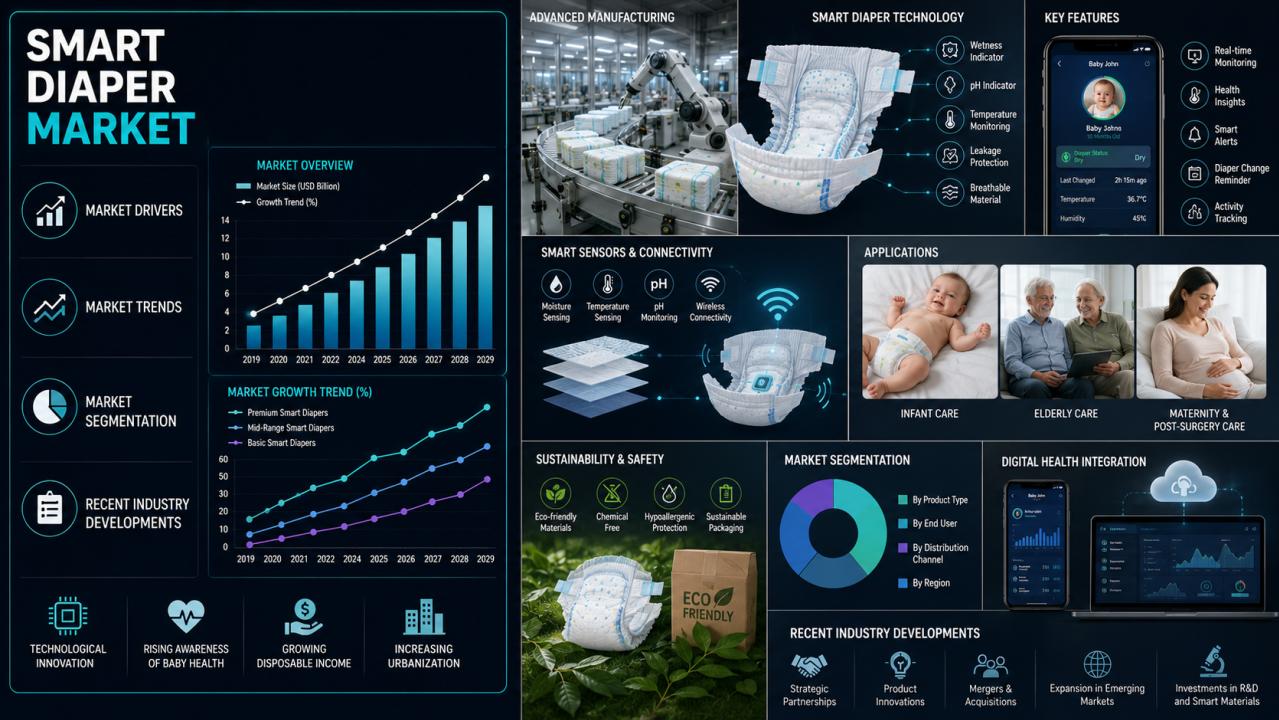
According to IMARC Group's latest research publication, "Smart Diaper Market: Global Industry Trends, Share, Size, Growth, Opportunity and Forecast 2026-2034", The global smart diaper market size reached USD 1,006.1 Million in 2025. Looking forward, IMARC Group expects the market to reach USD 3,115.5 Million by 2034, exhibiting a growth rate (CAGR) of 12.98% during 2026-2034, exhibiting steady expansion driven by rising awareness about infant health, increasing adoption of connected devices, convenience offered by these diapers, and technological advancements in sensor technology and data analytics.
This detailed analysis primarily encompasses industry size, business trends, market share, key growth factors, and regional forecasts. The report offers a comprehensive overview and integrates research findings, market assessments, and data from different sources. It also includes pivotal market dynamics like drivers and challenges, while also highlighting growth opportunities, financial insights, technological improvements, emerging trends, and innovations. Besides this, the report provides regional market evaluation, along with a competitive landscape analysis.
Grab a sample PDF of this report: https://www.imarcgroup.com/smart-diaper-market/requestsample
How IoT and AI Are Reshaping the Future of the Smart Diaper Market
- Smart diapers embedded with Bluetooth sensors transmit real-time wetness and temperature data to paired mobile applications, enabling caregivers to act within minutes of a diaper event and reducing the risk of dermatological complications like diaper rash by up to 30%.
- Government-backed digital health infrastructure programs, including South Korea's Smart Healthcare Initiative and the U.S. FDA's regulatory push for connected medical devices, are creating compliant pathways for smart diaper manufacturers to scale clinical-grade monitoring solutions into home care environments.
- In January 2024, Korea-based startup Monit introduced its smart diaper monitoring system MECS at CES 2024 in Las Vegas, targeting market expansion across Singapore and the UAE, signaling growing cross-border demand for AI-assisted infant care products.
- Kimberly-Clark introduced a next-generation smart diaper prototype in 2024 with enhanced IoT integration for elder care, addressing the rising global aging population and the estimated 132.4 million babies projected to be born globally in a single year as parallel demand pools.
- Ontex Group unveiled its Stop and Lock anti-leak technology in May 2024, integrated into its baby care product line, reflecting how incumbents are bridging traditional diaper engineering with sensor-compatible infrastructure to stay competitive.
Key Trends in the Smart Diaper Market
- Rising Integration of Bluetooth Sensor Technology: Bluetooth sensors have emerged as the dominant technology in the smart diaper market, owing to their wide compatibility with consumer smartphones and the seamless real-time data transmission they enable. Manufacturers prefer Bluetooth-enabled sensors because they are relatively affordable to produce and integrate at scale, keeping the end-product accessible to a broader consumer base. The Bluetooth sensors segment currently commands the largest technology share in the global market, outpacing RFID-tag-based alternatives.
- Surge in Online Distribution Channels: E-commerce platforms are transforming how smart diapers reach end consumers, offering detailed product comparisons, caregiver reviews, and doorstep delivery that traditional retail cannot replicate. The COVID-19 pandemic accelerated this shift, pushing consumers toward online procurement of personal care products, and the preference has remained entrenched. Brands are investing in direct-to-consumer websites and marketplace partnerships to capture this growing digital buyer base globally.
- Expanding Adult Incontinence Application: While babies remain the dominant end-use segment with approximately 65% of total market share, the adult incontinence segment is rapidly gaining ground. An aging global population and the expansion of assisted living facilities have made smart diapers a practical caregiving tool, reducing the manual monitoring burden on nurses and home caregivers while improving patient dignity and comfort.
- Growing Sustainability Consciousness Among Manufacturers: Environmental concerns surrounding conventional disposable diapers have prompted smart diaper brands to explore eco-friendly materials, including plant-based absorbent layers and recyclable sensor components. In February 2026, leading manufacturers accelerated launches of biodegradable diaper variants made with chemical-free plant-based materials, reflecting how sustainability is no longer optional but a core product differentiator.
- North America's Tech-Savvy Parenting Culture Driving Premiumization: North American parents are increasingly embedding smart diapers into a broader connected parenting ecosystem alongside baby monitors, smart thermometers, and health-tracking apps. The region's robust healthcare infrastructure, higher disposable incomes, and willingness to pay a premium for convenience-driven infant care products have cemented North America as the leading regional market globally.
Growth Factors in the Smart Diaper Market
- Rising Parental Awareness About Infant Health and Hygiene: Parents and caregivers are increasingly conscious of how prolonged exposure to wet diapers can cause dermatological complications, infections, and discomfort in infants. A 2024 article published in the National Library of Medicine confirmed that smart diapers help nurses and caregivers avoid such complications by sending timely notifications for diaper changes. This clinical validation is accelerating institutional adoption in neonatal wards and pediatric care centers alongside household use.
- Rapid Adoption of Connected and IoT-Enabled Devices: The widespread normalization of IoT devices in daily consumer life, from smart speakers to wearable health trackers, has made the concept of a sensor-enabled diaper far less novel and far more desirable. Smart diapers seamlessly integrate with the digital life>
- Government and Regulatory Support for Digital Healthcare Infrastructure: South Korea's national healthcare modernization programs and the U.S. FDA's progressive stance on connected health monitoring devices have created a favorable policy environment for smart diaper market participants. In 2025, Monit Corp. partnered with healthcare providers in South Korea to pilot AI-enabled smart diapers in nursing care facilities, a collaboration made possible by the country's supportive digital health regulatory framework.
- Convenience and Time-Efficiency for Busy Caregivers: Smart diapers eliminate the need for constant manual checks by delivering automated alerts to smartphones or wearables the moment a diaper change is required. This optimization of caregiving schedules reduces disruptions to a baby's sleep routine and allows working parents and professional caregivers to manage their responsibilities more efficiently, making the product especially compelling for dual-income urban households.
- Premiumization of the Global Baby Care Products Sector: Consumers across both developed and rapidly urbanizing emerging markets are trading up to premium baby care products that offer added safety, data insights, and peace of mind. The broader baby care industry, valued at well over USD 90 billion globally, is increasingly being driven by technology-embedded product categories, and smart diapers are positioned at the forefront of this shift.
Leading Companies Operating in the Global Smart Diaper Industry:
- Abena North America Inc.
- ATZ Global Co. Ltd.
- CviCloud Corporation (CviLux Co. Ltd.)
- Essity AB
- Interuniversity Microelectronics Centre
- Monit Corp.
- Ontex Group
- Sinopulsar
- Smardii Inc.
- Vandrico Solutions Inc.
- Verily Life Sciences (Alphabet Inc.)
- Wonderkin Co.
Smart Diaper Market Report Segmentation:
Breakup By Technology:
- RFID Tags
- Bluetooth Sensors
Bluetooth sensors account for the largest technology share owing to their seamless compatibility with consumer smartphones, cost-effective integration, and ability to deliver real-time data transmission to paired mobile applications.
Breakup By Distribution Channel:
- Online
- Offline
Online distribution is witnessing strong momentum due to the convenience of doorstep delivery, wide product choice, and the ability for consumers to access detailed product information and caregiver reviews before purchasing.
Breakup By End Use:
- Babies
- Adults
Babies hold the largest end-use share on account of rising global birth rates, growing parental awareness of infant hygiene, and the specific design of smart diaper solutions catered to newborn and infant monitoring needs.
Breakup By Region:
- North America (United States, Canada)
- Asia Pacific (China, Japan, India, South Korea, Australia, Indonesia, Others)
- Europe (Germany, France, United Kingdom, Italy, Spain, Russia, Others)
- Latin America (Brazil, Mexico, Others)
- Middle East and Africa
North America enjoys the leading regional position owing to high technological adoption, strong healthcare infrastructure, elevated disposable income levels, and a tech-savvy parenting culture that actively embraces connected infant care solutions.
Recent News and Developments in the Smart Diaper Market
- January 2024: Korea-based startup Monit introduced its smart diaper monitoring system MECS at CES 2024 in Las Vegas, outlining expansion plans into Singapore and UAE as part of its global go-to-market strategy.
- May 2024: Ontex Group unveiled its Stop and Lock anti-leak technology integrated into its baby care product line, combining traditional diaper engineering with sensor-compatible construction to strengthen its competitive positioning.
- 2024: Kimberly-Clark introduced a next-generation smart diaper prototype with enhanced IoT integration specifically targeting the elder care and adult incontinence segment across assisted living facilities.
- 2025: Monit Corp. partnered with healthcare providers in South Korea to pilot AI-enabled smart diapers in nursing care facilities, leveraging the country's progressive digital health regulatory environment.
- February 2026: Leading smart diaper manufacturers accelerated the launch of eco-friendly and biodegradable diaper variants made with plant-based and chemical-free materials, responding to rising sustainability concerns among environmentally conscious caregivers.
- March 2026: Procter and Gamble strengthened its premium diaper portfolio by incorporating advanced absorbent technologies targeting enhanced skin protection and leakage control, amid surging demand for high-performance smart baby care products.
Note: If you require specific details, data, or insights that are not currently included in the scope of this report, we are happy to accommodate your request. As part of our customization service, we will gather and provide the additional information you need, tailored to your specific requirements. Please let us know your exact needs, and we will ensure the report is updated accordingly to meet your expectations.
About Us:
IMARC Group is a global management consulting firm that helps the world's most ambitious changemakers to create a lasting impact. The company provides a comprehensive suite of market entry and expansion services. IMARC offerings include thorough market assessment, feasibility studies, company incorporation assistance, factory setup support, regulatory approvals and licensing navigation, branding, marketing and sales strategies, competitive landscape and benchmarking analyses, pricing and cost research, and procurement research.
Contact Us:
IMARC Group
134 N 4th St. Brooklyn, NY 11249, USA
Email: sales@imarcgroup.com
Tel No:(D) +91 120 433 0800
United States: +1-201-971-6302