Market Overview
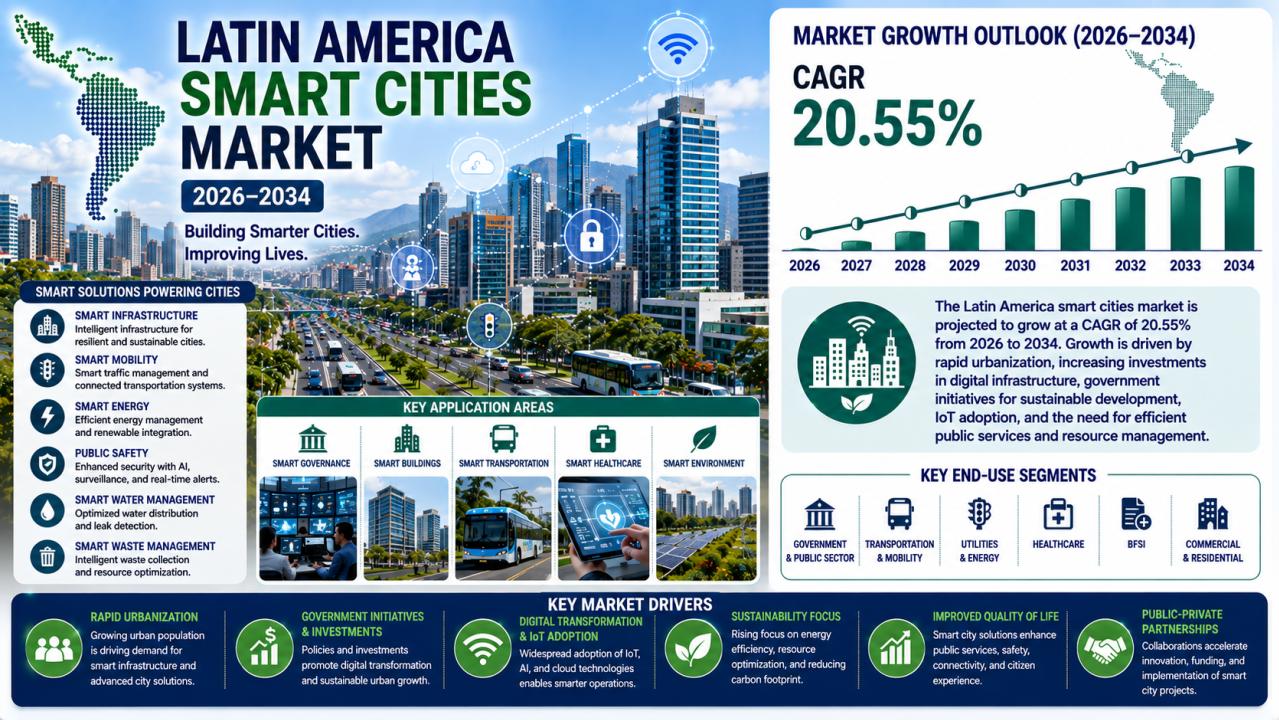
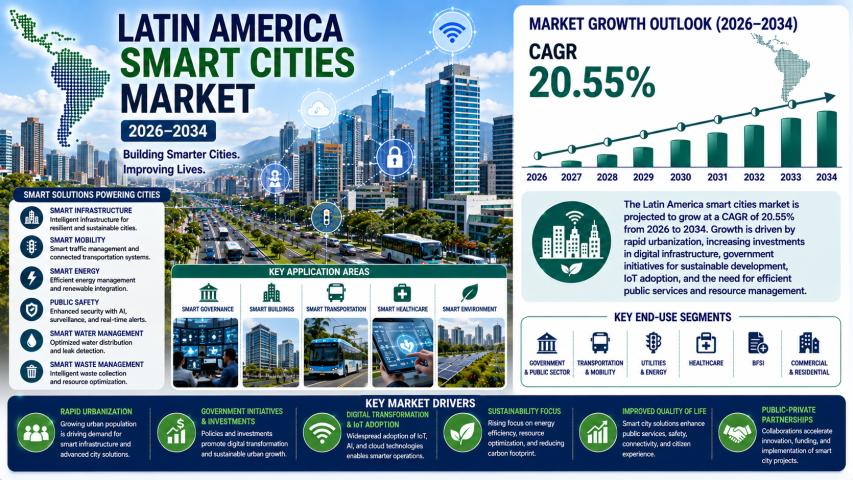
The Latin America smart cities market increased from USD 105.6 Billion in 2025 to USD 133.4 Billion in 2026, and is projected to reach USD 595.2 Billion by 2034, growing at a CAGR of 20.55% from 2026 to 2034. The market is driven by rapid urbanization, government-led smart infrastructure initiatives, rising investments in IoT and AI, and increasing demand for sustainable urban solutions, with countries like Brazil and Mexico leading the adoption of smart grids, intelligent transportation, and digital public services.
Request a Sample Report for In-Depth Market Insights: https://www.imarcgroup.com/latin-america-smart-cities-market/requestsample
Latin America Smart Cities Market Summary
- The market covers smart transportation, smart buildings, smart utilities, and smart citizen services, spanning applications from smart ticketing and traffic management to building energy optimization and smart healthcare.
- Latin America is now one of the most urbanized regions globally, with roughly 80% of its population living in cities as of 2023, up from just 40% in 1950, driving urgent demand for smarter infrastructure and public services.
- The region's urban population reached approximately 543.7 Million in 2023, growing 1.04% year-over-year, intensifying pressure on housing, transportation, and utility systems.
- Rio de Janeiro's "Smart Rio Project," a comprehensive public lighting modernization program, is forecast to cut energy use by up to 60% while improving public safety and reducing traffic accidents and street crime once complete.
- The number of smart electricity meters in Latin America is projected to grow at a 20.5% annual rate from 2023 to 2029, reaching 42.9 million units, with Brazil and Mexico together contributing over 70% of total shipments.
PORTER'S FIVE FORCES ANALYSIS
- Competitive Rivalry: High, among global technology integrators, security solution providers, and infrastructure firms competing for government smart city contracts across the region. Business implication: Differentiation depends on integrated, multi-domain solution capability rather than single-technology offerings.
- Supplier Power (IoT/Technology Providers): Moderate-to-High, given reliance on specialized IoT sensors, AI platforms, and smart grid technology from a relatively concentrated global supplier base. Business implication: Strategic technology partnerships help ensure reliable, cost-competitive access to core smart city infrastructure components.
- Buyer Power (Municipal/National Governments): High, as government procurement processes and public-private partnership structures give city and national authorities significant negotiating leverage over technology providers. Business implication: Building strong government relationships and demonstrating measurable outcomes is essential for winning and retaining large-scale contracts.
- Threat of Substitutes: Low, since traditional infrastructure and public service delivery models are increasingly unable to meet the demands of rapid urbanization without smart technology augmentation. Business implication: Structural urbanization pressure sustains long-term demand largely independent of short-term budget cycles.
- Threat of New Entrants: Moderate, as the technical complexity and capital requirements of large-scale smart city deployments favor established integrators, though specialized niche providers can enter through partnership-based projects. Business implication: Partnering with established local integrators can be an effective entry strategy for specialized technology providers.
MARKET TRENDS
The Latin America smart cities market is being shaped by rapid and sustained urbanization, as the region's urban population reached roughly 80% of the total by 2023, up dramatically from 40% in 1950, creating overpopulation, congested infrastructure, and intensifying public service demand that smart technologies like IoT, data analytics, and AI can help address through real-time infrastructure monitoring, traffic optimization, and energy management; and by expanding governmental initiatives and investment, as programs like Rio de Janeiro's "Smart Rio Project" modernize public lighting to improve safety and cut energy use by up to 60%, supported by market revenues that reached nearly USD 33.9 Billion in 2023 and growing public-private partnerships and international collaborations advancing smart city development across the region.
MARKET GROWTH DRIVERS
Growth is anchored by rapid urbanization creating structural demand for smarter infrastructure, as cities under pressure to deliver adequate housing, transportation, and utilities to fast-growing populations turn to IoT and AI-enabled solutions for more efficient resource management; by strong government-led initiatives and investment, as national and municipal governments actively launch smart infrastructure programs backed by public-private partnerships and international collaboration to modernize public services and encourage sustainable development; and by rising investment in smart utilities and metering infrastructure, as the projected growth of smart electricity meters to 42.9 million units by 2029 reflects broader momentum toward efficient energy management across the region.
MARKET OPPORTUNITIES
The clearest opportunities lie in smart utility and metering infrastructure expansion, where Brazil and Mexico's dominant share of projected smart meter growth signals a broader regional opportunity for energy management technology providers; in integrated smart transportation systems, where traffic management, connected vehicles, and smart ticketing can address chronic urban congestion challenges; and in public safety and street lighting modernization, where projects like Smart Rio demonstrate the dual efficiency and safety benefits that can justify large-scale municipal investment even amid budget constraints.
MARKET CHALLENGES
The market faces the operational complexity of deploying integrated smart infrastructure across cities with vastly different starting points in digital and physical infrastructure maturity, complicating standardized solution rollout; funding and budget constraints at the municipal level, since many smart city projects depend on public-private partnerships and international collaboration rather than guaranteed government budgets; and the challenge of managing large-scale, multi-year infrastructure projects, as programs like Smart Rio's citywide lighting modernization require sustained coordination across technology providers, government agencies, and construction partners over extended timelines.
LATIN AMERICA SMART CITIES MARKET SEGMENTATION
Focus Area Insights:
- Smart Transportation
- Smart Buildings
- Smart Utilities
- Smart Citizen Services
Smart Transportation Insights:
- Smart Ticketing
- Traffic Management System
- Passenger Information Management System
- Freight Information System
- Connected Vehicles
- Others
Smart Buildings Insights:
- Building Energy Optimization
- Emergency Management System
- Parking Management System
- Others
Smart Utilities Insights:
- Advanced Metering Infrastructure
- Distribution Management System
- Substation Automation
- Others
Smart Citizen Services Insights:
- Smart Education
- Smart Healthcare
- Smart Public Safety
- Smart Street Lighting
- Others
Regional Insights:
- Brazil
- Mexico
- Argentina
- Colombia
- Chile
- Peru
- Others
COMPETITIVE LANDSCAPE
The market features global technology integrators, security solution providers, and infrastructure firms competing for large-scale government smart city contracts, with competition increasingly centered on integrated, multi-domain capability spanning transportation, utilities, buildings, and citizen services rather than standalone point solutions. Strategic partnerships between technology providers and engineering/construction firms are becoming a common approach to deploying next-generation smart city infrastructure, combining specialized technical capability with local project execution expertise.
RECENT NEWS AND DEVELOPMENTS
September 2026: Cali, Colombia, announced that its first Smart City Expo Cali will take place from 30 September to 1 October. More than 3,000 specialized visitors had already registered, with around 70 national and 15 international speakers and 20 exhibitors confirmed. The event is focused on technology, innovation and sustainable urban development.
September 2026: The Smart City Expo network confirmed that Santiago de Cali, Colombia, will host its first Smart City Expo, expanding the regional smart-city event network alongside editions in Puebla, Mexico; Santiago, Chile; and Niterói, Brazil during 2026.
June 2026: The Smart City Expo Latam Congress was held in Puebla, Mexico, from 2–4 June. The 11th edition was expected to attract more than 8,500 attendees, with 120 speakers and more than 220 companies and institutions participating. The event focused on applying urban innovation and technology to inclusive and sustainable city development.
July 2026: UN Trade and Development reported that foreign direct investment into Latin America and the Caribbean increased 14% to US$188 billion in 2025. Brazil accounted for a substantial portion of the increase, with inflows rising from US$63 billion to US$77 billion. Higher investment flows provide a broader financing environment for infrastructure and technology projects relevant to smart-city development.
June 2026: The Inter-American Development Bank highlighted the growing economic relevance of AI across Latin America and the Caribbean. Its forthcoming 2026 research estimates that widespread AI adoption could increase regional economic output by 5.1% over a decade, compared with only 0.3% under limited adoption. AI-enabled urban services, public administration and infrastructure management are among the areas where digital technologies can contribute to city modernization.
June 2026: Smart-city investment discussions in Latin America increasingly focused on integrated urban infrastructure, including intelligent transportation, digital public services, energy management, AI and IoT-enabled infrastructure. Mexico and Colombia have been prominent markets for urban infrastructure investment, with a February 2026 mapping identifying more than US$3 billion in verified capital across selected projects and investors.
REGIONAL ANALYSIS
- Brazil: Likely the leading market, anchored by large-scale programs like the Smart Rio Project and dominant projected share of regional smart meter deployment.
- Mexico: A leading market, driven by strong government investment in smart infrastructure and substantial projected smart meter growth alongside Brazil.
- Colombia: A growing market supported by expanding urban infrastructure modernization initiatives.
- Chile: A growing market shaped by rising investment in sustainable urban technology.
- Argentina & Peru: Developing markets where growth depends on continued government investment and public-private partnership development.
KEY ASPECTS REQUIRED FOR THE LATIN AMERICA SMART CITIES MARKET
- Market Performance: USD 105.6 Billion in 2025, rising to USD 133.4 Billion in 2026, with a projected trajectory to USD 595.2 Billion by 2034.
- Market Outlook: A 20.55% CAGR through 2034, among the fastest-growing infrastructure technology categories globally, driven by extreme urbanization pressure and government investment.
- Growth Drivers: Rapid urbanization creating structural infrastructure demand; strong government-led initiatives and investment; and rising investment in smart utilities and metering infrastructure.
- Key Challenges: Deploying integrated infrastructure across cities with varying digital maturity, municipal funding and budget constraints, and managing large-scale, multi-year infrastructure projects.
- Competitive Landscape: A mix of global technology integrators and infrastructure firms competing for government contracts through integrated, multi-domain solutions.
- Industry Trends: Rapid and sustained urbanization driving smart technology adoption, and expanding governmental initiatives and investment in smart infrastructure.
- Strategic Recommendations: Pursue smart utility and metering infrastructure opportunities in Brazil and Mexico; build integrated smart transportation solution capability; partner with local engineering and construction firms for project execution; and prioritize public safety and lighting modernization projects with demonstrable efficiency returns.
Note: If you need any specific information that is not currently covered within the scope of the report, we will provide the same as a part of customization.
Speak to an analyst: https://www.imarcgroup.com/request?type=report&id=29486&flag=C
Report Format, Delivery, and Customization Details
- Report Format Mode: PDF and Excel (Editable version in PPT/Word format available on special request)
- Report Delivery Mode: Online Delivery, Physical Delivery
- Report Delivery Time: report delivered over email within 24 to 48 hours. If requested by the client, a physical copy will be delivered within three to ten days.
- Report Confirmation Mode: Yes, via email
- Report Customization Mode: Yes, via Email / Call
- Report Table of Content: Yes
- Report List of Figures: Yes
- Report Methodology Mode: Yes
- Request For Sample Report: Yes