Market Overview
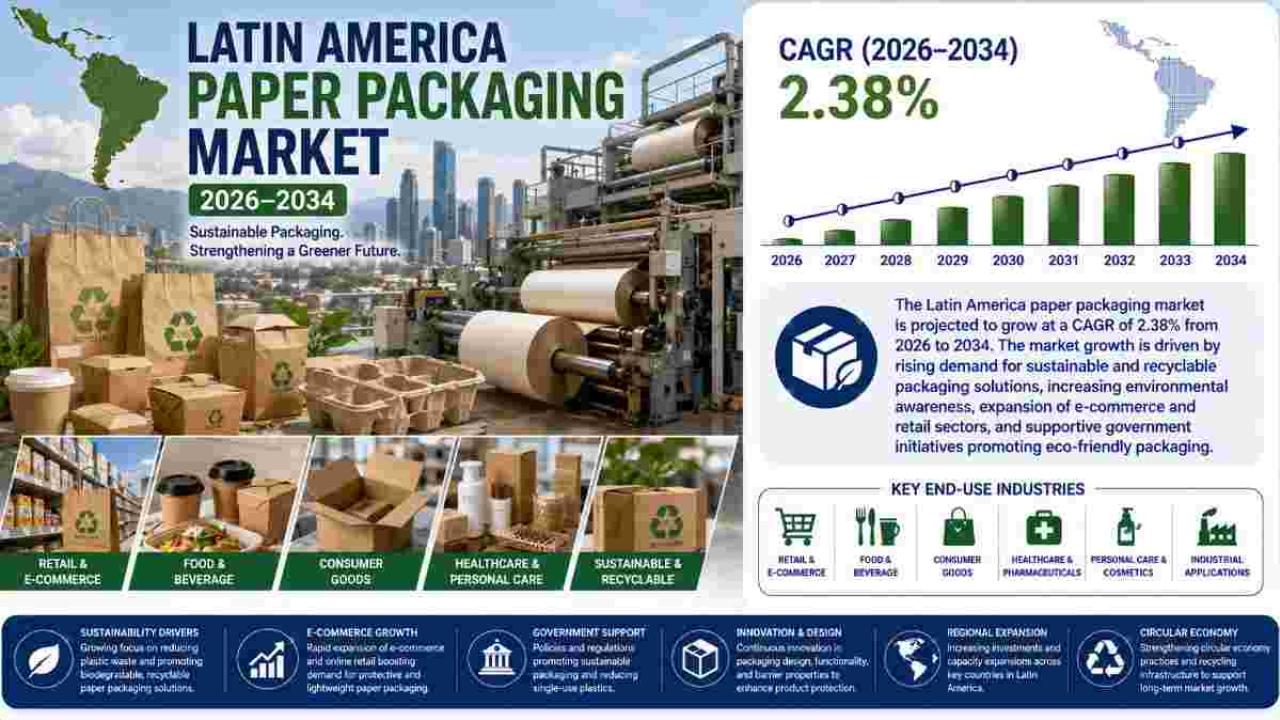
The Latin America paper packaging market size reached USD
27.0 Billion in 2025 and is projected to reach USD 33.3 Billion by 2034,
growing at a compound annual growth rate (CAGR) of 2.38% from 2026 to
2034. The market is growing due to rising sustainability demands, e-commerce
expansion, government regulations on plastic reduction, increasing investments
in innovation, lightweight materials, and circular economy initiatives to
enhance environmental and economic efficiency.
Request a Sample Report for In-Depth Market Insights: https://www.imarcgroup.com/latin-america-paper-packaging-market/requestsample
Latin America Paper Packaging Market Summary
- The
Latin America paper packaging market encompasses a range of products,
including corrugated boxes, folding boxes and cases, liquid paperboard
cartons, paper bags and sacks, and others, available in solid bleached,
coated recycled, uncoated recycled, and other grades.
- These
products are valued for their role in providing sustainable, recyclable,
and biodegradable packaging solutions across primary, secondary, and
tertiary packaging levels, serving diverse end-use industries.
- The
ecosystem includes paper manufacturers, packaging converters, raw material
suppliers, brand owners, retailers, and recycling companies across Brazil,
Mexico, Argentina, Colombia, Chile, Peru, and other countries.
- Major
segments identified in the market include product type (corrugated boxes,
folding boxes and cases, liquid paperboard cartons, paper bags and sacks,
others), grade (solid bleached, coated recycled, uncoated recycled,
others), packaging level (primary packaging, secondary packaging, tertiary
packaging), end-use industry (food, beverage, personal care and home care,
healthcare, others), and country (Brazil, Mexico, Argentina, Colombia,
Chile, Peru, Others).
- The
market is benefiting from surge in eco-friendly packaging demand, growth
of e-commerce and online retail packaging, innovation in paper packaging
for food and beverages, and government regulations on plastic reduction.
- In
October 2023, the Smurfit Kappa-WestRock merger was completed, creating
Latin America's largest packaging producer with a 14.5% regional
capacity share, surpassing Klabin. The merger leveraged Brazil and
Mexico's strategic advantages in pulp production and consumer proximity.
Porter's Five Forces Analysis
- Competitive
Rivalry: Moderate, with large multinational packaging producers,
regional manufacturers, and independent converters competing on price,
quality, sustainability credentials, and innovation. Business
implication: Companies must differentiate through sustainable product
innovation, cost efficiency, and vertical integration.
- Supplier
Power (Pulp and Raw Material Suppliers): Moderate. Suppliers of virgin
and recycled pulp have some leverage, but the presence of multiple
suppliers and the ability of large producers to secure long-term contracts
moderates this power. Brazil's strong pulp production base provides
competitive advantage. Business implication: Manufacturers should
maintain diverse supplier relationships and invest in recycling
infrastructure.
- Buyer
Power (Brand Owners and Retailers): High. Buyers have extensive choice
across packaging providers, materials, and formats, with growing awareness
of sustainability, cost, and performance. Business implication:
Providers must focus on quality, sustainability credentials, and cost
competitiveness to build loyalty.
- Threat
of Substitutes: Moderate. Plastic packaging, flexible packaging, and
reusable containers compete, but paper packaging's sustainability
credentials, recyclability, and regulatory compliance support its
position. Business implication: The industry should emphasize
environmental benefits, performance, and cost-effectiveness.
- Threat
of New Entrants: Moderate. Higher barriers for established players
(scale, distribution, certification, capital), but lower barriers for
niche and innovative paper packaging entrants. Business implication:
Established players should build defensible positions through scale,
sustainability certifications, and strategic partnerships.
Market Growth Drivers
Surge in Eco-Friendly Packaging Demand
The demand for sustainable and environmentally friendly
paper packaging has substantially grown in Latin America. The public and
private sectors are highly conscious about the ecological footprints of
conventional packaging and shifting towards more eco-friendly alternatives.
With rising ecological awareness, paper packaging made of recycled,
biodegradable, and renewable material is being taken up by firms on a growing
scale. According to the sources, in December 2024, Tetra Pak won the 'Resource
Efficiency' Award at the Sustainable Packaging News Awards for its paper-based
barrier innovation. This breakthrough reduces the carbon footprint of aseptic
cartons by one-third, enhancing sustainability with up to 90% renewable
content. Moreover, governments are also moving to strengthen regulations to
stem plastic waste, which in turn is hastening the shift towards paper-based
alternatives. Paper packaging, as it is recyclable and biodegradable, has
become a first choice for a variety of products ranging from food and drink to
personal care. The increasing demand for green packaging, both due to consumer
requirements and regulatory compliance, is likely to continue influencing the
paper packaging sector in Latin America. The movement is not unique to big
organizations but shared by small- and medium-scale businesses that look to
minimize their ecological impact.
Growth of E-Commerce and Online Retail Packaging
The growth of e-commerce in Latin America has created more
demand for customized packaging solutions for online shopping. With more and
more consumers buying goods online, there is a growing demand for packaging
that protects products while they are delivered to the consumers. Paper
packaging like corrugated boxes and folding cartons is very common in
e-commerce because it is strong, can be recycled, and can be customized for
different types of products. The e-commerce sector is also interested in having
a positive unboxing experience with branded and customized packaging,
increasing the need for paper packaging solutions. The eco-friendly e-commerce
companies are also using sustainable paper packaging to fulfill their green
strategies and reach environmentally conscious customers. The growing
popularity of online shopping in Latin America and the demand for packaging
that is in sync with trends of sustainability are likely to keep driving demand
for paper packaging solutions in the future.
Innovation in Paper Packaging for Food and Beverages
Latin American food and beverage (F&B) industry is
embracing paper packaging, fueled by customer demand for convenience,
sustainability, and better product preservation. Developments in materials such
as liquid paperboard and coated paperboard are gaining popularity as they
provide efficient packaging for liquids and perishable items with quality and
shelf-life extension. The transition towards environmentally friendly
alternatives, like paper packaging for liquids and snacks, is picking up steam
among consumers searching for sustainable choices. Also, the application of
cutting-edge coating technologies means that paper packaging can prevent
products from getting moisture, light, and oxygen damage, maintaining their
freshness without using plastic. With consumer tastes focusing more and more on
sustainability, paper packaging becomes a crucial element in F&B products.
This movement is set to continue as advances in paper-based packaging solutions
provide greater product protection and environmental sustainability.
Government Regulations on Plastic Reduction
Government regulations aimed at reducing plastic waste are a
significant driver of the Latin America paper packaging market. Several
countries in the region have imposed strict policies to reduce plastic
pollution and increase the use of sustainable materials. These regulations are
prompting manufacturers and retailers to seek alternative and eco-friendly
packaging solutions, driving demand for paper-based alternatives. The
regulatory pressure is accelerating the transition from plastic to paper
packaging across various end-use industries, creating new opportunities for
paper packaging manufacturers and converters. As regulations continue to
tighten, the demand for sustainable paper packaging solutions is expected to
grow further.
Latin America Paper Packaging Market Segmentation
Product Type Insights:
- Corrugated
Boxes
- Folding
Boxes and Cases
- Liquid
Paperboard Cartons
- Paper
Bags and Sacks
- Others
Grade Insights:
- Solid
Bleached
- Coated
Recycled
- Uncoated
Recycled
- Others
Packaging Level Insights:
- Primary
Packaging
- Secondary
Packaging
- Tertiary
Packaging
End-Use Industry Insights:
- Food
- Beverage
- Personal
Care and Home Care
- Healthcare
- Others
Country Insights:
- Brazil
- Mexico
- Argentina
- Colombia
- Chile
- Peru
- Others
Competitive Landscape
The Latin
America paper packaging market features a competitive landscape
encompassing large multinational packaging producers, regional manufacturers,
and independent converters. Market participants differentiate through
investment in sustainable product innovation, vertical integration, and circular
economy initiatives. The market is characterized by growing demand for
recyclable and biodegradable packaging, increasing regulatory pressure, and
expanding e-commerce sector. Competition is intensifying as companies invest in
lightweight materials, coating technologies, and sustainable packaging
solutions to capture growing demand. The competitive analysis includes market
structure, key player positioning, top winning strategies, competitive
dashboard, and company evaluation quadrant, with detailed profiles of all major
companies provided in the report.
Key players mentioned in the report context include:
- Smurfit
Kappa-WestRock merger was completed in October 2023, creating Latin
America's largest packaging producer with a 14.5% regional capacity
share, surpassing Klabin. The merger leveraged Brazil and Mexico's
strategic advantages in pulp production and consumer proximity,
significantly impacting the containerboard and packaging markets in these
countries.
- Amcor
introduced its AmFiber™ Performance Paper packaging in Latin
America in July 2023. This recyclable, high-barrier paper-based solution,
initially for the confectionery market, now extends to dry culinary and
beverage applications, featuring over 80% paper fiber content.
- Tetra
Pak won the 'Resource Efficiency' Award at the Sustainable Packaging
News Awards in December 2024 for its paper-based barrier innovation,
reducing the carbon footprint of aseptic cartons by one-third with up to
90% renewable content.
- Klabin
remains a major regional player in paper packaging production,
particularly in Brazil, with significant containerboard and packaging
capacity.
Regional Analysis
- Brazil:
The largest market in the region, driven by a large population, robust
agricultural sector, and significant pulp and paper production capacity.
Brazil benefits from strategic advantages in pulp production and consumer
proximity, with major players including Smurfit Kappa-WestRock and Klabin
operating large-scale facilities. The country is a major exporter of paper
packaging products and has a well-developed recycling infrastructure.
- Mexico:
A significant market driven by the food and beverage industry, growing
e-commerce sector, and expanding manufacturing base. Mexico benefits from
proximity to the US market and has a well-developed packaging industry
with increasing adoption of sustainable paper packaging solutions.
- Argentina:
A growing market driven by the food and beverage industry, increasing
consumer awareness of sustainability, and government regulations on
plastic reduction. The country has a well-established agricultural sector
supporting pulp and paper production.
- Colombia:
A growing market with expansion driven by the food and beverage industry,
growing e-commerce sector, and increasing adoption of sustainable
packaging solutions. The country benefits from improving retail
infrastructure and growing consumer awareness of environmental issues.
- Chile:
A significant market driven by the food and beverage industry, strong
consumer awareness of sustainability, and advanced environmental
regulations. The country has well-developed retail infrastructure and high
e-commerce penetration.
- Peru:
An emerging market with growing paper packaging demand, supported by
improving retail infrastructure, increasing consumer awareness of
sustainability, and growing e-commerce sector.
- Others:
Emerging markets including Ecuador, Uruguay, and others with varying
performance based on agricultural production, food industry development,
and regulatory frameworks.
Recent Industry Developments
September 2026: Latin America's containerboard market
faced tighter supply after approximately 4 million tonnes of U.S.
containerboard capacity was closed between early 2025 and March 2026.
Buyers in several Latin American countries reported difficulties securing
contracted kraftliner volumes, with some suppliers indicating confidence in
implementing a US$100/tonne price increase for September sales. The
tighter supply environment is increasing concerns around packaging costs and
continuity.
September 2026: Brazil's paper and corrugated
packaging production index increased 2.1% quarter-on-quarter in Q2 2026,
while total packaging production increased 2.4%. However, persistent
inflation, high interest rates, household debt and weaker consumer spending
continued to constrain packaging demand, creating a more cautious operating
environment for the remainder of 2026.
September 2026: Major consumer-goods companies
including Unilever, Nestlé, PepsiCo, Procter & Gamble, Colgate-Palmolive
and Mars joined the Ellen MacArthur Foundation's PaperFlex Consortium
to accelerate development of recyclable and biodegradable paper-based flexible
packaging. The initiative will focus on technologies including biodegradable
coatings and paper formats capable of providing product protection and shelf
life while improving recyclability.
August 2026: UFlex commissioned its first overseas
woven polypropylene bag manufacturing facility in Altamira, Mexico, with
annual capacity of 80 million bags and an investment of approximately €45
million. The facility includes an in-house recycling unit,
zero-solid-waste-discharge infrastructure and water-based inks, reflecting
continued investment in more resource-efficient packaging manufacturing in
Latin America.
Key Aspects Required for the Latin America Paper Packaging Market
- Market
Performance: USD 27.0 Billion in 2025, with a projected trajectory to
USD 33.3 Billion by 2034.
- Market
Outlook: A 2.38% CAGR through 2034 indicates steady growth across
product types, grades, packaging levels, end-use industries, and
countries, driven by sustainability demands, e-commerce expansion, and
government regulations.
- Growth
Drivers: Surge in eco-friendly packaging demand; growth of e-commerce
and online retail packaging; innovation in paper packaging for food and
beverages; government regulations on plastic reduction; increasing
investments in circular economy initiatives; and growing consumer
awareness of environmental issues.
- Competitive
Landscape: A competitive market with large multinational packaging
producers, regional manufacturers, and independent converters.
Differentiation occurs through sustainable product innovation, cost
efficiency, and vertical integration.
- Value
Chain Analysis: From pulp and raw material sourcing through paper
manufacturing, packaging conversion, and distribution to end-use in food,
beverage, personal care, and healthcare applications, with sustainability
and circular economy trends shaping market dynamics.
- Industry
Trends: Surge in eco-friendly packaging demand; growth of e-commerce
packaging; innovation in liquid paperboard and coated paperboard;
increasing use of recycled content; government regulations on plastic
reduction; and circular economy initiatives.
- Strategic
Recommendations: Invest in sustainable material innovation and
recycling infrastructure; expand production capacity for recyclable and
biodegradable packaging; develop lightweight and high-barrier paper
packaging solutions; leverage government incentives and regulatory support;
and focus on brand partnerships and consumer education.
Note: If you need any specific information that is not currently covered within the scope of the report, we will provide the same as a part of customization.
Speak to an analyst: https://www.imarcgroup.com/request?type=report&id=32286&flag=C
Report Format, Delivery, and Customization Details
- Report
Format Mode: PDF and Excel (Editable version in PPT/Word format
available on special request)
- Report
Delivery Mode: Online Delivery, Physical Delivery
- Report
Delivery Time: The report is delivered over email within 24 to 48
hours. If requested by the client, a physical copy will be delivered
within three to ten days.
- Report
Confirmation Mode: Yes, via email
- Report
Customization Mode: Yes, via Email / Call
- Report
Table of Content: Yes
- Report
List of Figures: Yes
- Report
Methodology Mode: Yes
- Request
For Sample Report: Yes