The healthcare industry is experiencing a major shift toward intelligent automation, and one area receiving significant attention is clinical documentation. Physicians and healthcare providers spend a substantial portion of their day creating patient notes, updating electronic health records (EHRs), and managing administrative paperwork. While documentation is essential for patient care, compliance, and billing, it often reduces the time clinicians can dedicate to direct patient interactions.
This challenge has fueled the rapid rise of AI-powered medical scribes. These intelligent systems can listen to doctor-patient conversations, understand medical terminology, generate structured clinical notes, and seamlessly integrate documentation into healthcare workflows. As healthcare organizations seek ways to improve efficiency and reduce physician burnout, investment in AI medical scribe app development has become a strategic priority.
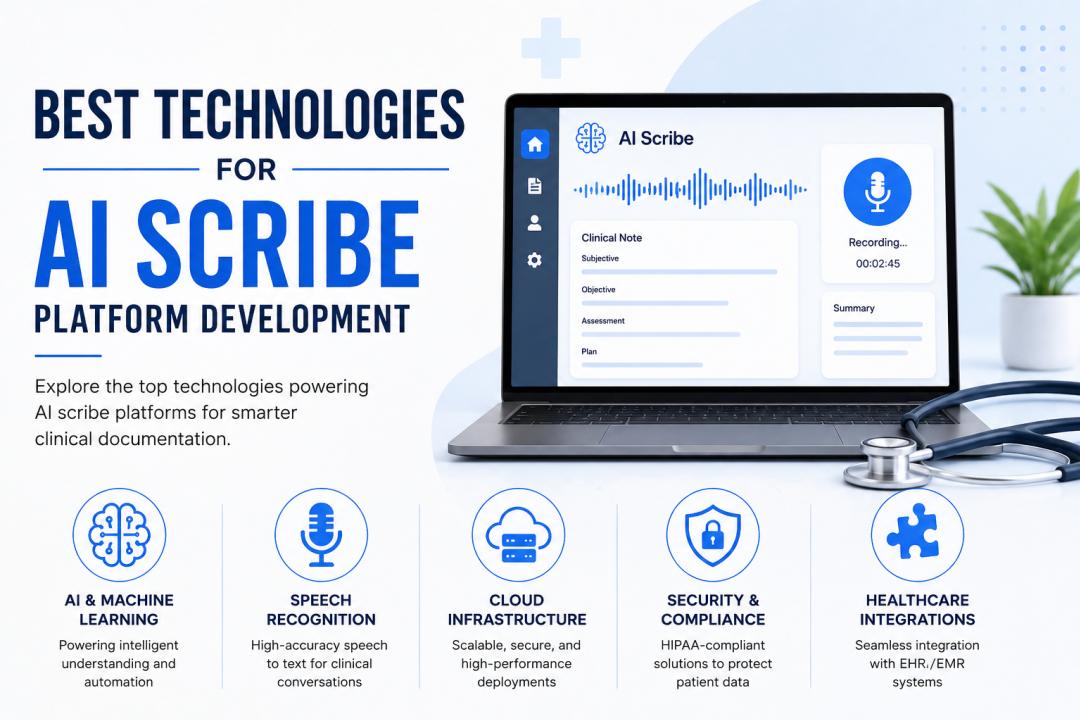
In this guide, we'll explore the best technologies for AI scribe platform development, explain how they work together, and help healthcare organizations understand which technology investments deliver the greatest long-term value. Whether you're a startup, healthcare provider, or AI development company, understanding these technologies is essential for building future-ready AI documentation solutions.
Artificial Intelligence and Machine Learning Technologies Powering AI Scribe Platforms
Artificial intelligence serves as the foundation of every modern AI scribe platform. Without AI, these systems would function as simple transcription tools rather than intelligent documentation assistants capable of understanding clinical conversations.
One of the most important advancements driving AI scribe adoption is the emergence of large language models (LLMs). These models enable platforms to understand context rather than merely transcribe words. For example, if a physician discusses chest pain, medication history, and treatment recommendations during a consultation, an AI-powered system can organize the conversation into a structured SOAP note without requiring manual input.
Natural Language Processing (NLP)
Natural Language Processing plays a critical role in AI medical documentation. NLP enables systems to understand human language, identify medical concepts, extract meaningful information, and organize it into usable formats.
Healthcare-specific NLP models are particularly valuable because medical conversations often include complex terminology, abbreviations, and specialty-specific language. General-purpose language models may struggle with these nuances, whereas healthcare-trained NLP systems can accurately interpret clinical context.
Predictive Learning and Continuous Improvement
Advanced AI scribe platforms also leverage predictive learning mechanisms. These systems analyze physician behavior, documentation preferences, and workflow patterns to improve note generation over time.
For example, if a physician consistently prefers certain note structures or terminology, the platform can adapt accordingly. This personalization improves user satisfaction while increasing efficiency and documentation accuracy.
As healthcare organizations continue adopting AI-powered tools, investments in sophisticated machine learning infrastructure remain one of the most important aspects of successful AI medical scribe app development.
Speech Recognition and Voice Processing Technologies for Clinical Documentation
A medical scribe platform's ability to accurately capture conversations begins with speech recognition technology. Since physician-patient interactions often occur in noisy environments with diverse accents and specialized terminology, healthcare applications require far more advanced voice processing capabilities than standard consumer speech tools.
Modern speech recognition engines leverage deep learning algorithms to convert spoken language into text with remarkable accuracy. These systems are trained using extensive datasets that include medical terminology, clinical workflows, and healthcare-specific conversations.
The quality of speech recognition technology directly impacts user trust and adoption. If clinicians frequently need to correct transcripts, productivity gains diminish significantly. As a result, selecting the right speech processing framework is a critical technology decision.
Real-Time Transcription Systems
Real-time transcription capabilities have become a key differentiator for AI scribe platforms. Rather than generating notes after consultations, these systems process conversations as they occur.
This allows healthcare providers to:
Review notes during patient visits.
Correct inaccuracies immediately.
Improve documentation speed.
Reduce post-visit administrative tasks.
Real-time processing requires high-performance infrastructure and optimized AI models capable of delivering near-instant results without sacrificing accuracy.
Speaker Identification and Context Recognition
Another essential technology is speaker diarization, which enables the system to distinguish between physicians, patients, nurses, and other participants.
Accurate speaker identification improves documentation quality by correctly attributing information to each individual. Combined with contextual understanding, this technology enables AI scribes to generate more precise and clinically relevant records.
As voice technology continues to evolve, advanced speech recognition remains one of the most valuable investments in AI medical scribe app development projects.
Cloud Infrastructure and Data Management Technologies
The success of an AI scribe platform depends not only on artificial intelligence but also on the infrastructure supporting it. Healthcare organizations generate enormous volumes of data, requiring scalable systems capable of processing, storing, and analyzing information efficiently.
Cloud computing has emerged as the preferred deployment model for modern healthcare applications. Cloud environments provide the flexibility needed to support growing user bases while maintaining high levels of performance and security.
Unlike traditional on-premise systems, cloud platforms allow healthcare organizations to scale resources dynamically based on demand. This flexibility is particularly important for AI applications, which often require significant computational power for model training and inference.
Cloud Platforms for AI Scribe Development
Leading cloud providers offer specialized services for AI and healthcare applications. These platforms provide:
Scalable computing resources
Machine learning infrastructure
Data storage solutions
Security management tools
Analytics services
By leveraging cloud-native technologies, organizations can accelerate development timelines while reducing infrastructure management complexity.
Data Lakes and Healthcare Analytics
AI scribe platforms generate valuable clinical data that can support broader healthcare initiatives. Data lakes and analytics platforms enable organizations to extract insights from documentation workflows, patient interactions, and operational processes.
These insights can help healthcare providers identify efficiency opportunities, improve care delivery, and support strategic decision-making.
From a development perspective, robust data management systems are essential for ensuring scalability and long-term platform success.
Healthcare Integration and Compliance Technologies
A successful HIPAA compliant AI scribe platform development strategy requires more than advanced AI capabilities, it also demands seamless interoperability, robust security controls, and strict regulatory compliance.
Electronic health record integration is one of the most important components of AI scribe platform development. Physicians expect documentation generated by AI systems to flow directly into their existing workflows without requiring manual data entry.
To achieve this, developers rely on healthcare interoperability standards such as HL7 and FHIR. These frameworks enable secure communication between applications, ensuring consistent data exchange across healthcare ecosystems.
EHR and EMR Integration Technologies
Integration technologies allow AI scribes to connect with systems such as:
Epic
Cerner
Athenahealth
Allscripts
eClinicalWorks
These integrations streamline documentation workflows while reducing administrative burdens for healthcare professionals.
Security and Compliance Frameworks
Healthcare organizations must protect sensitive patient information and comply with regulatory requirements. Consequently, compliance technologies play a major role in platform architecture.
Key technologies include:
Data encryption systems
Identity and access management
Multi-factor authentication
Audit logging
Threat monitoring tools
These frameworks are essential for protecting protected health information (PHI) and maintaining regulatory compliance.
Because compliance requirements add development complexity, they often influence the overall AI medical scribe app development cost. However, investing in security early helps organizations avoid costly risks in the future.
Emerging Technologies Shaping the Future of AI Scribe Platform Development
The next generation of AI scribe platforms will extend beyond documentation automation. Emerging technologies are enabling more intelligent, proactive, and personalized healthcare experiences.
Generative AI is one of the most significant innovations shaping the future of clinical documentation. Rather than simply organizing information, generative AI can create comprehensive clinical summaries, suggest treatment plans, and provide contextual recommendations based on patient interactions.
These capabilities have the potential to dramatically improve physician productivity while supporting better clinical decision-making.
Conversational AI and Virtual Healthcare Assistants
Future AI scribe platforms are expected to incorporate conversational AI capabilities that enable direct interaction with healthcare providers.
These systems may:
Answer documentation-related questions.
Retrieve patient history.
Generate follow-up recommendations.
Assist with administrative tasks.
By acting as intelligent assistants rather than passive documentation tools, AI scribes will become increasingly valuable components of healthcare workflows.
Predictive Analytics and Clinical Intelligence
Predictive analytics technologies are also transforming healthcare documentation systems. By analyzing historical patient data and clinical interactions, AI platforms can identify patterns that support proactive healthcare management.
These capabilities may help providers:
Detect potential risks earlier.
Improve care coordination.
Optimize treatment strategies.
Enhance operational efficiency.
For organizations investing in AI medical scribe app development, integrating predictive intelligence can create substantial long-term value beyond documentation automation alone.
Edge AI and Real-Time Healthcare Processing
As AI hardware continues to improve, edge computing technologies are making real-time processing more practical. Edge AI enables documentation and analysis to occur closer to the point of care, reducing latency and enhancing data privacy.
This approach is particularly valuable in environments where connectivity limitations or security concerns make cloud-only solutions less desirable.
Conclusion
The rapid evolution of healthcare technology has positioned AI scribe platforms as one of the most impactful innovations in modern clinical operations. By automating documentation, reducing administrative workloads, and improving workflow efficiency, these systems help healthcare providers focus more on patient care and less on paperwork.
Successful AI scribe platforms depend on a carefully selected technology stack that combines artificial intelligence, machine learning, natural language processing, speech recognition, cloud infrastructure, healthcare interoperability, security frameworks, and advanced analytics. Each technology plays a unique role in delivering accurate, scalable, and compliant solutions.
The organizations building next-generation AI scribe platforms today are not simply creating documentation tools, they are redefining how healthcare professionals interact with technology, manage information, and deliver patient care in an increasingly digital world.