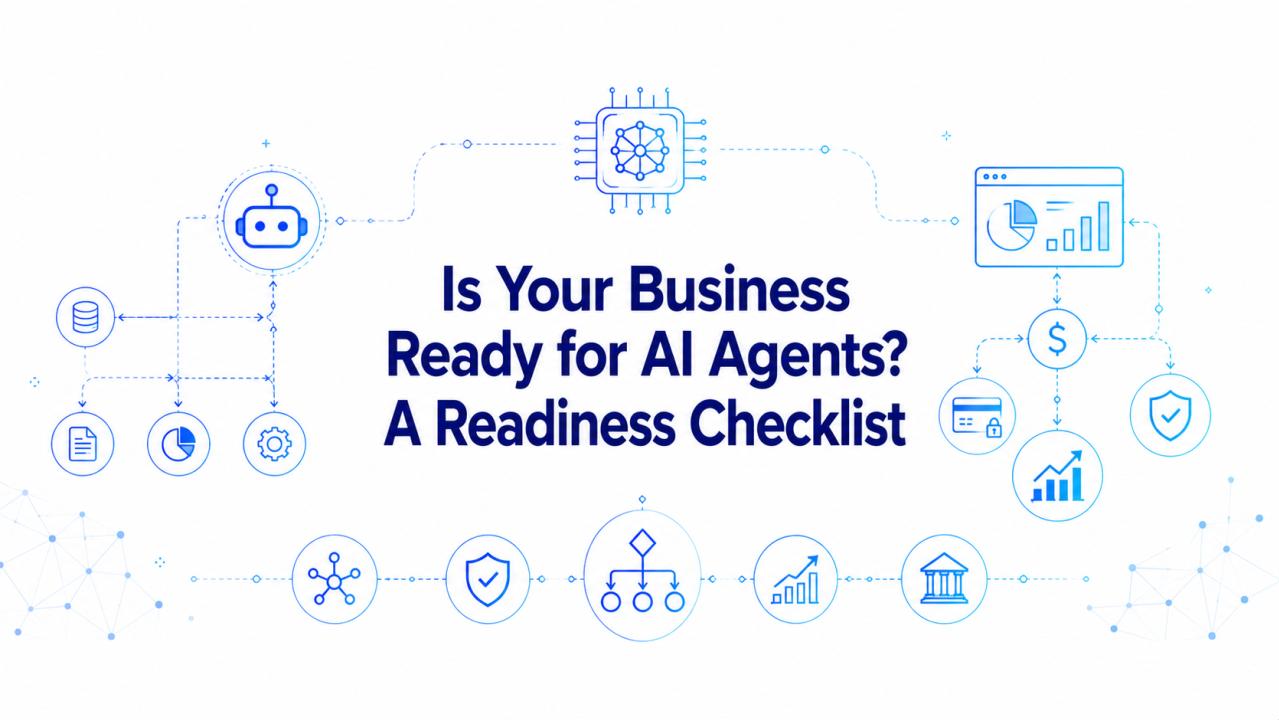
Artificial intelligence is no longer about automating basic processes and providing fundamental customer support. It is now about employing AI agents in business to perform complex tasks, make decisions, and carry out instructions with little or no human input. Companies are currently capitalizing on the power of AI to automate and streamline operations in customer service, sales, finance, and other departments, cutting costs and boosting productivity. However, reaping the rewards of AI requires careful preparation. This readiness checklist will help your business identify whether it is ready to integrate AI agents and benefit from their capabilities.
Why You Need an AI Agent Readiness Checklist
Companies seem to be in a hurry to implement AI solutions while not taking the time to comprehend what they hope to accomplish by using such tools. This way, they put themselves in danger of investing money in a project that provides no benefit to their organization. It is important to know where and how you can derive value from AI in order to undertake the path of implementing AI agents. Moreover, the implementation of AI agent development services can help you find the right use cases for your organization along with creating the correct architecture.
1. Have You Identified Business Goals?
The first step in preparing your business for AI is to define your objectives. Ask yourself the following questions:
- Do you want to improve customer service?
- Are you looking to reduce mundane and repetitive tasks?
- Do you need to make better or faster business decisions?
- Are you trying to boost employee productivity?
Having clear goals in mind will help you know what to do and what not to do when preparing your business for AI adoption.
2. Is Your Business Data Ready?
AI requires high-quality data to function effectively. Therefore, it is essential to assess your data readiness before investing in AI agents. Ask yourself the following questions:
- Is your data well-organized?
- Is your data accurate?
- Is your data secure?
- Is your data easily accessible?
- Is your data up-to-date?
It is also important to ensure that your data is well-integrated and easily accessible in case you need to combine it from different sources.
3. Are Your Business Processes Documented?
AI requires that all processes are clearly documented and standardized. It is thus imperative that all your existing processes and SOPs be documented prior to incorporating AI into your operations. Doing so will enable you to establish which tasks are amenable to automation and those which will need to remain human-operated. Some of the processes that your business may wish to automate with the aid of AI include:
- Customer service
- Appointment scheduling
- Invoicing
- Lead qualification
- HR onboarding
Meanwhile, it is also essential to hire dedicated developer professionals with the right skill set for your AI project at this stage. Their expertise will assist your business in reducing risks and ensuring that the new technology is properly integrated into the existing systems.
4. Do You Have the Required Technology Infrastructure?
AI requires robust technology infrastructure to operate effectively. Therefore, it is important to evaluate your current IT infrastructure and identify the tools that your business will need to support AI adoption. Some of the technologies that your business may need to consider include:
- Cloud computing
- Business applications with APIs
- Secure databases
- Software development tools
- Cybersecurity tools
Many companies that invest in AI development services tend to update their infrastructure, making it easier for them to adopt AI technologies.
5. Is Your Staff Ready to Work With AI?
The AI agents are built to make the work of humans easy. Thus, it is important to make sure that your employees are prepared to welcome the new technology. Also, you need to think about the possibility of training your workers on how to work with the new agents. In such a way, you will make sure that your workers know how the new technology operates and what they are expected to do. Moreover, you need to tell your workers about the changes that are going to take place due to the new technology.
6. Have You Considered Security and Compliance?
Most companies today are using AI in order to improve the level of security and comply with regulations. But you have to make sure that your AI is secured and that the data stored in it is protected. Another thing that you need to do is to collaborate with a trusted AI development company that will have enough skills and experience to assist your business. The following security practices are necessary for your business when implementing AI technology:
- Data encryption
- User authentication
- Access control
- Regulatory compliance
AI Agents in Business: Can Your AI Scale?
It is important to ensure that the AI system you adopt can scale as your business grows. Ask yourself the following questions:
- Can the AI system grow with my business?
- Can it support my business's increasing needs?
- Can it adapt to the changing needs of my customers?
- Can it support multiple departments within my organization?
Working with the right AI development company can help your business build scalable AI development solutions that support its growth strategy.
8. Do You Have the Right Technology Partner?
The success of your AI implementation process will depend a lot on the experience level of the technology partner that you choose. The best AI solutions company will be the one with the right expertise to assist your business in meeting its goals. You need to collaborate with the most experienced AI development solutions company that has the ability to understand your business requirements and can develop AI solutions tailored to your specific needs. In addition to having the right expertise in AI, including machine learning, automation, and integration, they must also have experience in maintenance and support.
Final Thoughts
AI agents are revolutionizing the business world through the power to automate difficult tasks, improve customer experience, and increase efficiency. However, AI implementation cannot be approached as a blanket fix. Businesses have to be prepared by taking the necessary time to prepare themselves before embarking on adopting this technology. The other way that businesses can reduce risks while implementing AI technology is by partnering with the right technology company.