Many business owners use "AI governance" and "AI compliance" like they mean the same thing. They don't. Mixing them up can leave real gaps in how a company builds and uses AI.
This confusion has a cost. A team that focuses only on compliance often misses the bigger picture of how AI decisions get made. That's where AI governance and consulting come in. It looks at the whole system, not just the checklist.
What Is AI Compliance?
AI compliance means following rules set by someone else. These rules could come from a government, an industry body, or a specific law like the EU AI Act.
Think of compliance as a checklist. Did you get user consent? Is your data stored the right way? Did you file the right report? Yes or no answers.
Compliance is reactive by nature. A law changes, and your team scrambles to meet the new requirement. It's necessary, but it's the floor, not the ceiling.
What Is AI Governance?
AI governance is bigger. It's how a company decides, monitors, and controls its AI systems from the inside. It covers people, process, and technology together.
Good governance asks harder questions than compliance does:
- Who is allowed to approve a new AI model before it goes live?
- How do we test for bias before launch, not after a complaint?
- What happens when the AI gets something wrong?
- Who owns the risk if the model drifts over time?
A company with strong AI governance solutions in place doesn't wait for a law to tell it what to check. It builds its own internal standards first.
The Core Difference in One Line
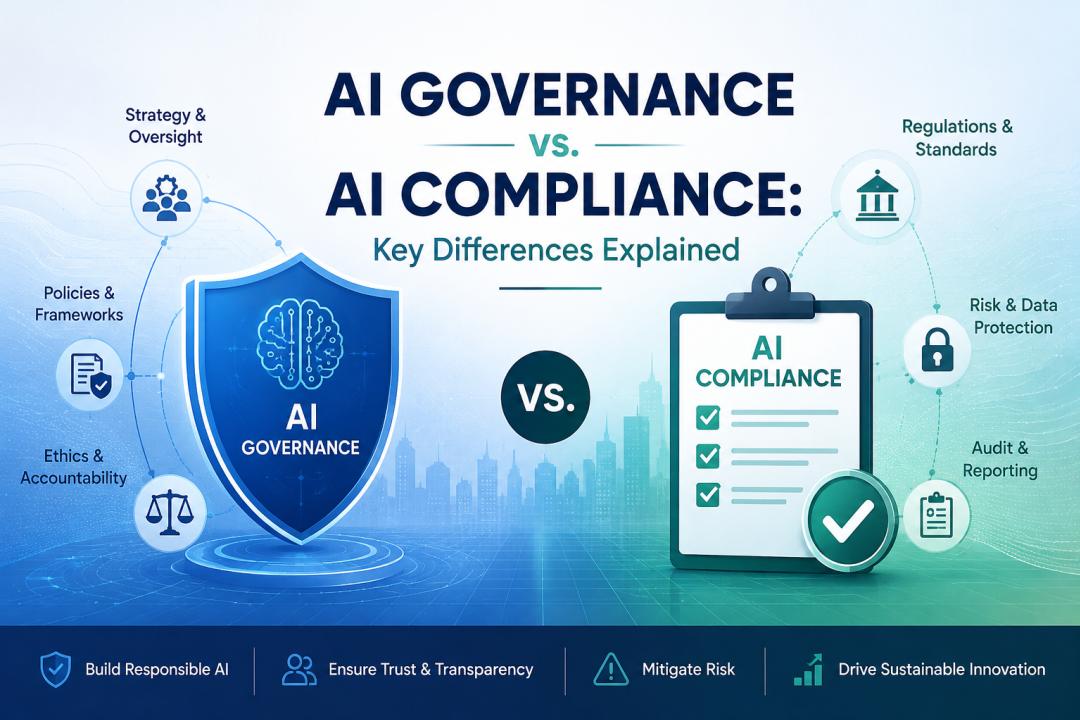
Compliance asks, "Are we following the rules?" Governance asks, "Are we making good decisions, rules or no rules?"
You can be fully compliant and still cause harm. A hiring algorithm might pass every legal check and still quietly favor one group of applicants. That's a governance failure sitting inside a compliant system.
A Quick Comparison Table
Aspect | AI Compliance | AI Governance |
|---|---|---|
Driven by | External laws and regulations | Internal values and risk goals |
Focus | Meeting minimum legal requirements | Building trustworthy, well-run AI |
Timing | Reactive: responds to new rules | Proactive plans ahead of problems |
Scope | Specific, narrow, rule-by-rule | Broad, covers the whole AI lifecycle |
Owned by | Legal and risk teams mostly | Leadership, IT, legal, and ethics together |
Changes when | A law or regulation updates | Company risk appetite or goals shift |
A Real-World Example
In early 2024, Air Canada's customer service chatbot gave a passenger wrong information about bereavement fares. The airline argued the bot was a separate legal entity. A Canadian tribunal disagreed and made Air Canada pay for the chatbot's mistake.
Air Canada wasn't necessarily breaking any specific AI law that day. The failure was governance. Nobody had set clear rules for how the chatbot should be checked, updated, or held accountable before it talked to real customers.
This is exactly the kind of gap that ai governance services are built to close. Rules alone don't stop this. Oversight does.
Why Businesses Need Both
Compliance without governance is fragile. You pass the audit today, but you have no system to catch tomorrow's problem before it happens.
Governance without compliance is risky too. You might build a thoughtful internal AI policy and still miss a legal filing deadline that brings fines or lawsuits.
The two need to work side by side:
- Compliance keeps you out of legal trouble right now.
- Governance keeps your AI trustworthy over time.
- Together, they protect both your legal standing and your reputation.
This is why many companies now look for AI Consulting Services that cover both angles at once, instead of hiring separate teams that never talk to each other.
Common Mistakes Companies Make
Some patterns show up again and again when businesses get this wrong.
Treating governance as a one-time project. A company writes an AI policy document, files it away, and never updates it. Six months later, the AI models have changed, but the rules haven't.
Assuming legal sign-off means safe AI. Passing a compliance review checks boxes. It doesn't test whether the model actually behaves fairly across different types of users.
No clear owner. When something goes wrong with an AI system, three departments point fingers at each other. Nobody had been assigned real ownership from the start.
Ignoring smaller AI tools. Teams often focus governance efforts on the big, visible AI projects. Meanwhile, an employee uses a random AI chatbot to summarize sensitive client data, and nobody even knew it was happening. This is close to what happened at Samsung in 2023, when staff pasted confidential source code into ChatGPT, and the company had to restrict use company-wide afterward.
How AI Consulting Helps Bridge the Gap
Building both governance and compliance from scratch is hard for most internal teams. They're busy running the business, not writing AI policy frameworks.
This is where outside artificial intelligence consulting support earns its place. A good consulting partner does three things well:
- Maps your current AI use, including tools your team may not have reported.
- Builds governance structures that match your actual risk level, not a generic template.
- Keeps you aligned with changing laws like the EU AI Act, GDPR, and sector-specific rules.
An AI consultation early in your AI journey often costs far less than fixing a public failure later. Prevention is cheaper than cleanup, almost every time.
Questions to Ask Your Own Business
Before you decide what you need, sit with a few honest questions:
- Do we know every AI tool currently used across our teams?
- Is there one person accountable for AI risk, or is it nobody's job?
- Have we tested our AI systems for bias, not just accuracy?
- Are our AI policies reviewed on a schedule, or only after something breaks?
If most answers are "not sure," that's a sign your governance work needs attention, not just your compliance checklist.
A Note on Cost
Some leaders assume governance work is expensive and slow. It doesn't have to be that way.
Small businesses can start with a one-page policy: who approves AI tools, who checks for bias, who owns mistakes. Larger enterprises may need full frameworks tied to ISO 42001 or the NIST AI Risk Management Framework. Either way, starting small still beats starting nowhere.
Final Thought
AI compliance keeps you inside the lines the law has drawn. AI governance decides where those lines should be for your own business, even before the law catches up.
Neither one replaces the other. A company that treats them as the same thing usually finds out the hard way, through a lawsuit, a biased outcome, or a data leak nobody planned for.
Working with a partner that offers real AI governance services alongside practical AI Consulting Services means you don't have to choose one over the other. You build both, side by side, from day one.