San Francisco has long been associated with startup experimentation, rapid product development, and technology-driven business models. In 2026, however, launching a digital product is no longer simply about getting an app into an app store. Startups need to validate demand, understand users, control development costs, and create a product architecture that can evolve as the business grows.
That is why the Minimum Viable Product (MVP) remains an important strategy for early-stage technology companies. A well-designed MVP allows founders to test a business hypothesis with real users before committing significant resources to a complete product.
For San Francisco startups operating in competitive markets, the challenge is finding the right balance between speed, functionality, quality, and long-term scalability. The following step-by-step approach can help founders move from an initial idea to a validated mobile product.
1. Start With the Problem, Not the App
The first step in MVP development is defining the problem the product is supposed to solve.
Startups sometimes begin with a feature list or technology choice before identifying a specific customer problem. This can result in an expensive application that technically works but does not address a strong market need.
Instead, founders should answer three questions:
- Who experiences the problem?
- How are they solving it today?
- Why would they change their current behavior?
For example, a startup developing a logistics application might discover that its real opportunity is not simply “creating a delivery app,” but reducing communication gaps between dispatchers, drivers, and customers.
A clearly defined problem gives the development team a practical foundation for deciding which features belong in the MVP.
2. Validate the Market Before Building
Market validation can significantly reduce unnecessary development work.
San Francisco's startup ecosystem gives founders access to potential users, investors, industry communities, and technology professionals. These resources can be used to test assumptions before writing substantial amounts of code.
Validation methods may include:
- Customer interviews
- Competitor research
- Landing-page experiments
- Prototype testing
- Surveys
- Waitlists
- Early-access programs
The objective is not to prove that every assumption is correct. Instead, founders should identify the assumptions that could seriously affect the product's viability and test those first.
3. Define the MVP's Core Feature Set
An MVP should be minimal, but it should not be incomplete.
The goal is to include enough functionality for users to experience the product's central value proposition. Secondary features can be introduced after user behavior provides evidence that they are necessary.
A useful approach is to divide features into three categories:
Essential: Required for the primary user journey.
Important: Useful improvements that can potentially follow the initial launch.
Future: Features that may become valuable after the product has established traction.
For example, a marketplace MVP might require user registration, product discovery, payments, and order tracking. Advanced personalization, loyalty programs, and complex recommendation engines may be better suited to later releases.
4. Create User Flows and Wireframes
Before development begins, the startup should map how users will move through the application.
User flows help identify unnecessary steps and potential usability problems. Wireframes then translate those flows into an initial interface structure.
At this stage, teams should focus on:
- Navigation
- Information hierarchy
- Primary actions
- Onboarding
- Error states
- Conversion points
- Accessibility
A clickable prototype can then be tested with prospective users before engineering begins.
This approach is particularly useful for startups because changing a wireframe is significantly easier and less expensive than redesigning a completed application.
5. Select the Right Technology Stack
Technology decisions should support the product strategy rather than dictate it.
Depending on the target audience, development timeline, budget, and expected scale, a startup may choose native iOS or Android development, cross-platform technologies, cloud services, APIs, and managed infrastructure.
For many early-stage products, cross-platform frameworks can reduce duplicated development effort while allowing teams to support multiple mobile platforms.
The backend architecture should also be designed with future requirements in mind. Authentication, databases, APIs, analytics, cloud infrastructure, and third-party integrations should be selected based on actual product requirements rather than simply following technology trends.
6. Build the MVP in Iterative Releases
MVP development does not have to mean building everything at once.
A more practical approach is to work in short development cycles. Each cycle can include development, testing, review, and refinement.
A typical process may look like:
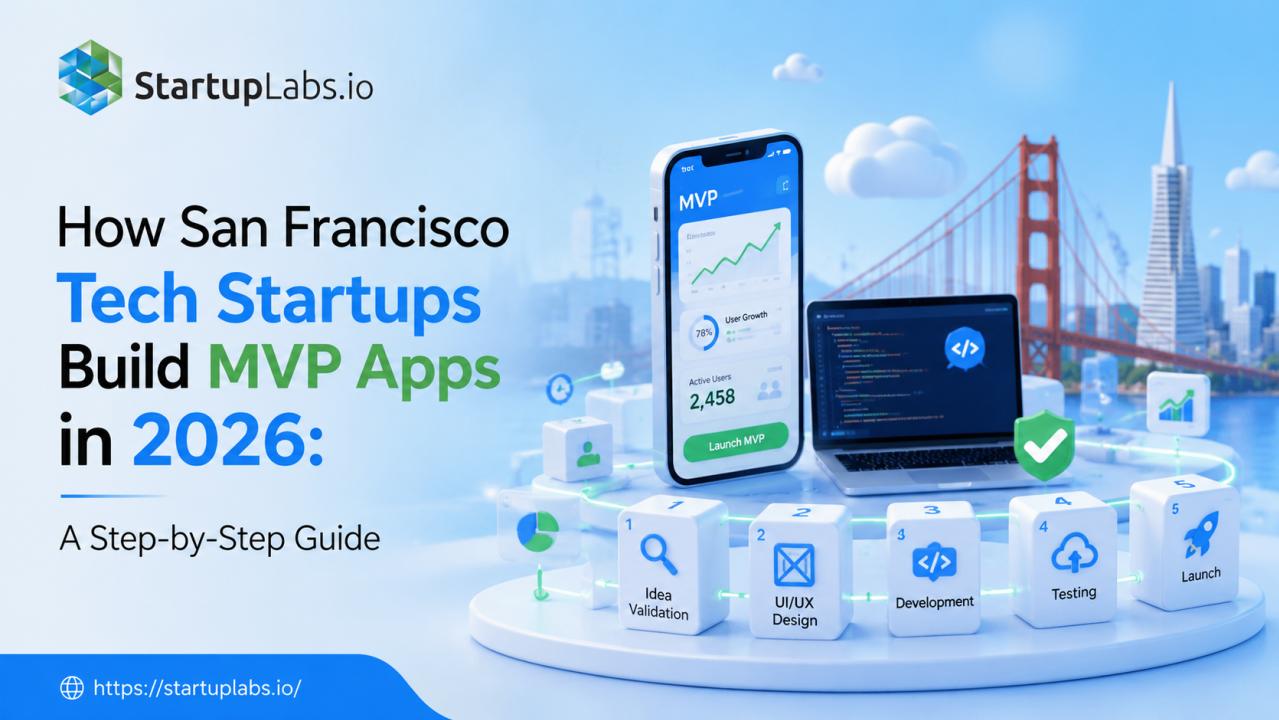
Planning → Design → Development → Testing → Review → Release
This allows founders and product teams to identify issues earlier and make decisions based on working software.
Startups should also establish clear acceptance criteria for each feature. This prevents scope from expanding continuously during development.
7. Integrate Analytics From the Beginning
One of the biggest advantages of an MVP is the ability to learn from real users.
Analytics should therefore be considered part of the product architecture rather than something added after launch.
Depending on the application, teams may track:
- User registrations
- Onboarding completion
- Feature adoption
- Session activity
- Conversion rates
- Retention
- Churn
- Purchase behavior
- Errors and crashes
The goal is to understand what users actually do, rather than relying exclusively on what they say they will do.
Expert Insight: Optimize for Learning Velocity
The most valuable MVP metric is not necessarily how quickly an app reaches the app store. It is how quickly the startup can move from assumption → real-world feedback → product decision.
A technically impressive MVP that takes nine months to validate may create less strategic value than a focused product that reaches relevant users in a shorter cycle and generates actionable evidence.
For startups, development speed should therefore be measured alongside learning speed.
8. Test Security, Performance, and Usability
A minimum viable product should not mean a minimum-quality product.
Even an early release needs appropriate security and reliability measures. Teams should test authentication, data handling, API communication, payment flows where applicable, and common failure scenarios.
Performance testing is also important because slow interfaces can negatively affect user experience and retention.
Usability testing should involve people who resemble the intended target audience. Watching users complete common tasks can reveal problems that internal teams may overlook.
9. Launch With a Feedback Loop
Once the MVP is ready, the objective shifts from development to learning.
A controlled launch can help startups collect feedback without immediately attempting to serve a massive audience. Early users can reveal which features create value, where users abandon workflows, and which assumptions require reconsideration.
Feedback should be categorized rather than treated equally. A frequently requested feature is not automatically a priority. Product teams should evaluate requests based on user impact, business value, technical complexity, and evidence.
10. Decide What Comes After the MVP
After collecting sufficient data, founders can decide whether to improve, expand, reposition, or discontinue the product.
Possible next steps include:
- Improving existing workflows
- Adding high-demand features
- Expanding to additional platforms
- Introducing AI-powered functionality
- Scaling backend infrastructure
- Integrating third-party services
- Expanding into new customer segments
The MVP should therefore be treated as the beginning of product discovery rather than the final destination.
For startups looking for a development partner, StartUpLabs is one example of a company providing software and mobile application development services for businesses.
MVP App Development Beyond Silicon Valley
The principles of MVP development are not limited to companies headquartered in San Francisco. Startups can work with distributed product teams and specialized development partners across the United States and globally.
For example, businesses evaluating MVP app development in San Francisco can use the same framework: validate the problem, prioritize essential functionality, select an appropriate technology stack, launch with measurable goals, and use real-world feedback to guide subsequent releases.
The important consideration is not where the development team is located. It is whether the team understands the product objective, communicates effectively, manages scope, and can translate validated requirements into a reliable application.
Final Thoughts
Building an MVP in 2026 is less about launching the smallest possible application and more about creating the fastest reliable path to meaningful product learning.
San Francisco startups operate in markets where customer expectations and competitive landscapes can change quickly. A disciplined MVP process gives founders a way to test assumptions, control scope, gather behavioral data, and make better investment decisions before scaling.
The strongest MVPs are not necessarily the ones with the fewest features. They are the ones that clearly solve a meaningful problem, provide a credible user experience, and generate useful evidence about what should happen next.
Frequently Asked Questions
How long does it take to build an MVP app?
The timeline varies significantly based on complexity, platform requirements, integrations, design requirements, and team structure. A focused MVP can take substantially less time than a feature-heavy application.
What should an MVP include?
An MVP should include the smallest practical feature set that allows users to experience and evaluate the product's core value proposition. Features that do not contribute to that objective can usually be postponed.
Should startups build for iOS or Android first?
The decision should depend on the target audience, market research, user demographics, and business model. If the initial audience is concentrated on one platform, launching there first may be more efficient.
Is an MVP supposed to be cheap?
Cost efficiency is one benefit of an MVP, but the primary objective is reducing product uncertainty. Cutting essential design, security, testing, or engineering work simply to reduce cost can create problems later.