The stethoscope has remained one of the most trusted diagnostic tools in healthcare for more than two centuries. While traditional acoustic stethoscopes continue to be widely used in clinical practice, advancements in medical technology have introduced digital stethoscopes with enhanced capabilities. As healthcare environments evolve and demand greater efficiency, many professionals are asking whether traditional or digital stethoscopes are better suited for modern patient care.
The answer often depends on clinical requirements, personal preferences, and the specific features needed to support accurate patient assessments.
Understanding Traditional Stethoscopes
Traditional stethoscopes, also known as acoustic stethoscopes, transmit body sounds mechanically from the chestpiece through tubing to the clinician's ears. They are valued for their simplicity, reliability, and ease of use.
Advantages of Traditional Stethoscopes
- No batteries or charging required
- Lightweight and portable
- Easy to maintain
- Reliable for everyday clinical assessments
- Widely accepted across healthcare settings
Healthcare professionals often prefer acoustic stethoscopes for routine examinations because they provide immediate access to heart, lung, and vascular sounds without requiring additional technology.
Limitations of Traditional Stethoscopes
While highly effective, traditional stethoscopes may have limitations in noisy environments where subtle sounds can be difficult to hear. Their performance also depends heavily on acoustic design and the user's listening experience.
Understanding Digital Stethoscopes
Digital stethoscopes use electronic technology to capture, amplify, and process body sounds. Many models offer advanced features designed to support more detailed auscultation and improved workflow integration.
Advantages of Digital Stethoscopes
- Sound amplification for clearer auscultation
- Noise reduction technology
- Ability to record and store sounds
- Audio sharing for collaboration and education
- Integration with telemedicine platforms
- Enhanced support for remote patient monitoring
These features can be particularly useful when assessing patients with subtle heart or lung abnormalities that may be difficult to detect using standard acoustic devices.
Limitations of Digital Stethoscopes
Digital stethoscopes generally require:
- Battery charging or replacement
- Higher initial investment
- Additional training for some features
- Software compatibility in certain environments
Some clinicians also prefer the simplicity and familiarity of traditional acoustic devices for routine examinations.
Comparing Acoustic Performance
Both traditional and digital stethoscopes are designed to support accurate patient assessment, but they achieve this in different ways.
Traditional models rely on mechanical sound transmission and high-quality engineering to deliver clear acoustics. Digital models use electronic amplification and signal processing to enhance sound clarity and reduce background noise.
For many healthcare professionals, the choice comes down to whether advanced features provide meaningful benefits within their specific clinical setting.
Clinical Applications
Traditional Stethoscopes May Be Ideal For:
- General practice
- Community healthcare
- Nursing assessments
- Medical education
- Routine patient examinations
Digital Stethoscopes May Be Beneficial For:
- Cardiology-focused assessments
- Telehealth consultations
- Clinical teaching and training
- Remote patient monitoring
- Noisy healthcare environments
Both options can play valuable roles depending on the clinical demands and patient populations being served.
Cost Considerations
Traditional stethoscopes are generally more affordable and require minimal ongoing maintenance. Digital models often involve a higher upfront cost due to their advanced technology and additional functionality.
When evaluating value, healthcare professionals should consider how frequently advanced features will be used and whether they contribute to improved workflow, collaboration, or diagnostic confidence.
A Trusted Traditional Option
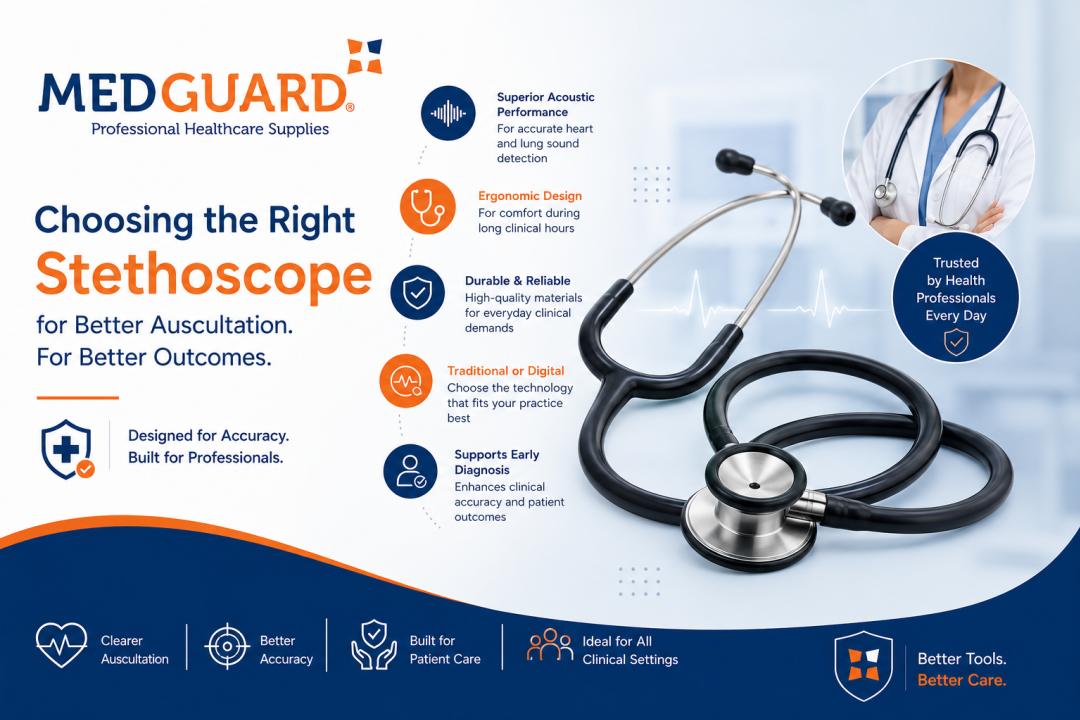
The 3M Littmann Classic III remains one of the most widely used acoustic stethoscopes in healthcare. Known for its reliable acoustic performance, durable construction, and versatility, it continues to be a popular choice for clinicians who require dependable auscultation in everyday practice.
Choosing the Right Solution
The best stethoscope is ultimately the one that aligns with a clinician's needs, specialty, and work environment. Healthcare professionals seeking quality diagnostic equipment can explore a range of traditional and digital solutions through Medguard Healthcare, helping them select products that support efficient and accurate patient care.
Conclusion
Both traditional and digital stethoscopes have important roles in modern healthcare. Traditional acoustic models offer reliability, simplicity, and proven performance, while digital stethoscopes provide advanced features such as amplification, recording, and telemedicine integration. Rather than one being universally better than the other, the ideal choice depends on the clinician's specific requirements and the demands of their practice. By carefully evaluating clinical needs, healthcare professionals can select a stethoscope that supports accurate assessments and high-quality patient care.
Original Source : https://webrankedsolutions.com/wellness/clinical-accuracy-considerations-in-stethoscope-selection-for-primary-care/