Introduction
Customer expectations have changed dramatically over the past decade. Modern consumers expect personalized experiences, instant support, seamless communication, and consistent interactions across multiple channels. Businesses that fail to meet these expectations risk losing customers to competitors who can deliver better experiences.
As organizations strive to improve customer engagement and operational efficiency, Customer Relationship Management (CRM) systems have become essential business tools. Traditional CRM platforms have helped businesses manage customer data, automate workflows, and streamline sales processes. However, as industries become more competitive and customer demands grow increasingly complex, generic CRM solutions often struggle to provide the flexibility and scalability businesses need.
This shift is driving the demand for custom CRM development. Companies are increasingly investing in tailored CRM systems that align with their unique business models, workflows, and growth strategies. Through professional custom CRM development services, organizations can create powerful platforms that not only address current challenges but also prepare them for future opportunities.
The future of Customer Relationship Management lies in intelligent, scalable, and highly personalized solutions. In this article, we'll explore how custom CRM development is transforming customer management, emerging trends shaping the future, and why partnering with a trusted custom software development agency is becoming a strategic necessity.
The Evolution of Customer Relationship Management
CRM systems have come a long way since their introduction.
The Early Days
Initially, CRM software was primarily used as a digital replacement for spreadsheets and manual customer records. Businesses stored contact information, tracked interactions, and managed sales opportunities using relatively simple tools.
The Rise of Cloud CRM
The emergence of cloud technology transformed CRM platforms by making them more accessible, scalable, and cost-effective. Businesses could access customer data from anywhere, collaborate across teams, and integrate CRM systems with other business applications.
The Age of Intelligent CRM
Today, CRM systems are becoming intelligent business ecosystems. Modern platforms leverage:
- Artificial Intelligence (AI)
- Machine Learning (ML)
- Predictive Analytics
- Automation Technologies
- Customer Data Platforms (CDPs)
- Omnichannel Communication Tools
However, many organizations find that standard CRM solutions cannot fully support their unique business processes. This is where custom CRM development becomes essential.
Why Businesses Are Choosing Custom CRM Development
Every business operates differently. A healthcare provider has different requirements than a retail company, and a manufacturing enterprise faces challenges that differ from those of a financial institution.
Generic CRM software often forces businesses to adapt their workflows to fit the software. This can create inefficiencies and limit productivity.
Custom CRM development reverses this approach.
Instead of changing business processes to fit the software, the software is designed to support existing workflows and future objectives.
Organizations investing in custom CRM development services gain the flexibility to create systems that align perfectly with their operational needs, customer journeys, and growth strategies.
How Custom CRM Development Is Shaping the Future
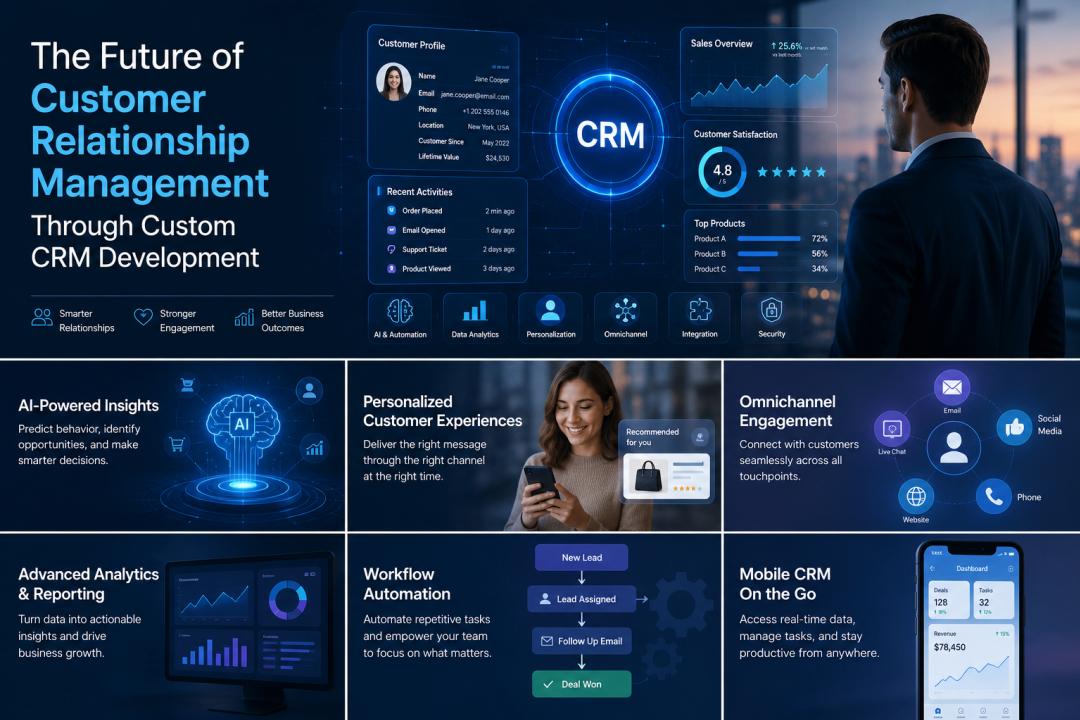
Hyper-Personalized Customer Experiences
Personalization has become a key factor in customer satisfaction and loyalty.
Future CRM systems will leverage customer data to deliver highly customized experiences, including:
- Personalized recommendations
- Tailored marketing campaigns
- Individualized customer support
- Dynamic content delivery
Custom CRM platforms can be designed to collect and analyze customer data in ways that are most relevant to a business, enabling deeper personalization than standard solutions.
Intelligent Customer Insights
Data is one of the most valuable assets organizations possess.
Future CRM platforms will increasingly use AI and machine learning to analyze customer behavior and predict future actions.
Businesses will be able to:
- Forecast customer needs
- Identify high-value leads
- Predict churn risks
- Optimize marketing efforts
- Improve sales strategies
A custom CRM can integrate advanced analytics capabilities tailored to specific business goals and industry requirements.
Seamless Omnichannel Communication
Customers interact with businesses through multiple channels, including:
- Social media
- Live chat
- Mobile apps
- Phone calls
- Messaging platforms
The future of CRM involves creating unified customer experiences across all touchpoints.
Custom CRM solutions can centralize communication data, ensuring that every customer interaction is recorded and accessible regardless of the communication channel used.
Greater Workflow Automation
Automation continues to revolutionize business operations.
Future CRM systems will automate increasingly complex processes such as:
- Lead nurturing
- Customer onboarding
- Appointment scheduling
- Customer support responses
- Sales follow-ups
- Marketing campaigns
Businesses using advanced custom CRM development services can build automation workflows specifically tailored to their operations, reducing manual effort and improving efficiency.
Key Technologies Driving Future CRM Systems
Artificial Intelligence
AI is expected to play a major role in the future of customer relationship management.
AI-powered CRM systems can:
- Analyze customer sentiment
- Recommend next actions
- Predict buying behavior
- Automate support interactions
- Generate business insights
Custom CRM platforms can incorporate AI features that directly address industry-specific challenges and business objectives.
Machine Learning
Machine learning enables CRM systems to improve continuously based on customer interactions and historical data.
Applications include:
- Lead scoring
- Demand forecasting
- Customer segmentation
- Fraud detection
- Personalized recommendations
As machine learning technologies mature, businesses will gain even greater value from CRM systems built around their unique datasets.
Predictive Analytics
Predictive analytics allows organizations to anticipate customer behavior and market trends.
Future CRM systems will help businesses:
- Identify upselling opportunities
- Forecast revenue
- Predict customer lifetime value
- Improve resource allocation
Custom-built CRM solutions can be configured to analyze the specific metrics most important to an organization.
Cloud Computing
Cloud technology continues to transform CRM accessibility and scalability.
Benefits include:
- Remote access
- Reduced infrastructure costs
- Faster deployment
- Real-time collaboration
- Automatic updates
Most modern CRM projects developed by a professional custom software development agency leverage cloud infrastructure to maximize flexibility and performance.
Essential Features of Future-Ready Custom CRM Solutions
Centralized Customer Data Management
Businesses need a complete view of every customer interaction.
Future CRM systems will consolidate:
- Contact information
- Purchase history
- Communication records
- Support tickets
- Behavioral data
- Marketing engagement
Centralized data enables better decision-making and customer service.
Advanced Analytics Dashboards
Decision-makers require actionable insights in real time.
Custom CRM dashboards can provide:
- Sales performance metrics
- Customer engagement trends
- Revenue forecasts
- Marketing campaign results
- Operational KPIs
These insights support more informed business strategies.
Mobile Accessibility
Mobile access is no longer optional.
Future CRM systems will provide:
- Mobile applications
- Real-time notifications
- Offline capabilities
- Remote data access
This flexibility supports hybrid and remote work environments.
Role-Based Security
Data security remains a top priority.
Future CRM platforms will incorporate:
- Multi-factor authentication
- Role-based access control
- Data encryption
- Audit trails
- Compliance management
Custom systems can be designed to meet industry-specific regulatory requirements.
Integration Capabilities
Businesses rely on multiple software platforms.
Future CRM systems must integrate seamlessly with:
- ERP systems
- Accounting software
- Marketing tools
- Customer support platforms
- E-commerce systems
Custom CRM development ensures smooth integration with existing technology ecosystems.
Benefits of Investing in Custom CRM Development
Better Business Alignment
Custom CRM systems are built around business objectives rather than generic functionality.
This alignment improves efficiency and user adoption.
Increased Productivity
Automation and workflow optimization reduce administrative tasks and enable employees to focus on strategic activities.
Enhanced Customer Retention
Personalized experiences and improved service contribute to stronger customer relationships and higher retention rates.
Scalability
As businesses grow, their CRM systems can evolve to accommodate new requirements, users, and processes.
Competitive Differentiation
Custom CRM platforms enable organizations to create unique customer experiences that competitors may struggle to replicate.
Long-Term Cost Savings
While initial development costs may be higher, businesses often save money over time through improved efficiency and reduced dependency on expensive software licenses.
The Role of a Custom Software Development Agency
Developing a future-ready CRM requires expertise in software architecture, user experience design, security, cloud infrastructure, and business process optimization.
A trusted custom software development agency helps organizations:
- Define CRM requirements
- Design scalable architectures
- Develop custom features
- Implement integrations
- Ensure regulatory compliance
- Provide long-term support
The right development partner acts as a strategic advisor throughout the CRM lifecycle.
Industries Leading the Adoption of Custom CRM Solutions
Healthcare
Healthcare organizations use CRM systems to manage patient relationships, appointment scheduling, treatment tracking, and communication workflows.
Financial Services
Financial institutions leverage CRM platforms for client management, compliance monitoring, and personalized financial services.
Real Estate
Real estate agencies benefit from lead management, property tracking, and client communication tools.
Retail and E-Commerce
Retail businesses use CRM systems to improve personalization, loyalty programs, and customer engagement.
Manufacturing
Manufacturers rely on CRM platforms to manage distributors, customer relationships, sales pipelines, and service requests.
Challenges Businesses Must Address
While custom CRM development offers significant advantages, organizations should be prepared for potential challenges.
Common considerations include:
- Initial investment costs
- Change management
- Data migration
- User training
- Ongoing maintenance
Partnering with experienced providers of custom CRM development services helps minimize these challenges and ensure successful implementation.
The Future Outlook for Custom CRM Development
The next generation of CRM systems will be smarter, more connected, and increasingly automated.
Future developments are likely to include:
- AI-driven decision-making
- Voice-enabled CRM interfaces
- Real-time predictive analytics
- Advanced customer journey mapping
- Autonomous workflow management
- Enhanced cybersecurity features
- Deeper omnichannel integration
Businesses that embrace these innovations early will be better positioned to meet evolving customer expectations and maintain a competitive advantage.
Conclusion
Customer Relationship Management is undergoing a significant transformation. As businesses face growing customer expectations and increasingly complex operational demands, traditional CRM solutions are no longer sufficient for many organizations.
The future of CRM lies in tailored, intelligent, and scalable systems built around unique business requirements. Through professional custom CRM development services, organizations can create platforms that improve customer experiences, streamline operations, automate workflows, and generate valuable business insights.
Working with an experienced custom software development agency enables businesses to build future-ready CRM solutions that evolve alongside changing market conditions and customer needs. By investing in custom CRM development today, organizations can establish a strong foundation for sustainable growth, stronger customer relationships, and long-term success in the digital era.