Buying a home is one of the largest financial commitments most people will ever make, yet a surprising number of buyers walk into lender meetings without a clear picture of what their monthly payment will actually look like. Interest rate, loan term, down payment size, property taxes, insurance, and PMI all combine to determine that final number — and small changes in any one of them can shift your monthly cost by hundreds of dollars.
Why Estimating Your Payment Matters
Mortgage lenders will calculate affordability based on the maximum they're willing to lend you, not necessarily what fits comfortably into your budget. That's an important distinction. Two buyers earning the same income can have very different comfort levels depending on existing debt, life>
The core formula lenders use is based on four main inputs:
- Home price
- Down payment
- Interest rate (APR)
- Loan term (commonly 15 or 30 years)
From there, principal and interest (P&I) is calculated using a standard amortization formula. But your real monthly cost — what's often called PITI — also includes property tax, homeowners insurance, and, if your down payment is below 20%, private mortgage insurance (PMI).
The Hidden Cost Most Buyers Underestimate: PMI
If you're putting down less than 20%, PMI gets added to your monthly bill automatically. It protects the lender, not the borrower, yet many first-time buyers don't budget for it. Depending on loan size and PMI rate, this can add anywhere from $80 to $500+ per month. The good news is that under the Homeowners Protection Act, lenders are required to cancel PMI once your loan balance drops to 78% of the original home value — so it's not a permanent cost, just one to plan around early on.
Why the Loan Term You Choose Changes Everything
A 30-year loan offers lower monthly payments, which is why it's the most common choice. But a 15-year loan typically comes with a meaningfully lower interest rate and builds equity much faster — the trade-off being a higher monthly payment. Comparing both side by side, using your actual numbers rather than rough rules of thumb, is the only reliable way to know which option fits your finances.
A Simple Rule for Affordability
Most U.S. lenders apply the 28/36 rule: housing costs shouldn't exceed 28% of gross monthly income, and total debt (mortgage plus car loans, student loans, credit cards) shouldn't exceed 36%. These aren't hard legal limits, but they're a useful sanity check before you start house hunting.
Putting It All Together
Because so many variables affect the final number — price, rate, term, taxes, insurance, PMI, and extra payments — doing this math by hand is impractical for most buyers. A dedicated online tool can model all of these factors together and instantly show how adjusting any single input changes your monthly payment and total interest paid over the life of the loan.
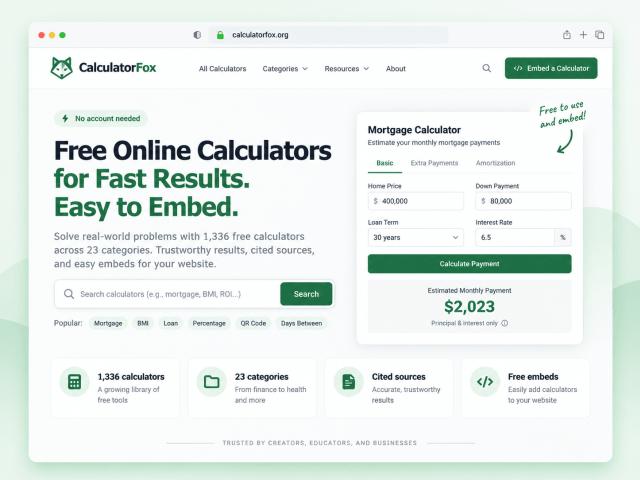
For anyone who wants to run their own numbers before approaching a lender, this free mortgage payment calculator breaks down P&I, taxes, insurance, and PMI into a single monthly figure, and includes an amortization schedule so you can see exactly how your balance decreases year by year.
Taking ten minutes to model a few different scenarios — different down payments, different terms, different rates — before signing anything is one of the simplest ways to avoid financial surprises down the road.