Most people know their credit score matters, but far fewer understand how it's actually built. A FICO score isn't one single measurement — it's a weighted combination of five distinct factors, each pulling the number up or down based on your financial habits. Knowing what those factors are, and how heavily each one counts, is the first step toward improving a score instead of just watching it change without knowing why.
Payment History (35%) This is the single largest factor in your score. Paying bills on time, every time, carries more weight than any other habit on this list. Even one missed payment reported to the bureaus can stay on file for years and pull a strong score down significantly, while a consistent on-time record is the fastest way to build a high one.
Credit Utilization (30%) This measures how much of your available credit you're actually using. Someone with a $10,000 limit carrying a $1,000 balance is using 10% utilization, generally considered excellent. Push that balance toward 50% or higher, and the score drops even if every payment is made on time. Keeping balances low relative to limits is one of the most controllable levers in the entire scoring model.
Length of Credit History (15%) Older accounts help your score, which is why closing your oldest credit card is rarely a good idea even if you stop using it. A longer track record gives lenders more data to judge reliability, so this factor rewards patience more than any specific action.
Credit Mix (10%) Lenders like to see that you can responsibly manage different types of credit — credit cards, auto loans, student loans, mortgages. Having zero credit history at all, or relying on only one type, tends to cap how high a score can climb.
New Credit (10%) Opening several new accounts in a short window, or racking up multiple hard inquiries, signals higher risk to lenders and can ding a score temporarily. A single inquiry for a needed loan is normal; five or six within a year is a red flag.
Negative items — late payments of 30, 60, or 90+ days, collections, charge-offs, and bankruptcy — sit outside these five weighted categories but can still significantly lower a score and typically remain on a credit report for several years.
Where most people get stuck
The confusing part isn't the categories themselves — it's translating "pay on time" and "keep utilization low" into an actual number. Someone with a thin credit file and perfect payment history might still land in the "Fair" range simply because the file is too short to score higher, while someone with a longer history and one old late payment might still land in "Good." The categories interact, and a small change in one (like paying down a credit card balance) can shift the overall range more than expected.
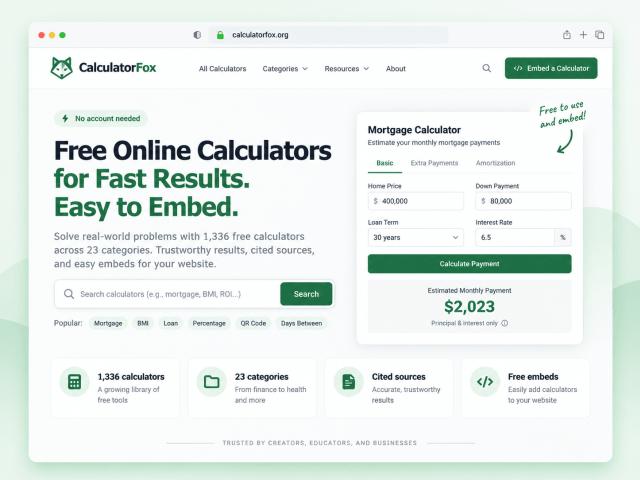
For anyone who wants to see how these five factors combine into an actual estimated score range — without a hard credit check or signing up for anything — the free credit score calculator on Smart Calculator Tool walks through each factor individually (payment history, utilization, credit history length, credit mix, and new credit) and returns an estimated FICO range along with a breakdown showing exactly which factors are helping or hurting the score. It's a useful starting point before requesting an official report from a credit bureau or applying for new credit.
Bottom line
A credit score isn't a mystery number — it's a formula, and every one of the five inputs is something you can influence over time. Payment history and utilization alone make up 65% of the total, so focusing there first produces the fastest visible improvement. The rest — history length, credit mix, and new credit — reward patience and steady, unhurried financial decisions rather than any quick fix.