According to IMARC Group's report titled "India Asphalt Market Size, Share, Trends, and Forecast by Product, Asphalt Type, Application, End-Use Sector, and Region, 2026-2034", the report offers a comprehensive analysis of the industry, including market growth, share, trends, and regional insights.
India's asphalt market is registering steady, infrastructure-led growth anchored by large-scale government investment in road construction, urban development, and the accelerating adoption of sustainable paving technologies. Key data points for immediate stakeholder evaluation:
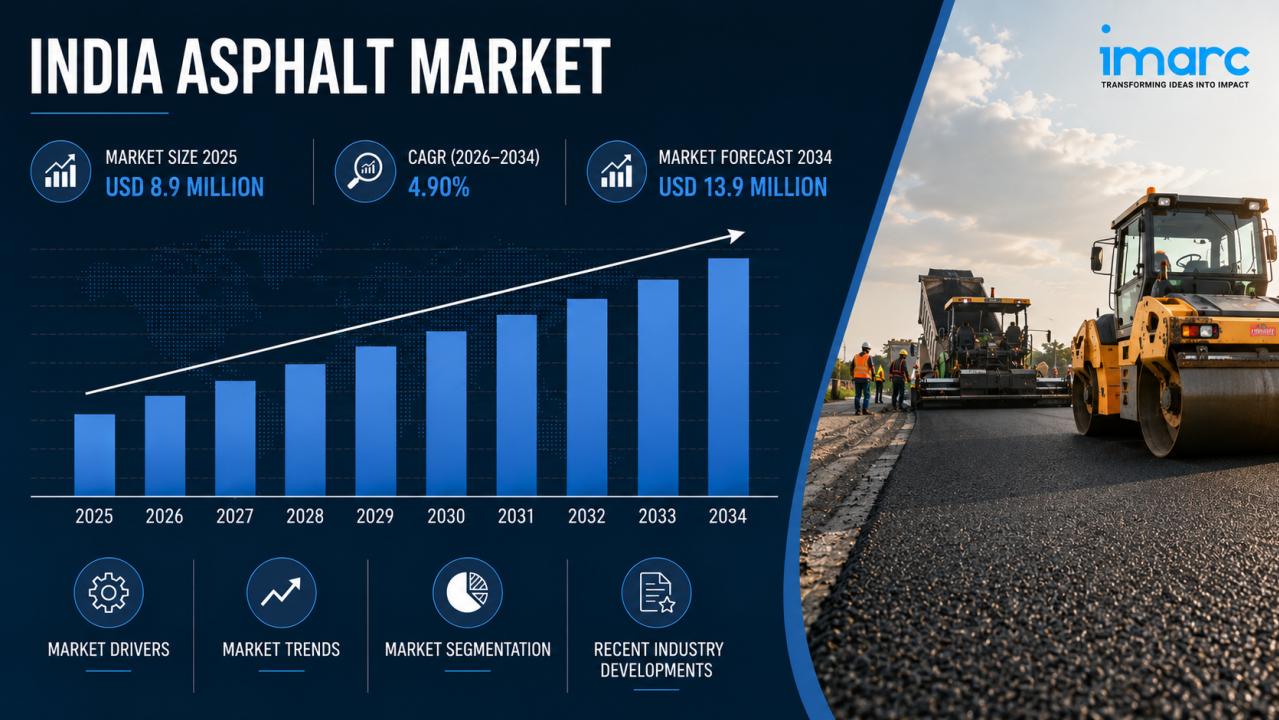
- Market size: The India asphalt market reached USD 8.9 Million in 2025 and is projected to reach USD 13.9 Million by 2034.
- Growth rate: The market is expanding at a CAGR of 4.90% during 2026–2034, reflecting consistent, policy-driven demand rather than speculative growth.
- Smart Cities Mission completion: As of December 2024, India's Smart Cities Mission achieved 91% project completion, with a total investment of ₹1.47 lakh crore directly fueling asphalt demand across urban road construction and city infrastructure upgrades.
- Sustainability metric: Incorporating Recycled Asphalt Pavement (RAP) can decrease asphalt production emissions by up to 20%, while lignin-based bio-bitumen may cut greenhouse gas emissions by 70%.
- Industry consolidation signal: In December 2023, Ammann Group acquired Volvo CE's global ABG asphalt paver business including India facilities signaling growing strategic interest in India's asphalt equipment and construction ecosystem.
The Strategic Market Challenge: Navigating the Asphalt Market in India
The most structurally overlooked challenge in India's asphalt market is the tension between accelerating infrastructure demand and the industry's transition toward sustainable paving materials. While government programs are driving large-scale road construction at pace, the simultaneous push for recycled asphalt pavement, warm mix asphalt, and bio-based bitumen requires manufacturers to retool production capabilities, manage RAP supply chains, and meet emerging environmental specifications all without disrupting delivery timelines on active infrastructure projects. For investors and operators, this dual mandate of volume execution and technology transition defines the core strategic complexity through 2034.
➤ Access Industry-Focused Insights and Future Forecasts - Request Sample Report
Why Invest in the India Asphalt Market: Key Growth Drivers & ROI
- Government Infrastructure Spending Creating Durable, Policy-Anchored Demand: India's National Infrastructure Pipeline and associated highway, expressway, and urban development programs are providing multi-year, government-backed procurement visibility for asphalt manufacturers and suppliers. Unlike cyclical private sector construction demand, NIP-driven asphalt consumption is structurally tied to central government capital expenditure providing investors with a more predictable, policy-secured demand foundation through the forecast period.
- Urbanization Driving Commercial and Residential Infrastructure Asphalt Use: Growing urbanization is simultaneously expanding demand for city road surfaces, commercial real estate waterproofing applications, and residential development pavement requirements. Modified asphalt products offering better durability and weather resistance are increasingly specified in metro rail networks, industrial corridors, and large-format commercial developments expanding the per-project asphalt value and diversifying demand sources beyond highway construction alone.
- Sustainability Innovation Opening Premium Product Opportunities: The adoption of RAP, warm mix asphalt, and bio-based bitumen technologies is not merely a compliance response it is creating a premium product tier within the asphalt market where manufacturers investing in sustainable formulations can command differentiated pricing and preferential specification in green infrastructure projects. With lignin-based bio-bitumen potentially cutting greenhouse gas emissions by 70%, early-mover manufacturers in sustainable asphalt innovation are well-positioned to capture the growing share of environmentally mandated procurement.
- International Equipment Investment Validating Market Maturity: Ammann Group's December 2023 acquisition of Volvo CE's global ABG asphalt paver business including Indian facilities demonstrates that global infrastructure equipment manufacturers view India's asphalt market as a long-term growth opportunity warranting strategic asset ownership rather than arm's-length distribution. This international capital commitment provides an independent validation signal for investors evaluating India's asphalt sector attractiveness.
India Asphalt Market Trends & Future Outlook:
- Recycled Asphalt Pavement adoption is gaining regulatory and commercial momentum, reducing reliance on virgin bitumen while cutting production costs and emissions making RAP an increasingly standard specification requirement in environmentally sensitive and cost-optimized infrastructure procurement.
- Warm mix asphalt is being actively promoted as an eco-friendly production alternative, reducing asphalt plant energy consumption and enabling paving at lower temperatures improving worker safety and extending the construction season in regions with temperature-sensitive paving windows.
- Modified asphalt for industrial corridors and metro rail projects is expanding the high-performance segment, with polymer-modified bitumen and crumb rubber modified asphalt gaining share in applications requiring superior durability, load resistance, and longevity under heavy traffic conditions.
- Airport and seaport infrastructure upgrades are creating specialized, technically demanding asphalt applications, where performance under heavy aircraft and cargo loads requires material specifications and quality standards significantly more rigorous than standard highway pavement supporting higher-margin product development.
- Bio-based and sulfur-enhanced bitumen technologies are entering early commercial development, with lignin-based bio-bitumen representing a potentially transformative sustainable alternative that aligns with India's broader green infrastructure and net-zero transition objectives.
Regulatory Landscape & Policy Catalysts in India:
- National Infrastructure Pipeline (NIP): The NIP framework provides a multi-year, government-backed capital expenditure blueprint for infrastructure investment creating the most predictable and sustained demand signal available to asphalt manufacturers planning production capacity and product development investments.
- Smart Cities Mission: According to the Ministry of Housing and Urban Affairs, the Smart Cities Mission's ₹1.47 lakh crore investment program at 91% completion as of December 2024 has embedded high-quality asphalt specification requirements into India's most comprehensive urban infrastructure development initiative.
- Green Road Construction Policy Direction: Government push for green infrastructure development under Smart Cities and related programs is accelerating institutional adoption of sustainable asphalt solutions, including RAP, WMA, and low-carbon bitumen progressively making environmental compliance a procurement requirement rather than a voluntary specification.
- Ministry of Road Transport and Highways (MoRTH) Standards: MoRTH's evolving material specification standards for national highway construction are progressively incorporating performance-grade bitumen and modified asphalt requirements raising the technical and quality floor for asphalt products used in government-funded road infrastructure.
- PM Gati Shakti National Master Plan: The PM Gati Shakti initiative's integrated infrastructure planning framework is coordinating road, rail, port, and logistics corridor development creating geographically concentrated infrastructure investment zones that generate clustered asphalt demand beneficial to regional manufacturers with proximity to major project sites.
➤ Explore the Complete TOC and Data Coverage - Get Full Brochure
Market Segmentation Breakdown:
Product Insights:
- Asphalt Paving Mixtures and Blocks
- Prepared Asphalt and Tar Roofing and Siding Products
- Roofing Asphalts and Pitches, Coatings and Cement
Asphalt Type Insights:
- Hot Mix Asphalt
- Warm Mix Asphalt
- Cold Mix Asphalt
Application Insights:
- Roadways
- Waterproofing
- Recreation
- Others
End-Use Sector Insights:
- Non-Residential
- Residential
- Others
Regional Insights:
- North India
- South India
- East India
- West India
By the IMARC Group, the Top Competitive Landscape & their Positioning:
Covering an in-depth analysis of the competitive landscape, market structure, key player positioning, competitive dashboards, top winning strategies, and detailed profiles of all major industry participants you will gain access to all these exclusive insights within the full research report.
Note: If you need specific information that is not currently within the scope of the report, we can provide it to you as a part of the customization.
➤ Align the Report Insights with Your Strategic Goals - Request Customization
Frequently Asked Questions (FAQs):
Q1: What is the current value and projected growth of the India Asphalt Market?
According to IMARC Group, the India asphalt market reached USD 8.9 Million in 2025 and is projected to reach USD 13.9 Million by 2034, growing at a CAGR of 4.90% from 2026 to 2034. This steady growth is driven by expanding infrastructure projects in road construction and urban development, government initiatives including the National Infrastructure Pipeline, and rising demand for durable, high-performance road surfaces.
Q2: What product types and asphalt formulations make up the India market?
The market spans asphalt paving mixtures and blocks, prepared asphalt and tar roofing products, and roofing asphalts and coatings. By asphalt type, the market encompasses hot mix asphalt, warm mix asphalt, and cold mix asphalt with warm mix asphalt gaining adoption as an energy-efficient, eco-friendly production alternative to conventional hot mix formulations.
Q3: Which applications drive the most asphalt demand in India?
Roadways represent the dominant application, driven by national highway, expressway, city road, and logistics corridor construction. Waterproofing is a significant secondary application, particularly in commercial and residential construction. Recreation surfaces and other specialist applications round out the market's application breadth across non-residential and residential end-use sectors.
Q4: How is sustainability shaping India's asphalt market evolution?
Sustainability is increasingly central to product development and procurement specifications. RAP adoption reduces asphalt production emissions by up to 20%, while lignin-based bio-bitumen may cut greenhouse gas emissions by 70%. Warm mix asphalt reduces production energy consumption and emissions. These technologies are moving from experimental to mainstream specification as green infrastructure procurement requirements tighten across government-funded construction programs.
Q5: What recent industry development signals international confidence in India's asphalt market?
Ammann Group's December 2023 acquisition of Volvo CE's global ABG asphalt paver business including Indian facilities signals strong international confidence in India's asphalt equipment and construction market. This strategic acquisition strengthens Ammann's product range in India while reflecting the global infrastructure equipment industry's conviction that India's asphalt infrastructure investment trajectory warrants significant, long-term capital commitment.
Strategic Insight & Verdict
India's asphalt market presents a steady, infrastructure-anchored investment opportunity underpinned by the world's most ambitious multi-year government construction program and an accelerating sustainability transition that is reshaping product specifications and procurement standards. Based on rigorous analysis of market fundamentals and policy architecture, we at IMARC Group have observed that manufacturers investing in sustainable asphalt innovation particularly RAP, warm mix asphalt, and bio-based bitumen are best positioned to capture preferential specification in India's green infrastructure procurement pipeline, making this a strategically sound category for investors seeking durable exposure to India's expanding road and urban infrastructure value chain through 2034.
Verified Data Source: India Asphalt Market Report by IMARC Group