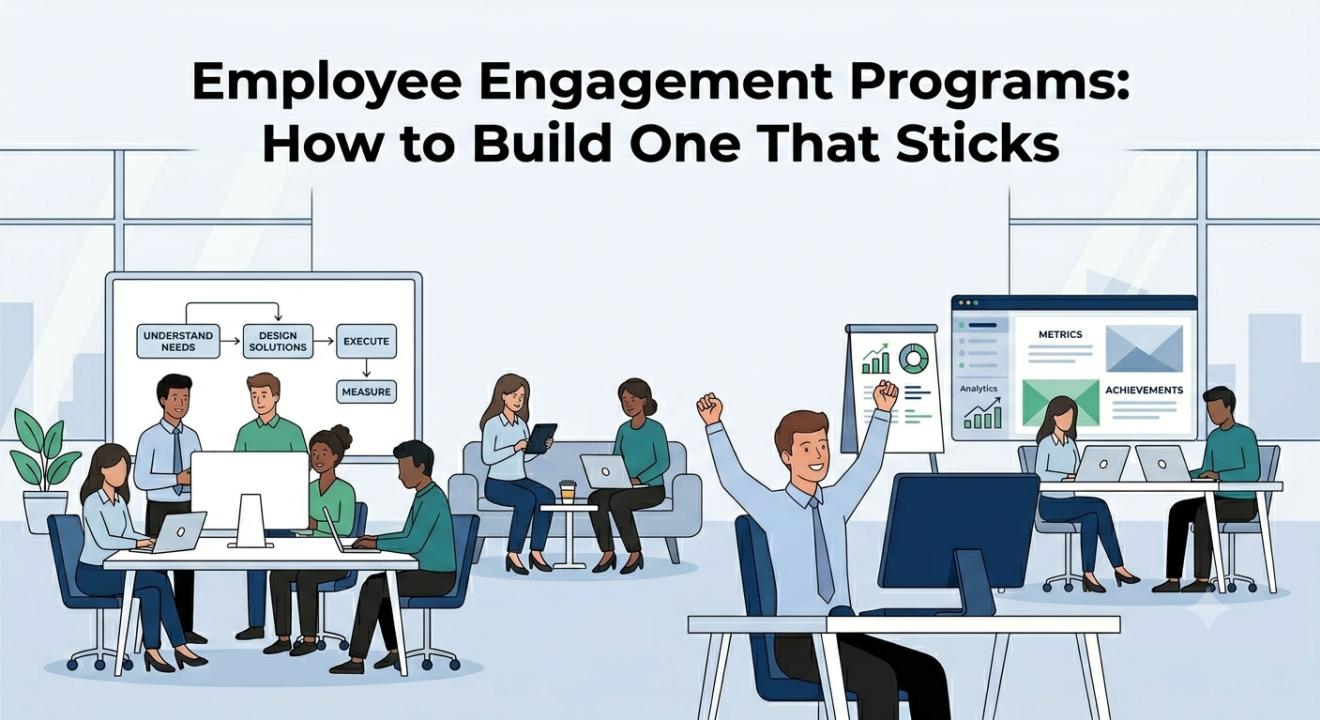
You've probably seen it before: a company rolls out a shiny new engagement initiative, a team lunch here, a recognition Slack channel there, and within three months, nobody's using it. Participation drops off, managers stop mentioning it, and the whole thing quietly dies. It's one of the most frustrating cycles in HR, especially when you know that employees who feel genuinely connected to their work are measurably more productive, less likely to quit, and better for customers. So the real question isn't whether your company needs employee engagement programs; it's why the ones you've tried haven't stuck, and what a program that actually works looks like.
23% Higher profitability at highly engaged companies (Gallup, 2023)
51% of employees are not engaged at work globally
3–4× more likely to stay when employees feel recognized
What "Employee Engagement" Actually Means (And What It Doesn't)
Here's an early distinction worth making: employee engagement is not the same as employee happiness. A happy employee might enjoy their benefits and like their coworkers, but still be mentally checked out by Tuesday afternoon. Engagement is about discretionary effort, the degree to which someone puts in more than what's strictly required because they actually care about the outcome.
Employee engagement programs are the structured, intentional efforts a company makes to create the conditions where that kind of investment becomes natural. That includes how people are recognized, how connected they feel to the company's mission, whether they trust their manager, and whether they see a real future for themselves at the company.
When those elements are built into how a workplace operates, not just bolted on as a quarterly event, that's when programs stop feeling like programs and start feeling like culture.
Why Most Programs Fail Before They Start
The biggest mistake organizations make is treating engagement as an output rather than an input. They run an annual survey, see low scores, and respond by scheduling a pizza party. That's not an engagement strategy; that's symptom management.
Programs also tend to fail when they're:
Too top-down: When employees have no voice in shaping the initiative, participation feels mandatory rather than meaningful.
Disconnected from daily work: A quarterly awards ceremony doesn't help someone who's been struggling with unclear expectations for six months.
One-size-fits-all: A 22-year-old just starting out and a 45-year-old senior engineer are motivated by very different things. Programs that don't account for that fall flat.
Unmeasured: Without tracking anything beyond "did people show up," there's no way to know what's working.
Quick reality check: Before designing anything, ask yourself whether your managers have the tools and training to actually act on employee feedback. The best program in the world won't move the needle if frontline leaders can't follow through.
The Building Blocks of a Program That Sticks
There's no universal playbook, but programs that sustain themselves tend to share a few structural traits.
1. Start With Listening, Not Announcing
Before you design anything, go find out what your employees actually need. Pulse surveys, manager conversations, stay interviews, and anonymous suggestion tools use whatever combination your culture will engage with. The goal isn't just to collect data. It's to show people that their input will result in visible change. That alone shifts trust.
2. Build Recognition Into the Workflow
Recognition is consistently one of the highest-impact levers in engagement, but it's also one of the most inconsistently applied. The mistake is making it a special occasion. Recognition works best when it's frequent, specific, and timely, meaning it happens close to the behavior you're reinforcing, not six months later at a performance review.
This is where structured incentive mechanics come in. For example, some companies use SPIFF programs (Sales Performance Incentive Funds) to recognize and reward specific behaviors in real time, particularly in sales-heavy environments. When designed well, these aren't just financial bonuses; they make the connection between effort and reward feel immediate and personal, which is exactly what drives repeat behavior.
3. Create Pathways, Not Just Perks
Benefits like gym memberships or free lunches are nice. They're not engagement drivers. What actually moves the needle is whether employees see a future at your company. That means investing in learning and development, internal mobility, mentorship, and clear conversations about career progression.
Ask your managers: when was the last time they had a genuine conversation with each team member about where they want to be in two years? If the answer is "not recently," that's your most urgent gap.
4. Use Incentive Structures That Reinforce Belonging
Beyond individual recognition, loyalty incentive programs can play a meaningful role in long-term engagement, particularly for tenured employees who might otherwise feel overlooked once the onboarding excitement fades. Milestone rewards, anniversary acknowledgments, and tiered benefits that grow with tenure give people a reason to think long-term, not just week to week.
The key is making sure these aren't just transactional. A five-year anniversary gift matters a lot more when it's accompanied by a genuine conversation about someone's contributions.
5. Make Managers the Engine, Not HR
This is probably the most underleveraged piece of most engagement strategies. Research from Gallup is pretty consistent here: the relationship between an employee and their direct manager accounts for a huge portion of engagement variance. HR can design great programs, but if managers don't model, reinforce, and participate in those programs, they'll stall.
That means manager enablement needs to be part of your engagement strategy, not an afterthought. Train managers to have effective one-on-ones, to recognize effort in the moment, and to understand what's actually going on with their people.
Practical Structure: What a Real Program Looks Like
Onboarding & First 90 Days: Structured introductions, assigned buddy, 30/60/90 check-ins. Set expectations early that engagement is a two-way street.
Continuous Feedback Loops: Monthly pulse surveys (5 questions max), manager follow-ups within 2 weeks, visible changes communicated back to the team.
Recognition Systems: Peer-to-peer recognition tools, manager shoutouts, and team wins are celebrated publicly. Tied to company values, not just results.
Growth & Development: Learning budgets, internal mobility postings, and quarterly career conversations between each employee and their manager.
Community & Belonging: ERGs (Employee Resource Groups), team rituals, cross-functional projects. Build connections across silos, not just within teams.
Measurement: Track eNPS, turnover by department, internal promotion rates. Tie engagement data to business outcomes, not just survey scores.
How to Measure Whether It's Working
If your only metric is "how many people attended the event," you're measuring activity, not impact. Engagement measurement should connect to outcomes the business already tracks:
Voluntary turnover rate (especially in the first 12 months)
Is the internal promotion rate of people growing here?
eNPS (Employee Net Promoter Score) over time, not just once a year
Manager effectiveness scores from direct reports
Absenteeism trends
Time-to-fill for open roles engaged cultures attract better candidates.
The goal isn't to prove that your program is great. It's to find out what's actually moving people and double down on that.
Common Missteps Worth Calling Out
Even well-intentioned programs make predictable errors. Watch for these:
Launching without leadership buy-in. If executives don't model engaged behavior themselves, nobody else will take it seriously.
Running the same program for years without revisiting it. Workforces change. A program built for your 2019 team may not fit your 2026 team at all.
Over-surveying without action. If employees fill out feedback forms and nothing changes, they'll stop responding and lose trust.
Making it an HR-only initiative. Engagement has to live in the business, not in a People Ops spreadsheet.
Conclusion
Building employee engagement programs that actually stick isn't about finding the right perk or launching the perfect platform. It's about creating the conditions in which people feel seen, valued, and invested in something bigger than their to-do lists. That requires honest listening, intentional recognition, manager development, and a willingness to measure what matters and change course when something isn't working.
The companies that get this right don't have some secret formula. They just treat engagement as an ongoing conversation, not a one-time initiative, and they make sure that conversation reaches all the way down to the frontline. Start there, and you'll be further ahead than most.
Frequently Asked Questions
What are the most effective employee engagement programs?
The most effective programs combine real-time recognition, continuous feedback loops, clear career development paths, and strong relationships with managers. No single initiative works in isolation; the companies with the highest engagement scores typically weave multiple touchpoints together: peer recognition, structured one-on-ones, learning budgets, and transparent communication from leadership.
How do you measure employee engagement?
The most useful metrics go beyond survey scores. Track eNPS (Employee Net Promoter Score) over time, voluntary turnover rate, internal promotion rates, absenteeism, and manager effectiveness scores from direct reports. Combining these with short pulse surveys (monthly or quarterly) gives you a fuller picture than an annual engagement survey alone.
What is the difference between employee satisfaction and employee engagement?
Satisfaction measures how content employees are with their current situation, pay, benefits, and environment. Engagement measures discretionary effort: whether employees go beyond the minimum because they care about the outcome. A satisfied employee can still be disengaged. Engagement is about emotional investment in the work itself, not just comfort with the conditions.
How long does it take to improve employee engagement?
Meaningful shifts in engagement scores typically take 6–18 months of consistent effort. Quick wins are possible; a strong recognition moment or a candid all-hands can shift sentiment in weeks, but sustainable improvement requires systemic changes to how managers lead, how feedback is acted on, and how growth opportunities are communicated. Patience and consistency matter more than speed.
What role do managers play in employee engagement?
Managers are the single biggest variable in employee engagement. Research consistently shows that the quality of someone's relationship with their direct manager explains more variation in engagement than almost any other factor, including pay or benefits. That's why manager training, enablement, and accountability need to be built into any serious engagement strategy, not treated as optional add-ons.