Imagine a workplace where employees no longer spend hours searching through documents, digging into dashboards, or waiting for answers from different departments. Instead, they simply ask a question and receive accurate, contextual answers within seconds.
This isn't a vision of the future it's the reality that AI assistants like Claude are helping organizations achieve today.
Over the last few years, enterprises have invested heavily in AI-powered productivity tools. While early chatbots focused on answering basic questions, modern AI assistants have evolved into intelligent business companions capable of understanding complex instructions, analyzing thousands of pages of documentation, generating insights, and even performing actions across enterprise systems.
As organizations witness the impact of platforms like Claude, many are asking a crucial question:
Can we build an enterprise app like Claude tailored to our own business needs?
The answer is yes.
In fact, building a custom enterprise AI application often provides greater control, stronger security, deeper integrations, and a significant competitive advantage compared to relying solely on third-party AI tools.
In this guide, we'll explore everything involved in building an enterprise app like Claude—from features and architecture to development costs and future opportunities.
Why Are Enterprises Looking Beyond Traditional AI Chatbots?
Most organizations have experimented with AI tools at some point. However, many quickly discover that consumer-grade AI solutions aren't designed to address enterprise challenges.
Businesses operate within complex ecosystems filled with proprietary data, compliance requirements, internal workflows, and industry-specific processes. Generic AI assistants often lack access to this information, limiting their usefulness in real-world business scenarios.
This is where enterprise AI applications stand apart.
Instead of serving as standalone chat interfaces, enterprise AI assistants act as centralized intelligence hubs. They connect employees with internal knowledge bases, automate repetitive tasks, streamline decision-making, and unlock insights hidden across organizational systems.
For example, a sales manager may want instant access to pipeline insights, while a legal team may need help reviewing lengthy contracts. Customer support teams may require quick answers from internal documentation, whereas HR teams may seek assistance with policy-related questions.
A custom-built Claude-like application can support all of these use cases within a single platform.
What Makes Claude a Benchmark for Enterprise AI Applications?
Claude has become one of the most recognized AI assistants because it combines powerful language understanding with enterprise-friendly capabilities.
Unlike traditional chatbots that rely on predefined responses, Claude understands context, follows complex instructions, and maintains coherence across extended conversations.
One of its biggest strengths is its ability to analyze large amounts of information. Whether it's lengthy reports, technical documents, legal agreements, or research papers, Claude can process extensive content and generate meaningful insights.
Beyond intelligence, it also prioritizes safety, reliability, and responsible AI behavior—qualities that are essential for enterprise adoption.
Organizations looking to build a similar application aren't necessarily trying to replicate Claude feature-for-feature. Instead, they aim to create a secure and intelligent platform tailored to their own business objectives.
Key Features Every Enterprise App Like Claude Should Include
Building an enterprise AI application requires much more than integrating a large language model. The platform must solve real business problems while delivering a seamless user experience.
Conversational Intelligence
At its core, the application should support natural language interactions.
Users should be able to ask questions, request summaries, generate reports, or seek recommendations without needing technical expertise.
The AI should understand context, remember previous interactions, and provide responses that align with organizational data and workflows.
Enterprise Knowledge Search
One of the most valuable capabilities of a Claude-like application is its ability to retrieve information from internal knowledge sources.
This may include:
- Company documentation
- Product manuals
- CRM records
- Policy documents
- Training materials
- Research reports
Rather than forcing employees to search manually, the AI delivers relevant information instantly.
Document Intelligence
Modern enterprises generate vast amounts of documentation every day.
Your application should be capable of:
- Reading PDFs
- Analyzing spreadsheets
- Summarizing contracts
- Extracting key insights
- Comparing documents
- Generating recommendations
Document intelligence significantly enhances productivity across departments.
Workflow Automation
Enterprise AI is rapidly moving beyond conversations.
Today's AI assistants can initiate actions such as:
- Creating tickets
- Sending emails
- Scheduling meetings
- Updating CRM records
- Generating reports
- Triggering approval workflows
This transforms the application from an information tool into an operational assistant.
Role-Based Access Controls
Not every employee should have access to every piece of information.
A robust enterprise application should include:
- User authentication
- Department-based permissions
- Role-specific visibility
- Data governance controls
These capabilities help maintain compliance and security across the organization.
The Architecture Behind an Enterprise App Like Claude
Building a Claude-like application requires multiple technology layers working together.
The user interacts with the application through a web or mobile interface. Behind the scenes, requests pass through an orchestration layer responsible for managing prompts, conversation history, permissions, and business logic.
The AI engine then processes requests using a large language model such as Claude, GPT, Gemini, or an open-source alternative.
However, enterprise applications cannot rely solely on pre-trained models. To provide accurate and relevant responses, organizations typically implement Retrieval-Augmented Generation (RAG).
RAG enables the AI to retrieve information from internal data sources before generating responses.
This architecture provides several advantages:
- More accurate answers
- Reduced hallucinations
- Access to real-time business data
- Improved compliance
- Better transparency
A vector database stores embeddings generated from enterprise content, allowing the AI to identify and retrieve relevant information quickly.
This combination of language models, retrieval systems, and enterprise integrations forms the foundation of modern enterprise AI platforms.
Step-by-Step Process to Build an Enterprise App Like Claude
Step 1: Define Business Objectives
Every successful AI initiative starts with a clear purpose.
Organizations should identify specific challenges they want the application to solve, such as:
- Knowledge management
- Customer support automation
- Employee assistance
- Document analysis
- Sales enablement
Clear objectives help prioritize features and accelerate ROI.
Step 2: Identify Data Sources
The next step involves mapping internal data sources.
These may include:
- SharePoint repositories
- Internal databases
- CRM systems
- ERP platforms
- Cloud storage solutions
- Knowledge management tools
The quality of your AI assistant depends heavily on the quality of the information it can access.
Step 3: Build the AI Foundation
At this stage, developers integrate large language models and establish the retrieval framework.
Key activities include:
- Embedding generation
- Vector database implementation
- Prompt engineering
- Context management
- Response optimization
This layer serves as the intelligence engine of the application.
Step 4: Develop Enterprise Integrations
The application should connect seamlessly with existing business systems.
Common integrations include:
- Salesforce
- SAP
- Microsoft Teams
- Slack
- Jira
- ServiceNow
- Google Workspace
These integrations enable the AI to access information and perform business actions.
Step 5: Implement Security Controls
Security should never be an afterthought.
Organizations should incorporate:
- Single Sign-On (SSO)
- Data encryption
- Audit trails
- Access management
- Compliance monitoring
- Activity logging
These capabilities help protect sensitive business information.
Step 6: Test, Optimize, and Scale
Before deployment, the system must undergo extensive testing.
Evaluation should focus on:
- Accuracy
- Response quality
- Performance
- Scalability
- Security
- User experience
Continuous optimization ensures long-term success.
Technology Stack Required for Claude-Like App Development
The technology stack depends on project requirements, but many enterprise applications rely on the following components:
Frontend Development
React, Next.js, TypeScript
Backend Development
Python, FastAPI, Node.js
Large Language Models
Claude, GPT-4, Gemini, Llama
Vector Databases
Pinecone, Weaviate, Milvus
Data Storage
PostgreSQL, MongoDB
Cloud Infrastructure
AWS, Microsoft Azure, Google Cloud
Authentication
Okta, Auth0, Azure Active Directory
AI Frameworks
LangChain, LlamaIndex, Haystack
Selecting the right stack depends on scalability requirements, compliance considerations, and long-term business goals.
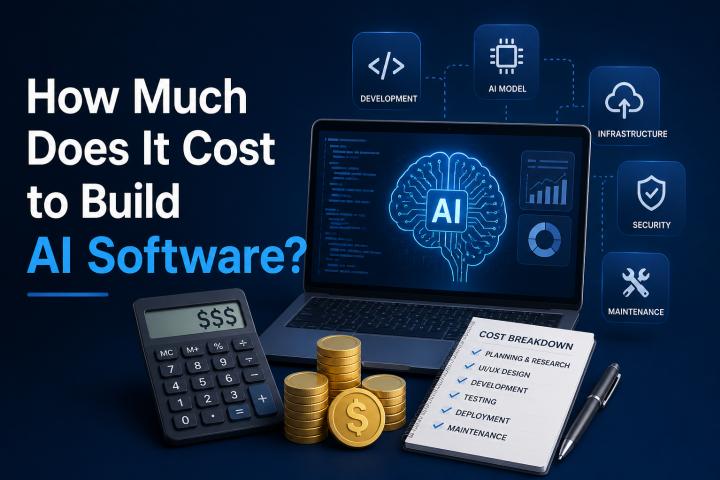
How Much Does It Cost to Build an Enterprise App Like Claude?
One of the most common questions business leaders ask is about development cost.
The answer depends on factors such as complexity, integrations, security requirements, deployment model, and AI capabilities.
A basic MVP with conversational AI and document search capabilities may cost between $40,000 and $80,000.
A production-grade enterprise platform with advanced integrations, workflow automation, analytics, and governance features can range from $100,000 to $300,000 or more.
Organizations seeking custom AI agents, industry-specific intelligence, and private model deployments may invest significantly more.
While the initial investment can be substantial, the long-term productivity gains often justify the cost.
Challenges Enterprises Face When Building Claude-Like Applications
Although the benefits are significant, organizations should be aware of potential challenges.
Data privacy remains a major concern, particularly for industries handling sensitive information.
Maintaining response accuracy can also be difficult when enterprise knowledge bases are incomplete or outdated.
Integration complexity often increases as organizations connect AI systems with legacy infrastructure.
Additionally, governance frameworks must be established to ensure responsible AI usage and regulatory compliance.
Addressing these challenges early helps reduce implementation risks.
The Future of Enterprise AI Applications
The next generation of enterprise AI assistants will be far more capable than today's systems.
Instead of simply answering questions, they will function as autonomous agents capable of executing complex business processes.
Future enterprise applications may:
- Manage workflows independently
- Coordinate across multiple systems
- Conduct research automatically
- Generate strategic recommendations
- Support voice-based interactions
- Analyze text, images, audio, and video simultaneously
As AI technology continues to evolve, enterprise applications will increasingly become the primary interface through which employees interact with organizational knowledge and systems.
Conclusion
Building an enterprise app like Claude is about far more than creating another chatbot. It is about designing an intelligent platform that empowers employees, unlocks organizational knowledge, and automates business processes at scale.
Organizations that invest in enterprise AI today are positioning themselves for a future where information is instantly accessible, workflows are increasingly autonomous, and decision-making is accelerated through intelligent systems.
Whether your goal is to improve employee productivity, streamline operations, enhance customer experiences, or create entirely new business capabilities, a Claude-like application can serve as the foundation of your enterprise AI strategy.
The question is no longer whether enterprises should adopt AI assistants. The real question is how quickly they can build one that delivers measurable business value.