Your points are expiring. Your rewards app hasn't been opened in three months. And the "exclusive offer" in your inbox is the same 10% discount you got last Tuesday. If that sounds familiar, you're not alone, and neither are the brands quietly losing you because of it. The loyalty program model that worked in 2010 is bleeding customers in 2026, and the businesses that haven't figured that out yet are about to feel it hard. The ones that have? They're using AI, and the gap between them and everyone else is growing fast.
What Are AI Loyalty Programs, and Why Do They Actually Matter Now?
AI loyalty programs are customer reward systems that use artificial intelligence, machine learning, predictive analytics, and behavioral data to make loyalty experiences feel personal, timely, and genuinely worth showing up for.
This isn't about slapping a chatbot onto your points dashboard. It's a fundamental rethink of how brands earn repeat business.
Traditional programs operate on a simple math equation: spend money, earn points, redeem for something generic. AI-driven programs operate on something closer to intuition. They learn what motivates each individual customer, predict when that customer is likely to disengage, and respond with the right offer at the right moment before the customer even thinks about leaving.
The difference in outcome is enormous. According to McKinsey, companies that lead in personalization generate 40% more revenue from these activities than average players do. Loyalty is where that gap shows up most clearly.
How AI Is Changing the Loyalty Game in 2026
Hyper-Personalization at Scale
The biggest shift AI brings to loyalty is the ability to treat a million customers like individuals without hiring a million relationship managers.
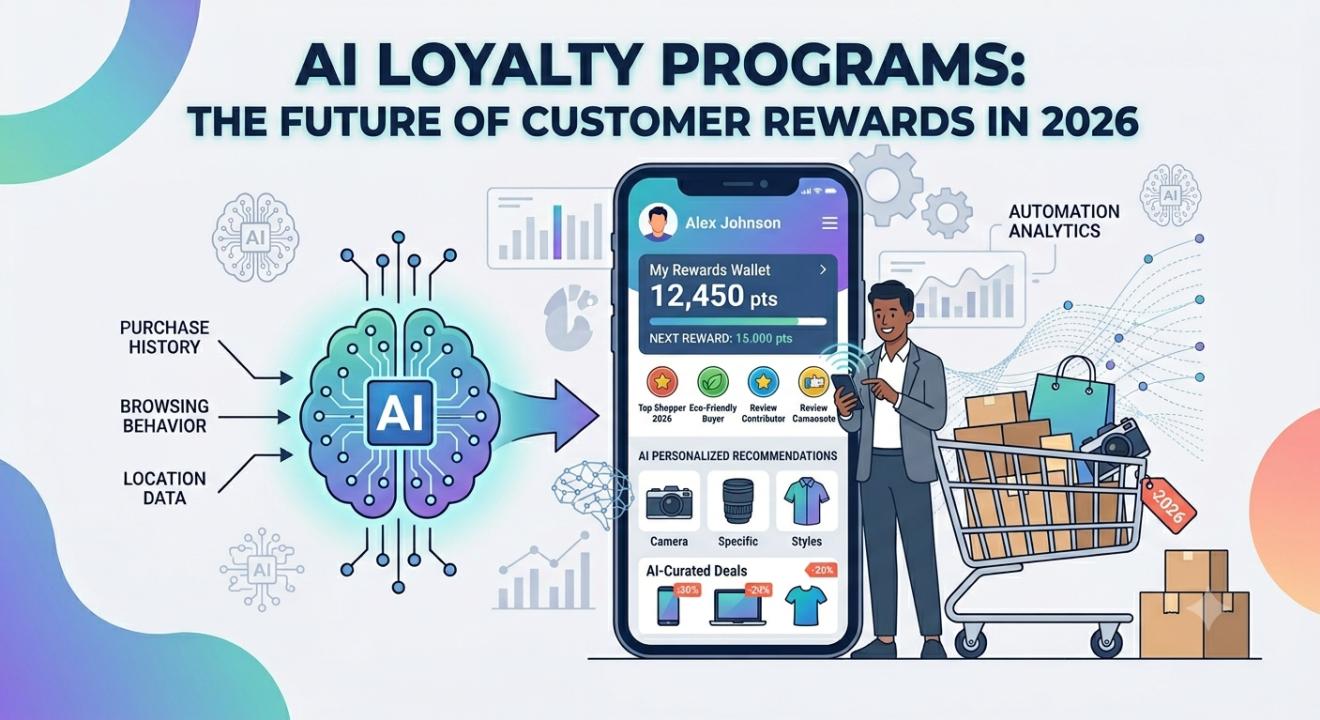
AI systems analyze purchase history, browsing behavior, location data, seasonal patterns, and even the time of day a customer is most likely to engage. From that, they build a real-time picture of what each person actually values and deliver rewards that reflect it.
A customer who buys coffee every weekday morning gets a free coffee offer on a Tuesday, not a discount on kitchen appliances. That sounds obvious. But until AI made it scalable, brands couldn't execute it consistently across their entire customer base.
Predictive Churn Prevention
One of the most powerful and underappreciated things AI does in loyalty programs is predict who's about to leave before they do.
Behavioral signals such as declining purchase frequency, unopened emails, or a single unresolved complaint can indicate that a customer is drifting. AI catches those signals early and triggers a re-engagement response automatically, a personalized offer, a surprise reward, or a timely check-in that feels human even when it's automated.
This is where AI loyalty programs earn their keep. Retaining an existing customer costs five times less than acquiring a new one. Catching one before they churn is worth far more than converting ten new sign-ups.
Dynamic Reward Structures
Static point systems are the loyalty equivalent of a participation trophy. AI makes rewards dynamic, adjusting the value, type, and timing of incentives based on what's most likely to drive action from that specific customer, right now.
Some customers respond to experiential rewards. Others want cashback. Some need an urgent, limited-time bonus, while others are motivated by milestone recognition. AI figures out which lever to pull for each person and pulls it at the optimal moment.
AI Loyalty Programs and the Workplace Connection
Here's something most loyalty conversations miss entirely: the same AI mechanics revolutionizing customer retention are being applied internally through employee engagement programs.
Forward-thinking companies in 2026 are running parallel loyalty ecosystems: one facing outward toward customers, the other facing inward toward their workforce. The logic is identical: understand what motivates each individual, deliver meaningful recognition at the right moment, and build a feedback loop that keeps engagement high over time.
AI-powered employee recognition platforms track contributions, flag burnout signals, personalize reward experiences, and help managers understand what their teams actually value, not what HR assumes they value. The result is the same on the customer side: people stick around longer, perform better, and feel genuinely seen.
When the internal and external loyalty ecosystems are aligned, the brand experience becomes coherent. Engaged employees deliver better customer experiences, and better customer experiences feed stronger loyalty metrics. It's a flywheel, and AI is what keeps it spinning.
The Role of Loyalty Incentive Programs in an AI-First World
Not every business needs a full-stack AI loyalty platform on day one. That's where loyalty incentive programs serve as a practical entry point, structured reward frameworks that can be progressively enhanced with AI capabilities over time.
Think of it as a spectrum. At one end, you have a simple punch card. At the other end, a fully autonomous AI system that personalizes every customer touchpoint in real time. Most businesses in 2026 are somewhere in the middle, running incentive-based loyalty structures and layering in AI tools to make those structures smarter.
The key is intentionality. An incentive program built on clean data, clear customer segmentation, and measurable engagement goals is one that AI can actually improve. Without that foundation, AI just automates mediocrity faster.
What Makes an AI Loyalty Program Actually Work
Many brands are calling their programs "AI-powered" when they mean "automated email sequences." Here's what separates real AI loyalty from the marketing version:
Real-time data processing: The system responds to behavior as it happens, not in the next weekly batch email.
Closed-loop learning: Every customer interaction feeds back into the model, making predictions sharper over time. The longer the program runs, the smarter it gets.
Cross-channel consistency: A customer who browses on mobile, buys in-store, and contacts support via chat should experience one unified loyalty relationship, not three disconnected touchpoints.
Transparent value exchange: Customers in 2026 are data-aware. AI loyalty programs that clearly communicate what data they use and what the customer gets in return earn significantly more trust and more opt-ins.
Human escalation pathways: AI handles the routine. Humans handle the moments that matter most. The best programs know the difference and design accordingly.
The Privacy Question Nobody Wants to Ask
Personalization and privacy are in constant tension, and AI loyalty programs sit right in the middle of that tension.
Customers want to feel known. They also want to feel safe. Getting this balance right in 2026 means building programs on first-party data that customers willingly share, rather than on third-party tracking that feels invasive.
The brands winning at AI loyalty aren't just collecting data. They're making an explicit case for why sharing that data benefits the customer. When customers understand the trade-off and choose to participate, the resulting data is richer, more accurate, and ethically sound. That's not just good compliance, it's good business.
Conclusion
Loyalty in 2026 isn't about who has the most points tiers or the flashiest app. It's about who understands their customers well enough to make them feel like the program was built specifically for them, because with AI, it essentially is.
The brands investing in AI loyalty programs today aren't just improving retention metrics. They're building the kind of relationships that make price comparisons irrelevant and switching costs feel emotionally real. That's the actual future of customer rewards, not more points, but more meaning.
If your loyalty strategy still looks the same as it did five years ago, it's not just outdated. It's actively costing you customers who have already decided to leave, they just haven't told you yet.
Frequently Asked Questions
1. What is an AI loyalty program, and how is it different from a traditional rewards program?
An AI loyalty program uses machine learning and behavioral data to personalize rewards in real time for each individual customer. Traditional programs offer the same points-for-purchases structure to everyone. The AI version adapts to learning what each customer values, predicting when they might disengage, and responding with the right incentive before that happens.
2. Are AI loyalty programs only for large enterprises?
Not anymore. While early AI loyalty tools required significant infrastructure, 2026 has seen a wave of scalable platforms built for mid-size and even small businesses. Many integrate directly with existing e-commerce or POS systems, making the entry point much lower than it was even two years ago.
3. How do AI loyalty programs handle customer data privacy?
The best programs are built on first-party data information that customers actively choose to share. Reputable platforms comply with GDPR, CCPA, and equivalent regulations, and are increasingly transparent with customers about what data is collected and how it improves their experience.
4. How long does it take to see results from an AI loyalty program?
Most businesses see measurable improvements in engagement and retention within 90 to 120 days of launch, once the AI has enough behavioral data to begin making accurate predictions. The system improves continuously, and results typically compound over the first year.
5. Can AI loyalty programs work for B2B companies, not just consumer brands?
Absolutely. B2B loyalty is one of the fastest-growing applications of AI reward systems in 2026. Account-based loyalty programs use AI to track engagement across buying teams, personalize incentives by role or decision-making stage, and flag accounts showing signs of churn, all of which are highly valuable in longer sales cycles where relationships drive revenue.