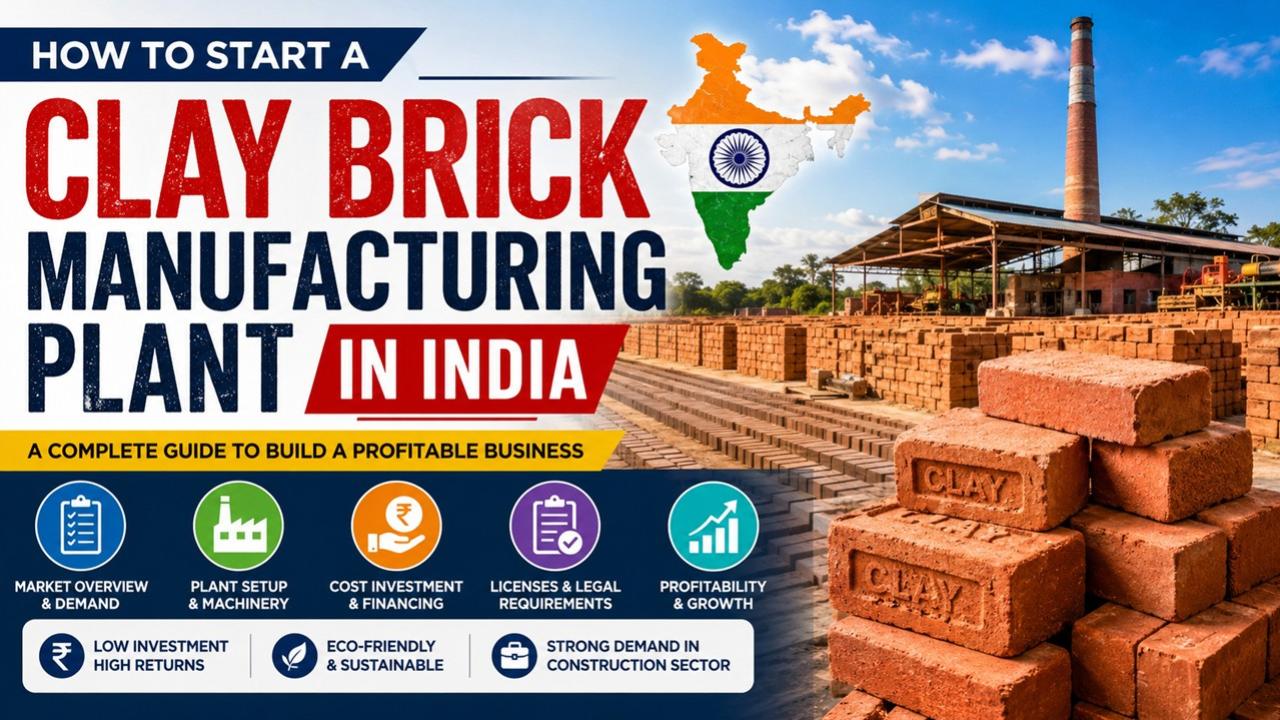
Setting up a clay brick manufacturing plant involves a series of carefully controlled processes such as raw material handling, clay preparation and mixing, shaping through extrusion or molding, drying, high-temperature firing in kilns, cooling, and packaging. Key equipment includes clay crushers, mixers and pug mills, extruders or molding presses, cutting wires, drying chambers, kilns (tunnel or periodic), cooling zones, and packaging or palletizing systems. As this is a construction-material focused facility, maintaining stringent quality control systems, performance testing standards, and compliance with building material regulations is critical. Additionally, evaluating the clay brick manufacturing plant cost is essential for understanding capital investment, machinery requirements, operational efficiency, and long-term profitability in this rapidly growing construction materials market.
The clay brick manufacturing industry is expected to witness steady growth through 2034, driven by rising global demand for durable and sustainable masonry materials across residential, commercial, and infrastructure sectors. As governments worldwide intensify efforts toward urbanization, affordable housing, and infrastructure development, clay bricks remain a critical input in meeting construction needs, while also helping builders achieve structural strength, thermal efficiency, and long service life.
IMARC Group's report, titled "Clay Brick Manufacturing Plant Project Report 2026: Industry Trends, Plant Setup, Machinery, Raw Materials, Investment Opportunities, Cost and Revenue," provides a complete roadmap for setting up a clay brick manufacturing plant. It covers a comprehensive market overview to micro-level information such as unit operations involved, raw material requirements, utility requirements, infrastructure requirements, machinery and technology requirements, manpower requirements, packaging requirements, transportation requirements, etc.
Request for a Sample Report: https://www.imarcgroup.com/clay-brick-manufacturing-plant-project-report/requestsample
Clay Brick Industry Outlook 2026
The clay brick manufacturing market is primarily driven by expanding residential and infrastructure construction, particularly in emerging economies experiencing urban population growth. For instance, the U.S. Census Bureau announced that construction spending during August 2025 was estimated at a seasonally adjusted annual rate of USD 2,169.5 Billion. Government-led housing programs, road and public infrastructure investments, and commercial real estate development continue to sustain brick demand. Clay bricks are favored for their durability, fire resistance, and thermal performance, supporting their use in long-term structures. Additionally, the material's compatibility with both traditional masonry and modern building techniques strengthens its market relevance. Beyond traditional residential applications, growing usage in commercial buildings, infrastructure projects, landscaping, and industrial facilities are broadening the industry's scope. Technological advancements in kiln efficiency, automated extrusion lines, and energy-recovery systems are shaping the future of clay brick manufacturing facilities.
The global clay brick market size was valued at USD 1,137.78 Billion in 2025. According to IMARC Group estimates, the market is expected to reach USD 1,458.80 Billion by 2034, exhibiting a CAGR of 2.8% from 2026 to 2034.
However, challenges such as price volatility of clay, coal, and rice husk used as primary raw materials, high energy consumption during firing, and evolving environmental and building code certification requirements may influence production costs and strategic investment decisions for new plant setups.
Key Insights for Setting up a Clay Brick Manufacturing Plant
Detailed Process Flow
- Product Overview
- Unit Operations Involved
- Mass Balance and Raw Material Requirements
- Quality Assurance Criteria
- Technical Tests
Project Details, Requirements and Costs Involved
- Land, Location and Site Development
- Plant Layout
- Machinery Requirements and Costs
- Raw Material Requirements and Costs
- Packaging Requirements and Costs
- Transportation Requirements and Costs
- Utility Requirements and Costs
- Human Resource Requirements and Costs
Capital Expenditure (CapEx) and Operational Expenditure (OpEx) Analysis
Project Economics
- Capital Investments
- Operating Costs
- Expenditure Projections
- Revenue Projections
- Taxation and Depreciation
- Profit Projections
- Financial Analysis
Profitability Analysis
- Total Income
- Total Expenditure
- Gross Profit
- Gross Margin
- Net Profit
- Net Margin
Key Cost Components
- Raw Materials: The primary cost driver, including clay (accounting for approximately 30-40% of total operating expenses), water, and coal or rice husk for firing, all essential for clay brick fabrication.
- Energy Costs: Clay brick manufacturing is energy-intensive, particularly for processes such as drying, high-temperature firing in kilns, and cooling, requiring consistent supplies of electricity, coal, and process heat. Utilities account for approximately 25-35% of OpEx.
- Machinery and Equipment: Capital investment in clay crushers, mixers and pug mills, extruders or molding presses, cutting wires, drying chambers, kilns (tunnel or periodic), cooling zones, and packaging or palletizing systems, along with their ongoing maintenance costs. Machinery costs account for the largest portion of the total capital expenditure.
- Labor: Includes salaries, training, and benefits for skilled and unskilled workers involved in clay preparation, shaping, drying, firing, quality testing, and plant operations.
- Utilities: Costs for electricity, water, steam, and other utilities essential for continuous and safe production.
- Packaging and Transportation: Expenses related to protective packaging, storing, and distributing finished clay bricks to dealers, contractors, or end users, including logistics infrastructure.
- Depreciation and Financing: Depreciation of fixed assets such as machinery and factory buildings, along with interest or repayment obligations for loans or capital invested in plant setup.
- Compliance and Safety: Investment in workplace safety measures, effluent treatment systems, advanced monitoring systems to detect deviations in the process, and compliance with building material quality and environmental certification standards.
- Overheads: Administrative costs such as insurance, office operations, licensing, marketing, and general plant management.
Economic Trends Influencing Clay Brick Plant Setup Costs 2026
Clay and Fuel Price Volatility: As clay, coal, and rice husk are among the primary raw materials for clay brick manufacturing, fluctuating global commodity prices and regional availability directly impact both capital and operating costs. Clay accounts for approximately 30-40% of total operating expenses. Higher material prices raise production expenses, making material efficiency optimization and supplier diversification more critical.
Urbanization and Infrastructure Spending: Rapid urbanization, population growth, affordable housing initiatives, and increased infrastructure spending are driving steady demand for clay bricks. Government-led housing programs, smart city initiatives, rural development schemes, and infrastructure investments directly stimulate demand for clay bricks. Such trends can influence both demand patterns and the scale of investment required for new plant setups.
Inflation and Interest Rates: Rising inflation inflates the cost of building materials, civil construction, labor, and machinery, while higher interest rates increase the cost of loans and financing needed for plant construction, equipment procurement, and commissioning of production lines.
Government Subsidies and Stimulus: Policies promoting domestic manufacturing and local materials further strengthen the sector. Such policies can reduce setup costs through grants, low-interest loans, or tax incentives aimed at clay brick plant investments.
Technological Advancements: Innovations in energy-efficient kilns, automated extrusion lines, and integrated quality control systems can increase upfront CapEx but offer significant productivity gains, improved product quality, and lower per-unit costs, enhancing long-term ROI.
Supply Chain Localization: Builders and contractors prefer nearby brick manufacturers to reduce transportation costs, ensure timely supply, and maintain consistent quality. This creates strong opportunities for regional producers with efficient operations and reliable raw material sourcing. Efforts to localize production may increase initial costs if domestic supply of specialized equipment is limited but improves supply chain resilience and delivery turnaround.
Labor Market Considerations: Shortages in skilled labor for operating precision extrusion, kiln, and quality testing equipment can drive up wages or necessitate investment in operator training and retention programs, raising both initial setup and ongoing operational expenses.
Speak to an Analyst for Customized Report: https://www.imarcgroup.com/request?type=report&id=14685&flag=C
Challenges and Considerations for Investors
- Raw Material Price Volatility: Clay brick manufacturing heavily depends on clay, coal, and rice husk. Fluctuations in global commodity prices and regional availability can significantly impact production costs and profit margins.
- High Capital Intensity: Establishing a clay brick plant requires substantial investment in specialized crushers, mixers, extruders, kilns, and packaging equipment. Long payback periods can deter risk-averse investors.
- Quality and Performance Compliance: Stringent product quality and building material certification requirements demand additional investment in testing infrastructure and continuous quality assurance processes.
- Government Policy Dependence: In many countries, demand for clay bricks is closely tied to government infrastructure spending, housing programs, and building codes, which may limit market predictability if such policies change.
- Market Competition: The global clay brick market is competitive, with several established players including Wienerberger AG, Ibstock Plc, Acme Brick Company, Forterra, General Shale, and China National Building Material Group. Investors must focus on operational efficiency or niche differentiation to remain viable.
- Logistics and Distribution: Transporting heavy clay bricks requires reliable infrastructure and careful handling. Poor logistics can lead to distribution bottlenecks, product damage, and increased delivery costs.
- Technological Barriers: Staying competitive requires adopting advanced, energy-efficient production technologies. Outdated systems lead to higher operational costs and lower product quality.
- Policy and Regulatory Risks: Changes in government policies, such as alterations to building codes, environmental regulations, or import duties on raw materials, can alter market dynamics abruptly and affect investment outcomes.
About Us
IMARC Group is a global management consulting firm that helps the world's most ambitious changemakers to create a lasting impact. The company excels in understanding its client's business priorities and delivering tailored solutions that drive meaningful outcomes. We provide a comprehensive suite of market entry and expansion services. Our offerings include thorough market assessment, feasibility studies, company incorporation assistance, factory setup support, regulatory approvals and licensing navigation, branding, marketing and sales strategies, competitive landscape, and benchmarking analyses, pricing and cost research, and procurement research.
Contact Us
IMARC Group
134 N 4th St. Brooklyn, NY 11249, USA
Email: sales@imarcgroup.com
Tel No: (D) +91 120 433 0800
United States: (+1-201-971-6302)