A friend runs a four-person branding studio. Last spring she hired her first full-time designer at $61,400 a year and did the math the way most owners do: divide the salary by 2,080 working hours, get about $29.52 an hour, and feel good about billing clients $85. The gap looked enormous. Then her accountant asked a question that changed how she quoted every project after that: what does an hour of that designer's billable time actually cost you?
That is a different number, and it is usually a lot higher than the wage suggests.
The wage is the part you can see
Salary is the headline figure because it is the one you negotiate and the one that shows up on the offer letter. It is also the least surprising cost you will carry. Around it sit several other costs that don't appear on a pay stub but leave your bank account all the same.
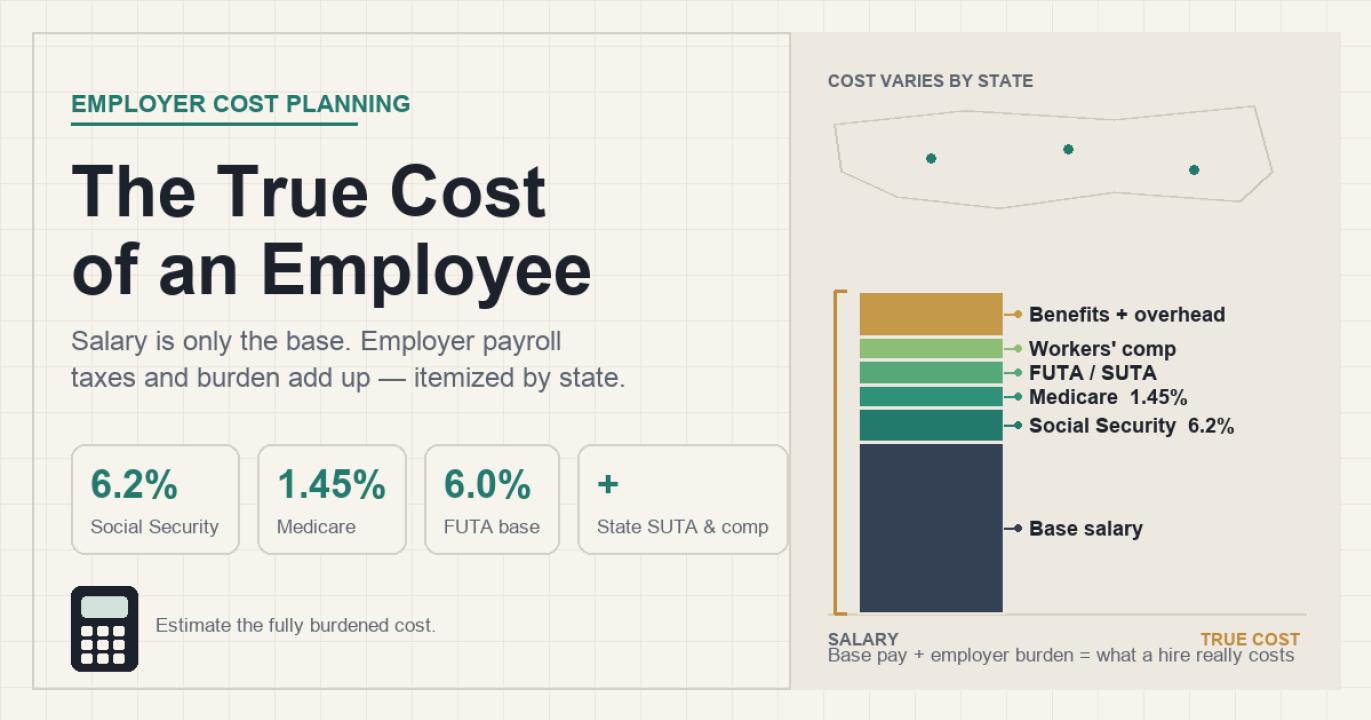
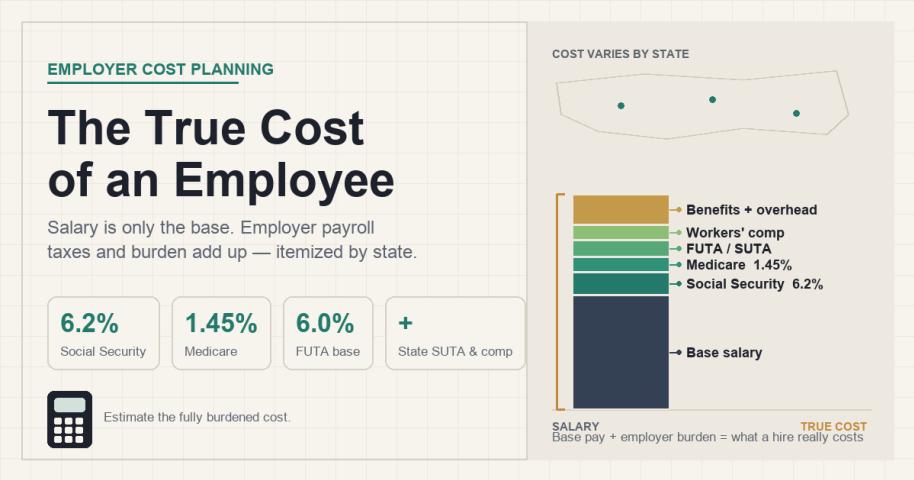
The employer side of payroll taxes is the first layer. On top of the wage, the business pays its share of Social Security and Medicare, plus federal and state unemployment. For a $61,400 salary that is roughly $5,000 a year, though the unemployment portion shifts with your state and your claims history. Then come the things you offer to be competitive: a health insurance contribution, maybe a retirement match, equipment, software seats, the phone line. In this studio's case the benefits added close to $7,800.
Stack those on the wage and the designer costs the business somewhere near $74,000 a year before anyone has drawn a single logo. That is the fully burdened figure, and it is the honest starting point.
Then there's the time you can't bill
Here is the part that quietly reshapes a services business. You pay for 2,080 hours a year, but nobody bills 2,080 hours. Subtract paid time off and holidays and you are already down to roughly 1,880 hours actually worked. Of those, a designer spends real time in internal meetings, in revisions that got scoped wrong, in the unpaid gap between projects, in answering Slack. A studio that lands 65% of worked hours as billable is doing well.
That leaves about 1,220 billable hours from a person you are paying for a full year.
Divide the burdened cost by the hours you can actually invoice, not the hours you pay for.
So the real cost per billable hour is closer to $74,000 divided by 1,220, or about $60.70. The $85 rate that looked like a 3x markup is nearer to 1.4x once you carry the full weight. Still profitable, but nowhere near the cushion the back-of-the-envelope version promised. If that designer's utilization drops to 55% during a slow quarter, the same rate barely clears cost.
Why the mistake is so common
The wage-divided-by-2,080 method isn't lazy. It is just the only number that is easy to reach without pulling together tax rates, benefit contributions, and a realistic utilization assumption. Most owners never build that composite because assembling it by hand feels like a finance project, and the payroll taxes in particular vary by state in ways that are annoying to look up.
That is the specific gap worth closing before you set rates for the year. When I was checking the numbers above I ran them through a free calculator that itemizes the true cost of an employee by state, which breaks out the employer tax pieces and burden components so you can see where the money actually goes instead of guessing at a flat percentage. It won't file anything or replace your accountant, and every figure it returns is a planning estimate rather than a compliance calculation. As a way to get from "salary" to "loaded cost per hour" in a few minutes, though, it beats a blank spreadsheet.
What to do with the number once you have it
A believable fully burdened hourly cost is useful in more places than pricing:
- Rate floors. If cost per billable hour is $60.70, you now know the rate below which a project loses money, and you can stop quoting there out of fear of losing the client.
- Hire-versus-contract calls. A freelancer at $70 an hour can look expensive next to a $29 wage and reasonable next to a $60 loaded cost. The comparison only works when both sides are burdened.
- Utilization targets. Once you see how much the billable-hour cost swings with utilization, "keep people busy" becomes a specific number to defend rather than a vibe.
Remember that any figure like this is an estimate. Employer costs move with your state, the wage base, insurance class, the benefits you offer, and local rules, so treat the output as a planning input and revisit it when something material changes. The point isn't a number carried out to the cent. It's replacing a wage you happen to know with a cost you can actually stand behind.
My friend didn't raise her rates dramatically after this. She raised them a little, tightened how she scoped revisions, and started watching utilization like it mattered, because it does. The designer was never too expensive. The old math just made the job look cheaper than it was.