A friend of mine bought three booster boxes of a new set the week it dropped, mostly because his group chat was posting nothing but rare pulls. Two weeks later the hype moved on, half the cards he wanted were still missing, and he had a stack of duplicates he couldn't trade because everyone else had the same ones. He wasn't unlucky, exactly. He just never looked at what was actually in the set before he committed the money.
That gap between "this set looks exciting" and "here is what the set contains" is where most collectors overspend. It's easy to skip, because the marketing does the opposite work: it shows you the ceiling, the one card everyone screenshots, and lets your brain fill in the rest.
What a set actually is, on paper
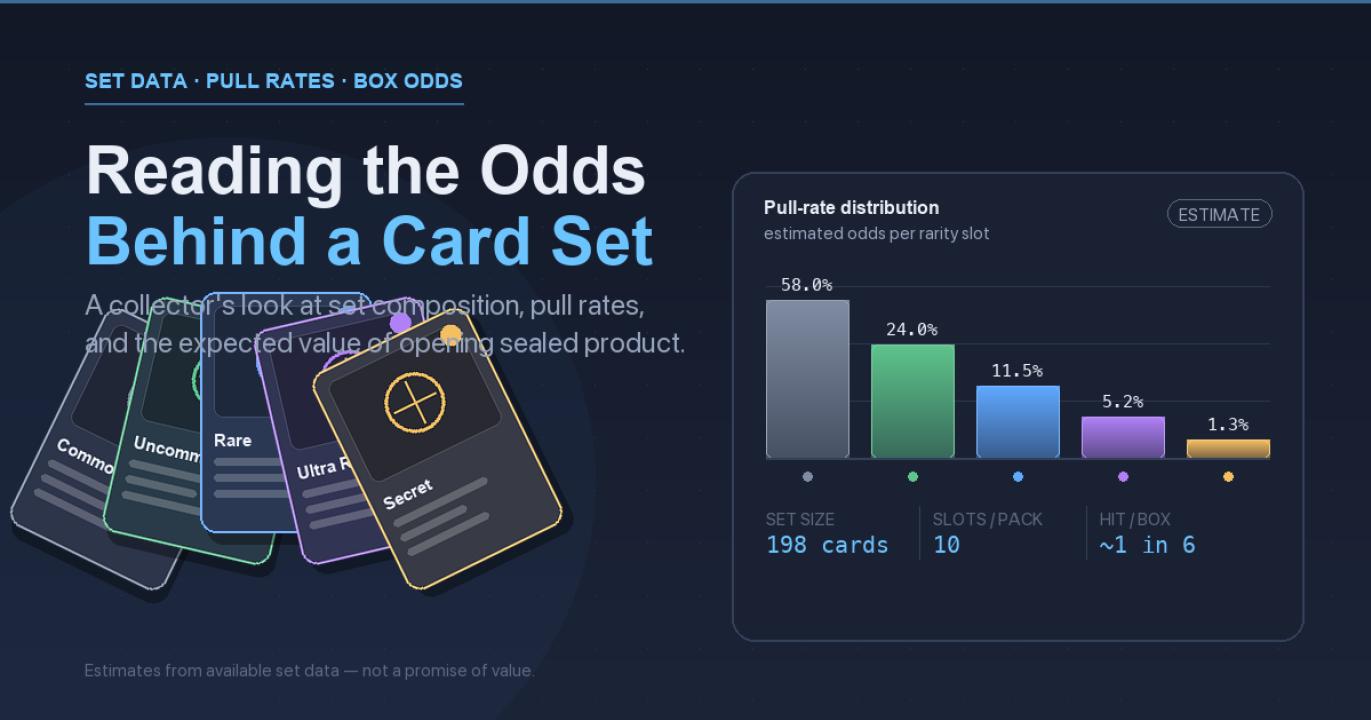
Every trading card set is a fixed structure before it's a feeling. It has a total card count, a breakdown by rarity tier, a number of chase cards, and a distribution baked into how packs are built. Once you can see those numbers laid out, a lot of the emotional pull quiets down and you can make a plain decision.
Say a set has 214 cards. Of those, maybe 18 sit in the top rarity tier, and 3 of those 18 are the ones driving demand. That's a very different set to chase than one with 90 cards and a single headline rare. The first one spreads your odds thin across many desirable cards; the second concentrates everything on one. Neither is bad. But they call for different budgets, and you can only tell them apart if you look at the composition instead of the box art.
The three questions worth answering first
- How many cards do I actually want from this set? Chasing 2 specific cards is a different project than trying to complete a 200-card master set.
- How thinly are those cards spread? A card that appears once in roughly every 40 packs behaves very differently from one that shows up once in every 6.
- Is buying sealed even the efficient path, or would singles get me there for less? Sometimes the two or three cards you care about cost less bought directly than the expected spend to pull them.
None of these require insider knowledge. They require the set's own data, read calmly before the purchase rather than rationalized after it.
Why "expected value" gets misread
People throw around expected value when talking about sealed product, and it's a useful lens, but it gets twisted into something it isn't. Expected value tells you the average outcome across many, many openings. It does not tell you what your box will do. And it definitely doesn't mean a box is a way to make money.
Here's the honest version. If the modeled value of what's inside a box lands somewhere near what the box costs, that's roughly what a fair hobby purchase looks like: you're paying for the experience of opening it and the chance at the cards you want. If the modeled value sits well below the price, you're paying a premium for the ritual, which is fine as long as you know that's the trade. Pull rates and expected values are estimates built from available data, not a promise. Collecting and buying sealed product shouldn't be treated as a guaranteed financial return, and the moment it starts to feel like one is usually the moment to slow down.
The number that protects your wallet isn't the price of the chase card. It's how many packs, on average, stand between you and it.
A quick example of reading before buying
Imagine you want two specific cards from a new release. You check the set structure and find each one appears at an estimated rate of about once per 30 packs. A box holds 24 packs. So a single box, on average, isn't even expected to contain one of your two targets, let alone both. That single fact reframes everything. Maybe you buy one box for the fun of opening it and then purchase the two cards you actually want as singles. Maybe the singles are cheap enough that you skip sealed entirely. Maybe you decide the opening experience is worth the premium and go in anyway, eyes open.
All three of those are reasonable. The unreasonable version is the one my friend picked: buying volume on vibes, then hoping the math bends in his favor.
Where to find the composition data
The set structure is usually public, but it's scattered. Card counts live in one place, rarity breakdowns in another, and pull-rate estimates in forum threads that may or may not agree. Pulling it into one view is the tedious part. Tools that aggregate this help here. I've used a reference that lays out set composition and odds context in one place to sanity-check a purchase before making it, mostly to answer that "how many packs per card I want" question without stitching together five browser tabs. It won't tell you whether a set is worth it to you. That's a personal call about how much the cards and the opening matter. What it does is replace a guess with a number.
The habit that saves the most money
Look at the set before the set looks at you. Spend ten minutes on the composition, answer the three questions, and decide your ceiling before you're standing in the aisle or hovering over a checkout button with the hype still fresh. Most of the regret in this hobby doesn't come from bad luck. It comes from buying before deciding what you were actually buying.
Collecting is more fun when the spending is deliberate. Reading the data first doesn't take the joy out of ripping packs. It just means the joy costs what you meant it to.